
Landlord Proof of Residency
Download a free Landlord Proof of Residency letter template in PDF or DOCX to confirm a tenant's address, rent history, and residency—free download, no signup.
DOCX
3 downloads
0
likes
Download Files
- DOCX
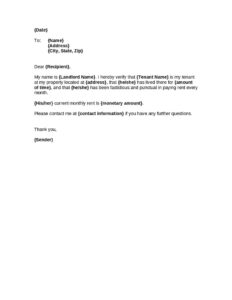
A Landlord Proof of Residency letter is a short, signed statement in which a landlord confirms that a named tenant lives at a specific rental property, how long they have lived there, and that rent has been paid reliably. People most often request it when a tenant needs to verify their address for a school, bank, government agency, or new landlord. You can download this template free in PDF and DOCX, with no signup required.
What Is a Landlord Proof of Residency Letter?
A Landlord Proof of Residency letter is a written confirmation, issued by a property owner or manager, that documents a tenant’s residence at a particular address. It functions as third-party evidence of where someone lives, supported by the authority of the person who controls the property. The letter typically states the tenant’s name, the rental address, the length of tenancy, the current monthly rent, and a comment on the tenant’s payment history. It is usually addressed to a specific recipient—such as an admissions office, a lender, or a relocation agency—and signed by the landlord. While brief, it carries weight because it comes directly from the person responsible for the lease.
When Do You Need a Landlord Proof of Residency Letter?
Tenants and landlords reach for this letter in a wide range of everyday situations where an official address confirmation is required:
- Enrolling children in school: School districts often require proof of residency to confirm a family lives within the catchment area.
- Applying for a new rental: A prospective landlord may ask for a reference confirming the applicant’s current tenancy and rent-paying record.
- Opening a bank account or applying for credit: Financial institutions may accept a landlord letter as supplementary proof of address.
- Government benefits, ID, or licensing: Agencies issuing driver’s licenses, voter registration, or assistance programs sometimes require residency verification.
- Immigration or visa documentation: Applicants may need to demonstrate a stable, verifiable place of residence.
- Employment relocation or background checks: Employers and relocation services may request confirmation of a current address and rental history.
What a Proof of Residency Letter Should Have
To be useful and credible, the letter should be clear, factual, and verifiable. The essential elements include the date the letter is written, the recipient’s name and address, an introduction identifying the landlord, the full name of the tenant, the exact rental address, the length of time the tenant has lived there, the current monthly rent amount, and a brief comment on the tenant’s payment reliability. It should also include the landlord’s contact information so the recipient can verify the details, followed by a closing and the landlord’s signature. Accuracy is paramount—everything stated should be something the landlord can confidently confirm if contacted.
How to Fill Out a Landlord Proof of Residency Letter
- Enter the Date the letter is written at the top.
- In the To block, add the recipient’s Name, Address, and City, State, Zip—for example the school office or lender requesting the letter.
- Open with the greeting using the Recipient name (for instance, “Dear Admissions Office” or a named contact).
- State your name in the Landlord Name field to identify yourself as the property owner or manager.
- Insert the Tenant Name of the person whose residency you are verifying.
- Add the property address where the tenant lives.
- Choose the correct pronoun (he/she, His/her) so the wording reads naturally for your tenant.
- Fill in the amount of time the tenant has lived at the property (e.g., “two years” or “since March 2022”).
- Enter the current monthly rent in the monetary amount field.
- Provide your contact information—phone and email—so the recipient can reach you.
- Close the letter and sign it in the Sender line.
Tips for Writing a Credible Letter
Keep the tone professional and the facts precise. Use the tenant’s full legal name exactly as it appears on the lease, and match the property address to the lease document to avoid discrepancies. State the length of residency in a way you can support—an approximate range is fine if you note it as such. If you manage the property rather than own it, consider clarifying your role (for example, “property manager”) so the recipient understands your authority. Print the letter on letterhead if you have it, and provide a phone number you actually answer, since many recipients call to confirm. A clear, honest letter is far more useful than an exaggerated one.
How This Differs From a Lease or Rent Receipt
A proof of residency letter is not the same as a lease agreement or a rent receipt, though they overlap. A lease is a binding contract that sets out the full terms of the tenancy, while a rent receipt records a single payment. The proof of residency letter is a narrative summary—it confirms the existence of the tenancy and the tenant’s good standing in plain language for an outside party. Recipients often request it precisely because it is concise and easy to read, whereas a full lease may contain sensitive terms the tenant would rather not share. In some cases, the requesting party may ask for the letter alongside a copy of the lease or recent receipts.
Common Mistakes to Avoid
- Misstating the move-in date or duration: An inaccurate length of residency can undermine the whole letter if it is later checked.
- Leaving out contact information: Recipients frequently call to verify, so an unreachable landlord weakens credibility.
- Using a nickname instead of the legal name: The tenant’s name should match their official documents and the lease.
- Overstating payment history: Only confirm reliable rent payment if it is genuinely true.
- Forgetting to sign: An unsigned letter may be rejected as unofficial.
- Mismatched address details: Ensure the property address matches the lease and any other documents the recipient may see.
Frequently Asked Questions
What is a Landlord Proof of Residency letter used for? It is used to confirm to a third party—such as a school, bank, government agency, or new landlord—that a tenant lives at a specific address. It documents the rental address, the length of tenancy, the current rent, and the tenant’s payment history. The letter serves as credible evidence because it comes directly from the property owner or manager.
How do I fill out the letter? Start with the date and the recipient’s name and address, then introduce yourself as the landlord. Add the tenant’s full name, the property address, how long they have lived there, and the current monthly rent. Finish with your contact information, a closing line, and your signature so the recipient can verify the details.
Does a proof of residency letter need to be notarized? In most cases a signature is sufficient, but some recipients—particularly government agencies or immigration offices—may request notarization. Check the requirements of the organization requesting the letter before you send it. If notarization is needed, sign the letter in the presence of a notary public.
Is this letter legally binding? The letter is a factual statement rather than a contract, so it does not create binding obligations the way a lease does. However, knowingly providing false information can carry consequences, so everything you state should be accurate and verifiable. Treat it as an honest confirmation of facts you can stand behind.
Can a property manager write this letter instead of the owner? Yes. A property manager or authorized agent can write and sign the letter on behalf of the owner. It is helpful to note your role so the recipient understands your authority to confirm the tenancy.
How much does this template cost? Nothing—this Landlord Proof of Residency template is completely free to download in PDF and DOCX formats, with no signup required. You can edit the DOCX version to match your details and reuse it whenever a tenant needs verification.
This template is a general example provided for informational purposes only and is not legal, financial, or tax advice. Residency verification requirements vary by jurisdiction and by the organization requesting the letter. Consult a qualified professional if you need guidance specific to your situation.
Official resource: for the rules that apply to your situation, see HUD.
Related Forms
- Agreement On Tenant Alterations To Rental Unit
- Rental Unit Smoke Detector CO2 Log
- Request for Tenant Repairs
- Landlord Checklist
- Tenant Utilities Increase Letter
- Landlord Lead Disclosure Form
Browse more in Landlord Documents.