
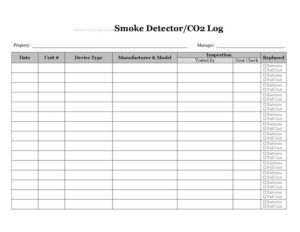
Rental Unit Smoke Detector CO2 Log
Download a free Rental Unit Smoke Detector CO2 Log template to track inspections, test dates, and battery changes for every property—free PDF and DOCX download.
PDF
DOCX
3 downloads
0
likes
Download Files
- DOCX
A Rental Unit Smoke Detector CO2 Log is a simple record landlords and property managers use to document the testing, inspection, and maintenance of smoke detectors and carbon monoxide (CO) alarms in a rental property. The most common reason people use it is to prove that life-safety devices were checked and working at move-in and during routine inspections. It’s free to download here in both PDF and DOCX formats, with no signup required.
What Is a Rental Unit Smoke Detector CO2 Log?
A Rental Unit Smoke Detector CO2 Log is a documentation form that records each time a smoke detector or carbon monoxide alarm in a rental unit is tested, serviced, or replaced. It’s typically created and maintained by the landlord, property manager, or maintenance staff, and may be reviewed or signed by tenants. The log captures the date of each inspection, the device location, the test result, battery status, and the name of the person who performed the check. By keeping a consistent record across every unit, owners can demonstrate ongoing compliance with fire-safety and habitability obligations and quickly spot devices that are due for service or replacement.
When Do You Need a Rental Unit Smoke Detector CO2 Log?
- At tenant move-in, to confirm that all alarms are present, tested, and functioning before keys are handed over.
- During routine periodic inspections, such as quarterly or annual safety walkthroughs of each unit.
- When you replace batteries or whole devices and need a dated record of the change.
- After a tenant reports a chirping, dead, or malfunctioning alarm and you respond with a service visit.
- At tenant move-out, to verify the alarms are intact and were not removed or disabled during tenancy.
- To support an insurance claim or legal defense if a fire or CO incident occurs and you must show devices were maintained.
What a Smoke Detector and CO2 Log Should Have
A complete log makes it easy to see, at a glance, that every alarm in the property has been accounted for. Strong logs include the property and unit address, a list or row for each device by location (kitchen, hallway, each bedroom, each level), the type of device (smoke, CO, or combination), and the date of each test. Each entry should note the result of the test, whether the battery was replaced, the device’s age or installation date, and the initials or signature of the inspector. Space for tenant acknowledgment and a comments column for follow-up items round out a thorough record.
How to Fill Out a Rental Unit Smoke Detector CO2 Log
- Property and unit details: Enter the full rental address, unit number, and the tenant’s name so the log is tied to a specific occupied space.
- Device location: List each alarm by its physical location—for example, “upstairs hallway,” “master bedroom,” or “kitchen.” Add a row for every device.
- Device type: Mark whether each unit is a smoke detector, a carbon monoxide alarm, or a combination unit.
- Install or manufacture date: Record when the device was installed or its printed manufacture date, since most alarms expire after 7–10 years.
- Test date: Enter the date you pressed the test button or performed the inspection.
- Test result: Note whether the alarm passed (sounded correctly) or failed.
- Battery action: Indicate whether the battery was checked, replaced, or if the unit is hardwired or sealed.
- Inspector name and signature: Have the person performing the test sign or initial each entry.
- Comments and tenant acknowledgment: Record any follow-up needed and obtain the tenant’s signature where applicable.
How Often Should Alarms Be Tested and Replaced?
While exact requirements vary by jurisdiction, a widely used practice is to test smoke and CO alarms at every tenant turnover and at least once during the tenancy each year. Many landlords test at the start of a lease, document it on the log, and then ask tenants to test monthly themselves. Replaceable batteries are commonly swapped once or twice a year, while sealed ten-year units and the alarms themselves are replaced according to the manufacturer’s expiration date. Keeping these dates in your log helps you plan replacements before a device reaches end of life rather than scrambling after a failure.
Why Keeping the Log Protects You
Beyond meeting safety duties, a maintained log is one of the strongest pieces of evidence a landlord can have. If a tenant later claims an alarm was missing or disabled, a dated record showing the device was tested and signed for at move-in tells a different story. Insurers and courts tend to look favorably on owners who can show a consistent, contemporaneous maintenance routine. Store completed logs with each unit’s lease file and keep them for several years after a tenancy ends.
Common Mistakes to Avoid
- Skipping the device location column—a single “tested all alarms” note doesn’t prove each individual unit was checked.
- Leaving the result blank so it’s unclear whether the alarm actually sounded during the test.
- Forgetting to record battery or device replacement dates, which makes it impossible to track end-of-life timing.
- Not having the inspector sign or initial each entry, weakening the record’s credibility.
- Failing to get tenant acknowledgment at move-in, missing a chance to confirm devices were present and working.
- Letting the log lapse between inspections so there are unexplained gaps in the maintenance history.
Frequently Asked Questions
What is a Rental Unit Smoke Detector CO2 Log used for? It is used to document that the smoke detectors and carbon monoxide alarms in a rental property were tested, serviced, and found working on specific dates. Landlords use it to track maintenance, plan device replacements, and create proof of compliance with fire-safety duties.
How do I fill out the log? Start with the property address, unit, and tenant name, then add a row for each alarm by its location and type. For every inspection, record the test date, the result, any battery or device replacement, and the inspector’s signature, leaving room for tenant acknowledgment and comments.
Does this log need to be notarized or witnessed? No, a smoke detector and CO log does not require notarization. Many landlords do, however, have the tenant sign at move-in to acknowledge the alarms were present and tested, which strengthens the record if a dispute arises later.
How often should I test smoke and CO alarms in a rental? Requirements vary by location, but a common approach is to test at every tenant turnover and at least annually during the tenancy. Tenants are often asked to test monthly themselves, and the landlord documents the formal tests on the log.
Is this log legally required? Smoke and carbon monoxide alarm requirements differ by state and municipality, and some jurisdictions require landlords to maintain or be able to prove alarm maintenance. Even where a log isn’t mandated, keeping one is a practical way to demonstrate you met your safety obligations.
How much does this template cost? Nothing—this Rental Unit Smoke Detector CO2 Log is completely free to download in PDF and DOCX formats with no signup. You can use it as-is or customize the columns in the editable version to match the devices in your properties.
This template is provided as a general example for informational purposes only and is not legal advice. Smoke detector and carbon monoxide alarm requirements vary by state and local jurisdiction; consult your local housing authority, fire code, or a qualified professional to confirm your specific obligations.
Official resource: for the rules that apply to your situation, see HUD.
Related Forms
- Landlord Maintenance Request
- 30-Day Notice to Landlord
- Covid Rent Extension Landlord
- Landlord Lead Disclosure Form
- Tenant Complaint Log
- Tenant Property Damage Letter
Browse more in Landlord Documents.