
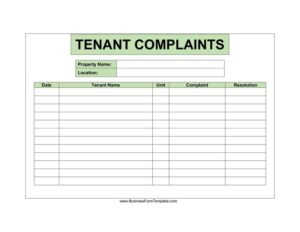
Tenant Complaint Log
Track and resolve renter issues with a free Tenant Complaint Log template — record dates, details, and resolutions in PDF or DOCX with no signup.
PDF
3 downloads
0
likes
Download Files
A Tenant Complaint Log is a running record landlords and property managers use to document every complaint a tenant reports — from noisy neighbors to a leaking faucet — along with the date received and how it was resolved. The most common reason people use one is to keep an organized, time-stamped paper trail that protects both parties and proves issues were handled promptly. You can download this template free in PDF and DOCX, with no signup required.
What Is a Tenant Complaint Log?
A Tenant Complaint Log is a simple but powerful document maintained by a landlord, property manager, or leasing office to capture each complaint a renter submits and the action taken in response. It typically lists the tenant’s name, unit number, the date the complaint was received, a description of the issue, the priority or status, the person assigned to handle it, and the resolution with a closing date. Rather than relying on scattered emails, voicemails, or memory, the log consolidates everything in one chronological place. This makes it easy to spot recurring problems, demonstrate responsiveness, and reference past events when questions or disputes arise later.
When Do You Need a Tenant Complaint Log?
A complaint log is useful for landlords of any size, from a single rental unit to a large multi-family building. Common situations include:
- Maintenance and repair requests — logging a broken appliance, plumbing leak, or HVAC failure so the repair timeline is documented.
- Noise and nuisance disputes — recording when one tenant reports excessive noise, smoking, or disruptive behavior from a neighbor.
- Habitability concerns — tracking complaints about heat, water, mold, or pests that may carry legal obligations to respond.
- Lease violation reports — documenting complaints about unauthorized pets, occupants, or parking issues.
- Recurring problem identification — spotting patterns when the same issue or the same tenant generates repeated entries.
- Dispute defense — providing dated evidence that a landlord acted in good faith if a complaint escalates to mediation or court.
What a Tenant Complaint Log Should Have
An effective complaint log balances enough detail to be useful with enough simplicity to be maintained consistently. Strong logs include a unique entry or reference number, the tenant’s name and unit, the date and method the complaint was received, a clear description of the issue, a priority level, the staff member assigned, the action taken, and the resolution date. A status column — such as Open, In Progress, or Closed — helps you see outstanding items at a glance. Leaving room for notes or follow-up dates lets you record reminders, tenant communications, and any costs incurred. Consistency matters more than complexity: a log that is filled in the same way every time becomes far more reliable evidence.
How to Fill Out a Tenant Complaint Log
- Enter the date received. Record the exact day the complaint came in; this anchors the response timeline.
- Add an entry or reference number. Assign a sequential number so each complaint can be tracked and referenced easily.
- Record the tenant name and unit. Identify who reported the issue and which unit it affects.
- Note how it was received. Indicate whether the complaint arrived by phone, email, in person, or a tenant portal.
- Describe the complaint. Write a clear, factual summary of the problem — avoid opinions or assumptions.
- Set a priority or category. Mark urgency (for example, emergency, high, routine) and the type of issue.
- Assign responsibility. List the staff member, contractor, or manager handling the matter.
- Document the action taken. Summarize the steps performed, communications sent, and any vendor or repair details.
- Update the status and resolution date. Mark the entry Closed and note the date the issue was fully resolved.
Tips for Keeping an Effective Log
Update the log immediately when a complaint comes in rather than batching entries at the end of the week, when details are easy to forget. Use neutral, factual language — stick to what was reported and what was done, not personal commentary about the tenant. If you manage multiple properties, keep a separate log per building or use a property column so records stay sorted. Pair the log with copies of supporting documents, such as work orders, photos, or emailed correspondence, and reference those by date or file name in the notes. Reviewing the log monthly helps you catch unresolved items and identify maintenance trends before they become bigger problems.
How It Differs From a Maintenance Request Form
A Tenant Complaint Log and a maintenance request form serve related but distinct purposes. A maintenance request is usually a single document submitted by a tenant for one specific repair, capturing what needs fixing and when. The complaint log, by contrast, is an ongoing internal record maintained by the landlord that summarizes all complaints — maintenance and otherwise — across time. Think of the request form as an input and the log as the master tracker that consolidates those inputs alongside noise disputes, lease concerns, and other issues. Many landlords use both: the request form to gather details from tenants, and the log to monitor overall responsiveness and patterns.
Common Mistakes to Avoid
- Recording complaints late — delays cause missing details and weaken the log as evidence.
- Leaving the resolution blank — an entry with no closing action or date looks unresolved and incomplete.
- Using vague descriptions — “tenant unhappy” tells you little; specifics make the record useful.
- Inconsistent formatting — skipping columns or changing how you label statuses makes the log hard to read.
- Mixing personal opinions with facts — keep entries objective in case the log is ever reviewed by others.
- Not backing up the log — store a secure digital copy so records aren’t lost.
Frequently Asked Questions
What is a Tenant Complaint Log used for? It is used to document every complaint a tenant submits, along with the date received and how the issue was resolved. Landlords rely on it to stay organized, respond promptly, spot recurring problems, and keep a dated record they can reference if a dispute arises later.
How do I fill out a Tenant Complaint Log? Enter the date received, a reference number, the tenant’s name and unit, how the complaint arrived, and a factual description of the issue. Then assign someone to handle it, document the action taken, and update the status and resolution date once it is closed.
Is a Tenant Complaint Log legally required? A complaint log itself is generally not required by law, but landlords often have legal obligations to respond to certain complaints, such as habitability or repair issues, within set timeframes. Maintaining a log helps demonstrate that you met those obligations. Requirements vary by jurisdiction, so check your local landlord-tenant rules.
Does a complaint log need to be signed or notarized? No. A Tenant Complaint Log is an internal record kept by the landlord or property manager and does not require signatures or notarization. Keeping it accurate, dated, and consistently maintained is what gives it value if it is ever reviewed.
How long should I keep tenant complaint records? Many landlords keep complaint records for the duration of the tenancy plus several years afterward, in line with how long they retain leases and financial records. Retention periods can vary by location and by the type of issue involved, so follow your local guidelines and any insurance or legal recommendations.
Is this Tenant Complaint Log template free to download? Yes. You can download this Tenant Complaint Log template completely free in both PDF and DOCX formats, with no signup or account required. The DOCX version is easy to customize with your property name, columns, and branding.
This template is a general example provided for informational purposes only and is not legal advice. Landlord-tenant laws and recordkeeping requirements vary by jurisdiction. Consult a qualified attorney or property management professional to ensure your practices comply with applicable laws.
Official resource: for the rules that apply to your situation, see HUD.
Related Forms
- Pre-Rental Comparison Checklist
- Tenant Security Deposit Log
- Tenant Utilities Increase Letter
- Room Rental Agreement
- Notice of Overdue Rent
- Rental Unit Smoke Detector CO2 Log
Browse more in Landlord Documents.