
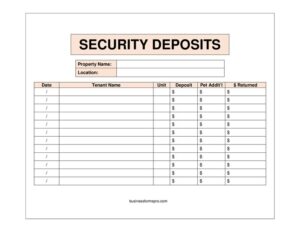
Tenant Security Deposit Log
Track every tenant security deposit, deduction, and return with this free Tenant Security Deposit Log template, available as a free PDF and DOCX download.
PDF
DOCX
1 downloads
0
likes
Download Files
- DOCX
A Tenant Security Deposit Log is a simple record that landlords and property managers use to track every security deposit they collect, hold, and return across one or more rental units. Most people reach for it to keep deposit money organized, stay compliant with holding rules, and avoid disputes when a tenant moves out. You can download it free in PDF and DOCX, with no signup required.
What Is a Tenant Security Deposit Log?
A Tenant Security Deposit Log is a running ledger that documents the security deposits associated with each tenancy. It typically lists the tenant’s name, the rental unit, the deposit amount, the date received, where the funds are held, and any deductions or refunds at the end of the lease. Landlords, property managers, and small real estate businesses use it to maintain an audit trail for funds that legally belong to the tenant until earned or returned. Because security deposits are often held in trust and subject to strict timelines, a centralized log makes it easy to confirm balances, calculate refunds accurately, and produce documentation if a tenant ever questions how their money was handled.
When Do You Need a Tenant Security Deposit Log?
Any landlord who collects deposits benefits from a single, reliable record. The log earns its keep in everyday situations such as:
- Collecting a new deposit at lease signing and recording the exact amount and date received.
- Managing multiple rental units where deposits could easily be confused or misplaced.
- Tracking which bank account or trust account holds each deposit, especially where separate accounts are required.
- Calculating end-of-lease deductions for damage, unpaid rent, or cleaning, and documenting the remaining refund.
- Preparing for tax season or a year-end review when you need a clear summary of held funds.
- Responding to a tenant dispute or small claims action where proof of receipt and return timing matters.
What a Tenant Security Deposit Log Should Have
A complete log captures enough detail to reconstruct the full life of each deposit. At minimum it should identify the tenant and unit, the deposit amount, and the date received. It should also note the holding location, any interest accrued if your jurisdiction requires it, the move-out date, itemized deductions, the refund amount, and the date the refund was issued. Leaving room for a notes column helps you record check numbers, forwarding addresses, or references to a separate itemized statement. The strongest logs are kept current in real time so balances always match your bank records.
How to Fill Out a Tenant Security Deposit Log
- Enter the tenant’s full name exactly as it appears on the lease, adding co-tenants if the deposit covers more than one person.
- Record the rental unit or property address, including the unit number, so each entry is tied to a specific tenancy.
- Write the deposit amount collected and the date received, matching your receipt or bank deposit slip.
- Note the holding location — the bank name and account where the funds sit, particularly if you use a dedicated trust account.
- Log any interest earned over the tenancy if your area requires deposits to be held in an interest-bearing account.
- At move-out, fill in the lease end date and list each deduction with a short description and dollar figure.
- Calculate and enter the refund amount returned to the tenant, then record the date the refund was issued and the payment method or check number.
- Use the notes field for the tenant’s forwarding address, dispute details, or a reference to the itemized deduction statement.
Keeping Deposits Compliant and Separate
Many jurisdictions impose specific rules on how security deposits must be held, when they must be returned, and what notice a tenant must receive about deductions. Common requirements include placing deposits in a separate or trust account, returning the balance within a set number of days after move-out, and providing an itemized list of any amounts withheld. Your log will not replace these legal obligations, but it dramatically simplifies meeting them. By recording the holding location and refund dates, you can quickly confirm you stayed within the required timeline. Because rules vary widely by state, city, and even property type, treat the log as your internal tracking tool and verify the precise statutory requirements that apply to your rentals.
Log vs. Receipt vs. Itemized Statement
It helps to understand how this log differs from related documents. A deposit receipt is what you hand the tenant when you collect the money — it proves a single transaction. An itemized deduction statement is the breakdown you give a tenant at move-out explaining each charge against their deposit. The Tenant Security Deposit Log sits behind both: it is your master record summarizing every deposit across all tenancies, linking receipts and statements together. Keeping all three in sync — receipt at the start, log throughout, and statement at the end — gives you a clean, defensible paper trail for each tenant.
Common Mistakes to Avoid
- Mixing deposit funds with operating cash so you can no longer prove the balance held for each tenant.
- Forgetting to update the log when a deposit is collected or refunded, leaving gaps that undermine its accuracy.
- Recording deductions without a clear description, which weakens your position if a tenant disputes the charge.
- Missing the legal deadline to return the deposit because the move-out date was never logged.
- Failing to note the tenant’s forwarding address, making it harder to send the refund and statement on time.
- Keeping only a single copy with no backup; store a digital version so the record survives a lost or damaged file.
Frequently Asked Questions
What is a Tenant Security Deposit Log used for? It is used to track every security deposit a landlord collects, holds, and returns. The log records the tenant, unit, amount, holding location, deductions, and refund details so you always know how much money belongs to each tenant and when it was returned.
How do I fill out a Tenant Security Deposit Log? Start by entering the tenant’s name, unit, deposit amount, and date received for each tenancy. As the lease progresses, add the holding account and any interest, then complete the deduction, refund amount, and refund date at move-out so the entry is fully reconciled.
Is a Tenant Security Deposit Log legally required? The log itself is generally not a legally mandated document, but the obligations it helps you meet — separate holding, timely refunds, and itemized deductions — often are. Maintaining it makes proving compliance far easier if a tenant or regulator ever asks.
Does this log replace a deposit receipt or itemized statement? No. The receipt confirms you collected the money and the itemized statement explains deductions at move-out, while the log is your internal master record tying everything together. Use all three for the strongest documentation.
How long should I keep deposit records? Many landlords keep deposit records for several years after a tenancy ends to cover potential disputes, tax review, and statute-of-limitations windows. Check the recordkeeping rules in your jurisdiction, since required retention periods vary.
How much does this template cost? The Tenant Security Deposit Log template is completely free to download here in both PDF and DOCX formats, with no signup required. Use the editable DOCX to add columns for your specific properties or print the PDF for a quick paper ledger.
This template is a general example provided for informational purposes only and is not legal, financial, or tax advice. Security deposit laws and recordkeeping requirements vary by jurisdiction. Consult a qualified attorney or professional to confirm the rules that apply to your rental properties.
Official resource: for the rules that apply to your situation, see HUD.
Related Forms
- Consent To Assignment Of Lease
- Noise Complaint Letter
- Landlord Rent Increase
- Landlord Lease Renewal
- Rental Unit Smoke Detector CO2 Log
- Landlord Lead Disclosure Form
Browse more in Landlord Documents.