
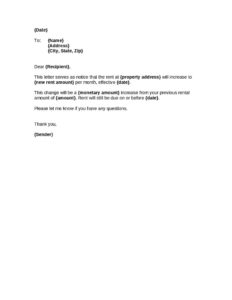
Landlord Rent Increase
Download a free Landlord Rent Increase letter template to notify tenants of a new monthly rent amount and effective date — free PDF and DOCX download.
DOCX
2 downloads
0
likes
Download Files
- DOCX
A Landlord Rent Increase letter is a written notice a landlord gives a tenant to formally announce that the monthly rent will go up, along with the new amount and the date the change takes effect. It is most commonly used at lease renewal or when a month-to-month tenancy continues at a higher rate, and it creates a clear paper trail both parties can reference. You can download this template free in PDF and DOCX with no signup required.
What Is a Landlord Rent Increase Letter?
A Landlord Rent Increase letter is a simple document issued by a property owner or property manager to inform a tenant that the rent on a leased property is being raised. It states the current rent, the new rent, the dollar amount of the increase, and the date the new rate begins. The letter does not change the underlying lease terms beyond price — it simply documents the adjustment in a respectful, professional format. Landlords use it to satisfy notice requirements, keep accurate records, and reduce the chance of disputes. Because it is delivered in writing, both the landlord and tenant have a dated reference confirming exactly what was communicated, when, and at what new monthly amount.
When Do You Need a Landlord Rent Increase Letter?
This letter comes into play any time the cost of renting a property is going to change. Common situations include:
- Lease renewal — when a fixed-term lease is ending and you offer to renew at a higher monthly rate.
- Month-to-month tenancies — adjusting rent for a tenant who has stayed past the original lease and rents on a rolling basis.
- Rising costs — passing along increases in property taxes, insurance, utilities, or maintenance expenses.
- Market rate adjustments — bringing a below-market unit closer to comparable local rents.
- Property improvements — after upgrades or renovations that add value to the unit.
- Annual scheduled increases — when a lease or local rule allows periodic, predictable rent reviews.
In every case, the goal is the same: give the tenant clear, advance, written notice so they can decide whether to renew, negotiate, or make other plans.
What a Rent Increase Letter Should Have
A complete and effective rent increase notice includes a handful of essential elements. It should clearly identify the tenant by name and the rental property by address so there is no confusion about which unit and lease are affected. It must state the new monthly rent, the previous rent, and the exact dollar amount of the increase so the tenant can see the math at a glance. Crucially, it must include the effective date on which the higher rent begins, and confirm the date each month payment remains due. Finally, it should be dated, signed by the landlord or manager, and written in a polite, professional tone that invites questions.
How to Fill Out a Landlord Rent Increase Letter
This template uses straightforward placeholder fields. Work through them in order:
- Enter the Date at the top — the day you are writing and sending the notice.
- In the To block, add the tenant’s Name, their Address, and the City, State, Zip so the letter is properly addressed.
- Open with the greeting, inserting the Recipient name (for example, “Dear Jordan Smith”).
- Fill in the property address of the rented unit so it is unmistakably identified.
- State the new rent amount — the new monthly figure the tenant will pay.
- Enter the effective date on which the new rent begins.
- Add the monetary amount of the increase and the previous rental amount so the change is fully transparent.
- Confirm the due date each month so the tenant knows when payment is expected.
- Close with your name in the Sender field and sign the letter.
Review every figure before sending, and keep a copy for your records.
Notice Periods and Delivery Tips
How much advance notice you must give before a rent increase takes effect is set by law and varies by location — many areas require 30 or 60 days for month-to-month tenancies, and some require more for larger increases or rent-controlled units. Always check the rules for your state, county, or city before choosing your effective date. Some jurisdictions also limit how often or by how much rent can rise. For delivery, use a method that proves the tenant received the notice: hand delivery with a witness, certified mail, or a documented email where the lease permits electronic notice. Keeping proof of delivery protects you if a tenant later claims they never got the notice.
Keeping the Relationship Positive
A rent increase is a sensitive message, so tone matters. Giving generous notice, explaining the change is consistent with market conditions or rising costs, and inviting questions all help preserve a good landlord-tenant relationship. A respectful letter makes a tenant far more likely to renew rather than move out, which saves you the cost and hassle of turnover. Offering a brief conversation or a slightly smaller increase for a reliable long-term tenant can be a smart retention move.
Common Mistakes to Avoid
- Giving too little notice — failing to meet the minimum notice period required in your area can make the increase unenforceable.
- Leaving out the effective date — without a clear start date, the tenant won’t know when to pay the new amount.
- Math errors — make sure the new rent, old rent, and increase amount are consistent.
- Vague property identification — always include the full rental address, especially if you own multiple units.
- Raising rent mid-lease — you generally cannot increase rent during a fixed-term lease unless the lease specifically allows it.
- No proof of delivery — sending the notice without a record can lead to disputes later.
Frequently Asked Questions
How much notice do I have to give before raising rent? Notice periods are set by state and local law, and many places require at least 30 days for month-to-month tenants, with longer periods for larger increases. Always confirm the specific requirement where your property is located before setting an effective date.
Can I raise the rent in the middle of a lease? Generally no — during a fixed-term lease, the agreed rent stays the same until the term ends, unless the lease itself contains a clause permitting an increase. For month-to-month tenancies, you can raise rent with proper written notice.
Is there a limit to how much I can increase rent? Some cities and states have rent control or rent stabilization laws that cap the percentage or frequency of increases, while many areas have no cap. Check your local rules before deciding on a new amount.
Does a rent increase letter need to be notarized or witnessed? A rent increase notice typically does not require notarization or witnesses. What matters most is delivering proper written notice within the required timeframe and keeping proof that the tenant received it.
What happens if the tenant refuses to pay the higher rent? If the tenant does not agree to a lawful increase, they may choose to move out at the end of the notice period or lease term. If they stay and pay only the old amount despite a valid notice, you should review your options under local landlord-tenant law.
Is this rent increase letter template free? Yes. You can download this Landlord Rent Increase letter free in both PDF and DOCX formats, with no signup required, and edit it to match your property, tenant, and new rent amount.
This template is a general example provided for informational purposes only and is not legal, financial, or tax advice. Landlord-tenant laws, notice requirements, and rent increase limits vary by jurisdiction. Consult a qualified attorney or local housing authority to ensure your notice complies with applicable rules.
Official resource: for the rules that apply to your situation, see HUD.
Related Forms
- Landlord Warning
- Tenant Complaint Log
- Rent Demand Letter
- Tenant Repair Deductible
- Tenant Deposit Letter
- Agreement On Tenant Alterations To Rental Unit
Browse more in Landlord Documents.