
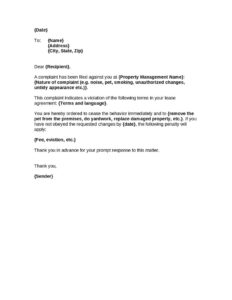
Landlord Warning
Download a free Landlord Warning letter template to formally notify tenants of a lease violation and request corrective action — free PDF and DOCX download.
DOCX
6 downloads
0
likes
Download Files
- DOCX
A Landlord Warning letter is a written notice a property owner or manager sends to a tenant to document a lease violation and demand that the behavior stop. It is most often used when a landlord receives a complaint — about noise, a pet, smoking, or property damage — and wants to create a formal paper trail before taking further action. You can download this Landlord Warning template free in PDF and DOCX formats, with no signup required.
What Is a Landlord Warning?
A Landlord Warning is a formal letter that informs a tenant they have breached a specific term of their lease and instructs them to correct the issue by a stated deadline. It is typically issued by the landlord, property manager, or management company that holds the lease. The letter documents the nature of the complaint, cites the relevant lease language, describes the required corrective action, and spells out the consequence — such as a fee or eviction proceedings — if the tenant does not comply. Unlike a casual conversation or text message, a written warning creates a dated record that can support later steps in the dispute process if the behavior continues unchecked.
When Do You Need a Landlord Warning?
This letter is useful any time a tenant’s conduct or property use crosses the line set out in their lease and an informal reminder has not worked. Common scenarios include:
- Noise complaints — repeated loud music, parties, or disturbances reported by neighbors.
- Unauthorized pets — a tenant keeping an animal in violation of a no-pet clause or breed/size restriction.
- Smoking violations — smoking inside a unit or in areas where the lease prohibits it.
- Property damage or neglect — broken fixtures, unkempt yards, or damage that the tenant is responsible for repairing.
- Unauthorized changes — painting, structural alterations, or installations made without the landlord’s consent.
- Untidy or unsanitary conditions — clutter, trash, or appearance issues that breach maintenance terms in the lease.
In each of these situations, a warning gives the tenant a clear, documented chance to fix the problem before more serious measures are considered.
What a Landlord Warning Should Have
A complete and effective warning letter includes several core elements. It should clearly identify the tenant by name and address, state the date the letter was issued, and name the property or management company sending it. The heart of the letter is the description of the complaint and the specific lease term that was violated — quoting or paraphrasing the actual lease language strengthens your position. The letter should also state exactly what corrective action is required, set a firm compliance deadline, and explain the penalty for non-compliance. Finally, it should close with a courteous tone and the sender’s name so the tenant knows who to contact.
How to Fill Out a Landlord Warning
Use the template’s bracketed fields as your guide and complete each one in order:
- Enter the Date the letter is being sent at the top.
- In the To block, add the tenant’s Name, Address, and City, State, Zip exactly as they appear on the lease.
- Address the tenant by name in the Dear {Recipient} greeting.
- Fill in your Property Management Name where the complaint was filed.
- Describe the Nature of complaint — for example noise, an unauthorized pet, smoking, unapproved changes, or untidy appearance.
- Quote or summarize the Terms and language from the lease that the behavior violates.
- State the required corrective action in the next field — such as removing a pet, completing yardwork, or replacing damaged property.
- Set the compliance date by which the tenant must comply.
- Specify the penalty — a fee, eviction, or other consequence — that applies if the deadline passes without action.
- Sign off with your name in the Sender field.
Keeping a Record and Following Up
A warning letter is only as strong as the proof that the tenant received it. Keep a copy of every letter you send, and consider delivering it by a method that confirms delivery — such as certified mail, hand delivery with a witness, or a documented email — depending on what your lease and local rules allow. Note the date you sent it and the deadline you gave. If the tenant corrects the problem, keep the letter in your records in case the issue recurs. If the deadline passes without compliance, the documented warning becomes part of the timeline you may rely on for the next step, whether that is a formal notice to cure, a fee, or eviction proceedings.
How a Warning Differs From an Eviction Notice
A Landlord Warning is generally an earlier, less severe step than a formal eviction notice. The warning asks the tenant to fix a problem and stay; an eviction notice typically begins the legal process of ending the tenancy. Many leases and local rules expect a landlord to give the tenant a reasonable chance to cure a violation before pursuing eviction, which is exactly what this letter does. Treating the warning as a good-faith opportunity to resolve the issue can also help preserve the landlord-tenant relationship and avoid the cost and time of a formal dispute.
Common Mistakes to Avoid
- Being vague about the violation — always name the specific behavior and the exact lease term it breaks.
- Leaving out a deadline — a warning without a clear compliance date is hard to enforce.
- Skipping the required action — tell the tenant precisely what they must do to comply.
- Using a hostile or threatening tone — keep the letter firm but professional.
- Not keeping proof of delivery — without a record, the tenant can claim they never received it.
- Threatening a penalty the lease doesn’t allow — make sure any fee or consequence is supported by your lease and local law.
Frequently Asked Questions
What is a Landlord Warning letter? It is a formal written notice from a landlord or property manager telling a tenant they have violated a lease term and must correct the issue by a stated deadline. It documents the complaint, the lease language breached, and the consequence for not complying.
How do I fill out a Landlord Warning? Enter the date, the tenant’s name and address, your property management name, the nature of the complaint, the violated lease terms, the required corrective action, a deadline, the penalty for non-compliance, and your signature. Use the bracketed fields in the template as a step-by-step guide.
Is a Landlord Warning legally binding? The warning itself is a notice rather than a contract, but it can carry legal weight as documentation of a lease violation and the tenant’s opportunity to cure it. Its enforceability depends on your lease terms and local landlord-tenant law, so review both before relying on it.
Does a Landlord Warning need to be notarized? No, a warning letter generally does not require notarization or witnesses. What matters more is that the tenant actually receives it, so use a delivery method that creates a record, such as certified mail or documented hand delivery.
How much does this template cost? It is completely free to download here in PDF and DOCX formats, with no signup or payment required. You can edit the DOCX version to match your property, lease, and the specific complaint.
What happens if the tenant ignores the warning? If the tenant does not comply by the deadline, the penalty stated in your letter — such as a fee or eviction proceedings — may apply, subject to your lease and local rules. The documented warning then becomes part of your record supporting any further action.
This Landlord Warning template is a general example provided for informational purposes only and is not legal advice. Landlord-tenant requirements, notice periods, and permissible penalties vary by jurisdiction. Consult a qualified attorney or your local housing authority before acting on a lease dispute.
Official resource: for the rules that apply to your situation, see HUD.
Related Forms
- Consent To Assignment Of Lease
- Eviction Notice
- Landlord Lease Renewal
- Notice Of Intent To Enter Dwelling
- Tenant Utilities Increase Letter
- Tenant Late Rent Log
Browse more in Landlord Documents.