
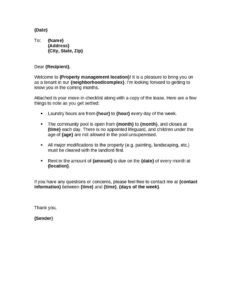
Landlord Welcome
Greet new tenants professionally with our free Landlord Welcome Letter template, available as a free download in PDF and DOCX with editable fields.
DOCX
2 downloads
0
likes
Download Files
- DOCX
A Landlord Welcome Letter is a short, friendly note a property owner or manager sends to a new tenant at the start of a lease to greet them, confirm move-in details, and share key contact information. Most people use it to make a strong first impression and set a cooperative tone from day one. You can download this Landlord Welcome Letter free in both PDF and DOCX formats — no signup required.
What Is a Landlord Welcome Letter?
A Landlord Welcome Letter is a written greeting issued by a landlord or property management company to a tenant who has just signed a lease. It documents the start of the relationship in a warm, professional way and typically accompanies practical materials like the signed lease and a move-in checklist. Rather than a binding legal contract, it serves as a courtesy communication that reinforces the terms already agreed upon and gives the tenant a single, clear point of contact. A good welcome letter reduces early confusion, encourages tenants to report issues promptly, and helps build trust between both parties at the very beginning of the tenancy.
When Do You Need a Landlord Welcome Letter?
A welcome letter is useful any time a new tenant is moving in, regardless of whether you manage one unit or a large complex. Common situations include:
- A tenant has just signed a lease and is about to receive keys for move-in.
- You manage a multi-unit complex and want every new resident to receive a consistent, professional greeting.
- You are a first-time landlord renting out a single-family home or condo and want to set clear expectations early.
- A property management company is onboarding tenants on behalf of an owner and needs a branded, repeatable introduction.
- You want to deliver the signed lease and move-in checklist together with a friendly cover note.
- You are switching management companies and want to reintroduce yourself as the new point of contact for existing residents.
What a Landlord Welcome Letter Should Have
While the tone is casual, a complete welcome letter still covers a few essential elements. It should clearly identify the property and the new tenant, express a genuine greeting, and reference the attachments — usually the lease and a move-in checklist. Crucially, it should list how and when the tenant can reach you, including a phone number or email, available hours, and the days of the week you respond. Many landlords also use the letter to highlight a few practical reminders, such as how to submit maintenance requests, where to park, trash and recycling schedules, or how rent should be paid. Keeping these items short and scannable makes the letter genuinely useful rather than just a formality.
How to Fill Out a Landlord Welcome Letter
- Enter the Date you are sending the letter, ideally close to the move-in day.
- Address the letter to the tenant by completing the Name, Address, and City, State, Zip fields with their new rental details.
- Personalize the greeting using the Recipient field — write the tenant’s first name for a warmer tone.
- Fill in the Property management location so the tenant knows which property or company is welcoming them.
- Complete the neighborhood/complex field to name the specific community, building, or street they are joining.
- Confirm that the move-in checklist and a copy of the lease are attached, then add any short notes about getting settled.
- Provide your contact information, then set your availability by entering the start and end time and the relevant days of the week.
- Sign off by adding your name in the Sender field as the landlord or manager.
Tips for Writing an Effective Welcome Letter
The strongest welcome letters feel personal without being long. Use the tenant’s name, mention something specific about the property or neighborhood, and keep the practical reminders to a tight list of three to five items. Consider including details that prevent the most common first-week questions: where to park, how to set up utilities if applicable, the preferred method for paying rent, and how to report a maintenance emergency versus a routine request. If you manage multiple units, save a master version of this DOCX template so you only need to swap the tenant-specific fields each time. A clean, branded letter signals that you run an organized, responsive operation, which tends to encourage tenants to treat the property and their lease obligations with the same care.
What to Attach With the Letter
This template references a move-in checklist and a copy of the lease, and pairing those documents with the welcome letter is good practice. The move-in checklist gives the tenant a structured way to note the unit’s condition at the start of the tenancy, which protects both parties when it comes time to assess the security deposit. Including a copy of the fully signed lease ensures the tenant always has the agreed terms on hand. Some landlords also add a one-page resource sheet with local utility providers, the property’s rules or HOA guidelines, and emergency contacts. Delivering everything together in one welcome packet reduces back-and-forth and helps the tenant settle in smoothly.
Common Mistakes to Avoid
- Forgetting to attach the documents the letter mentions, such as the lease or move-in checklist.
- Leaving contact hours vague — always specify the time range and days so tenants know when to reach you.
- Using an impersonal greeting; addressing the tenant by name in the Recipient field makes a better impression.
- Overloading the letter with rules instead of a brief, scannable list of the most important reminders.
- Sending the letter too late, after the tenant has already moved in and formed first impressions.
- Restating binding lease terms inaccurately — refer tenants to the actual lease rather than paraphrasing obligations.
Frequently Asked Questions
What is a Landlord Welcome Letter? It is a friendly note a landlord or property manager sends to a new tenant at the start of a lease. It greets the tenant, names the property, references attached documents like the lease and move-in checklist, and provides clear contact details and availability.
Is a welcome letter legally binding? No, the welcome letter itself is a courtesy communication, not a contract. The legally binding terms of the tenancy live in the signed lease agreement. The letter simply introduces you and points the tenant toward the documents and contacts they need.
When should I send the Landlord Welcome Letter? Send it right around move-in — either with the keys, in a welcome packet, or by email shortly before the tenant arrives. Timing it close to move-in ensures the contact information and reminders are fresh and immediately useful.
What should I include with the letter? Most landlords include the signed lease and a move-in checklist, as this template suggests. You can also add a resource sheet with utility providers, parking and trash details, rent payment instructions, and emergency contacts to answer common first-week questions.
Do I need to send a welcome letter for every tenant? It is not required, but it is a simple way to set a professional, cooperative tone with each new resident. Using a reusable template lets you personalize the tenant name, property, and contact fields quickly for every move-in.
How much does this template cost? Nothing — this Landlord Welcome Letter is completely free to download in both PDF and DOCX formats with no signup required. You can edit the DOCX version to match your branding and reuse it for future tenants.
This template is a general example provided for informational purposes only and is not legal, financial, or tax advice. Landlord-tenant requirements vary by state and locality, so consult a qualified professional or attorney to ensure your documents and practices comply with applicable laws.
Official resource: for the rules that apply to your situation, see HUD.
Related Forms
- Landlord Checklist
- Rental Unit Smoke Detector CO2 Log
- Security Deposit Return Letter
- Pre-Rental Comparison Checklist
- Landlord Proof of Residency
- Tenant Late Rent Log
Browse more in Landlord Documents.