
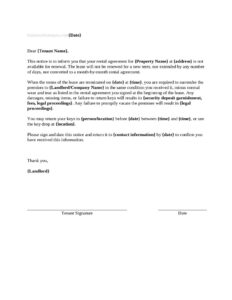
Landlord Non-Renewal Letter
Download a free Landlord Non-Renewal Letter template in PDF and DOCX to formally notify a tenant that their lease will not be renewed — free download.
DOCX
1 downloads
0
likes
Download Files
- DOCX
A Landlord Non-Renewal Letter is a written notice a landlord sends to a tenant to formally announce that their lease will not be renewed once the current term ends. Property owners most often use it to clearly establish a move-out date and avoid the tenancy automatically rolling into a month-to-month arrangement. You can download this Landlord Non-Renewal Letter free in both PDF and DOCX formats, with no signup required.
What Is a Landlord Non-Renewal Letter?
A Landlord Non-Renewal Letter is a formal communication, issued by the landlord or property manager, that informs a tenant their fixed-term lease will end on its scheduled expiration date and will not be extended or renewed. It documents the landlord’s intent, the lease end date, and the date by which the tenant is expected to vacate. Unlike an eviction notice, a non-renewal letter is not about a breach of the lease — it simply confirms that the parties will part ways when the term naturally concludes. The letter creates a paper trail showing the tenant received timely warning, which protects both sides and reduces disputes over move-out timing and deposit returns.
When Do You Need a Landlord Non-Renewal Letter?
Landlords reach for this letter whenever they want a tenancy to end cleanly at the close of a term. Common situations include:
- Selling the property: You plan to list or close on the home and need it vacant for the new owner.
- Moving in yourself or family: You or a relative intends to occupy the unit after the lease ends.
- Major renovations: You are taking the unit off the rental market for substantial repairs or remodeling.
- Changing tenants: You have decided not to continue the relationship and prefer to re-rent to someone new.
- Adjusting terms or rent: You want to end the current lease so a new agreement with updated terms can be negotiated.
- Preventing auto-renewal: The lease contains an automatic renewal clause and you must give notice to stop it from extending.
What a Landlord Non-Renewal Letter Should Have
A complete and effective non-renewal letter contains several key elements so there is no ambiguity about who is involved and when the tenancy ends. At minimum, it should include the date the letter is written, the full names of the landlord and tenant, and the complete rental property address including any unit number. It must state the original lease start date and its scheduled expiration date, a clear statement that the lease will not be renewed, and the exact date by which the tenant must vacate and return possession. Strong letters also remind the tenant about returning keys, scheduling a move-out inspection, providing a forwarding address for the security deposit, and the landlord’s signature and contact details.
How to Fill Out a Landlord Non-Renewal Letter
Work through the template section by section so nothing important is left out:
- Date the letter. Enter the date you are sending it — this anchors your notice period.
- Add tenant details. Write the tenant’s full legal name and the complete rental address, including unit or apartment number.
- Identify the landlord. Insert your name (or the property management company’s name) as the party issuing the notice.
- Reference the lease. State the lease start date and its expiration date so the tenant knows exactly which agreement is ending.
- State non-renewal clearly. Include a direct sentence confirming the lease will not be renewed and will terminate on the expiration date.
- Specify the move-out date. Give the exact day the tenant must vacate and hand back possession of the unit.
- Add move-out instructions. Mention returning keys, the inspection process, and requesting a forwarding address for the deposit.
- Sign and provide contact info. Sign the letter and include a phone number or email so the tenant can reach you with questions.
Notice Periods and Delivery
The amount of advance notice required before a lease ends varies widely by jurisdiction and by lease type. Many areas require 30 or 60 days’ written notice for a fixed-term lease, while some jurisdictions and longer tenancies call for 90 days or more. Always check your local rules and the notice clause in the existing lease, then count backward from the lease expiration date to make sure you send the letter in time. How you deliver the letter matters too: sending it by certified mail with return receipt, or using a delivery method permitted by your lease and local law, gives you proof the tenant received it. Keep a copy of the signed letter and any delivery confirmation in your records.
Non-Renewal Letter vs. Eviction Notice
It is important not to confuse the two. A non-renewal letter ends a tenancy at the natural conclusion of the lease term and does not allege wrongdoing — the tenant has simply reached the end of the agreement. An eviction notice, by contrast, is used when a tenant violates the lease, fails to pay rent, or stays past the move-out date, and it can lead to a formal court process. Using a polite, professional non-renewal letter helps keep the relationship civil and the move-out cooperative. In some rent-regulated or just-cause jurisdictions, landlords may need a legally recognized reason to decline renewal, so verify local requirements before sending.
Common Mistakes to Avoid
- Sending it late: Missing the required notice window can force the tenancy into another full term or month-to-month.
- Vague dates: Failing to state the precise lease expiration and move-out dates invites confusion and disputes.
- No proof of delivery: Relying on a text or verbal mention leaves you without evidence the tenant was notified.
- Ignoring local just-cause rules: Some areas restrict non-renewals or require a stated reason.
- Mixing it with deposit demands: Keep the letter focused on non-renewal; handle deposit accounting separately and according to your timeline.
- Forgetting to sign: An unsigned letter may be challenged as informal or invalid.
Frequently Asked Questions
What is a Landlord Non-Renewal Letter? It is a formal written notice from a landlord telling a tenant that their fixed-term lease will end on its expiration date and will not be renewed. It sets a clear move-out date and documents that the tenant was given timely warning.
How much notice do I have to give? Notice requirements vary by jurisdiction and lease type, commonly ranging from 30 to 90 days. Always check your local rules and the notice clause in the existing lease, then send the letter early enough to satisfy that window.
Does a non-renewal letter need to be notarized? Notarization is generally not required for a non-renewal letter. What matters most is that it is in writing, clearly dated, signed by the landlord, and delivered in a way that proves the tenant received it.
Is a non-renewal letter the same as an eviction? No. A non-renewal letter ends a tenancy at the lease’s natural conclusion without alleging any violation, while an eviction is a legal process triggered by a breach such as nonpayment or staying past the move-out date.
Do I have to give a reason for not renewing? In many places you do not, but some rent-regulated or just-cause jurisdictions require a legally recognized reason. Confirm the rules in your area before deciding whether to state a reason.
Is this template really free? Yes. You can download this Landlord Non-Renewal Letter free in PDF and DOCX with no signup, then edit the names, dates, and address to fit your situation.
This template is a general example provided for informational purposes only and is not legal advice. Landlord-tenant laws, notice periods, and just-cause requirements vary by jurisdiction. Consult a qualified attorney or your local housing authority to confirm your obligations before sending a non-renewal letter.
Official resource: for the rules that apply to your situation, see HUD.
Related Forms
- Rental Unit Smoke Detector CO2 Log
- Tenant Utilities Increase Letter
- Move-In Letter
- Rent Demand Letter
- Landlord Maintenance Request
- Covid Rent Extension Landlord
Browse more in Landlord Documents.