
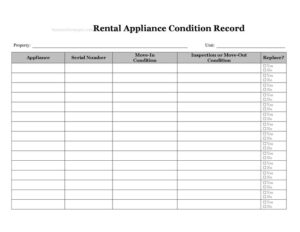
Rental Appliance Condition Record
Document the working order of every rental appliance at move-in and move-out with this free Rental Appliance Condition Record template — free download in PDF and DOCX.
PDF
DOCX
2 downloads
0
likes
Download Files
- DOCX
A Rental Appliance Condition Record is a landlord document used to log the make, model, and working condition of every appliance provided with a rental unit at move-in and move-out. The most common reason people use it is to settle disputes over appliance damage and security deposit deductions with clear, dated evidence. It’s free to download here in both PDF and DOCX, with no signup required.
What Is a Rental Appliance Condition Record?
A Rental Appliance Condition Record is a written inventory that documents the condition of each appliance supplied in a rented home or apartment — the refrigerator, oven, dishwasher, microwave, washer, dryer, and similar items. It is typically completed by the landlord or property manager and reviewed and signed by the tenant at the start and end of a tenancy. The record establishes a shared baseline so that both parties agree on what was working, what was damaged, and what was missing. Because appliances are among the most expensive items in a rental, this document protects landlords from being blamed for pre-existing wear and protects tenants from being charged for damage they did not cause.
When Do You Need a Rental Appliance Condition Record?
This form is useful any time appliances change hands or their condition needs to be verified. Common situations include:
- Documenting appliance condition during a move-in walkthrough before a new tenant takes possession.
- Completing a move-out inspection to compare current condition against the move-in baseline.
- Justifying or disputing a security deposit deduction for a damaged or non-functioning appliance.
- Recording the delivery or replacement of an appliance mid-lease, such as a new dishwasher or stove.
- Creating a maintenance and warranty paper trail showing model numbers, ages, and service history.
- Resolving a tenant complaint about an appliance that stopped working and determining who is responsible.
What a Rental Appliance Condition Record Should Have
A complete record leaves no room for ambiguity. It should clearly identify the rental property and the tenancy it covers, list every appliance individually rather than grouping them, and describe the precise condition of each item using consistent terms such as new, good, fair, or damaged. Strong records also capture make, model, and serial numbers, an approximate age or installation date, and a notes column for existing scratches, dents, or quirks. Most importantly, the form needs space for dated signatures from both landlord and tenant at move-in and again at move-out, along with photographs referenced by file name or attached as evidence.
How to Fill Out a Rental Appliance Condition Record
Work through the form systematically, ideally during a walkthrough with the tenant present:
- Enter the property address, unit number, and the tenant name(s) at the top so the record is tied to the correct lease.
- Record the inspection date and indicate whether this is the move-in or move-out inspection.
- List each appliance on its own line — refrigerator, range/oven, dishwasher, microwave, washer, dryer, garbage disposal, and any others provided.
- For each item, note the make, model, and serial number and an approximate age or install date.
- Mark the condition using a consistent scale and confirm whether the appliance is in working order.
- Use the notes/remarks column to describe any existing cosmetic or functional issues in detail.
- Reference any photos taken for each appliance.
- Have both the landlord and tenant sign and date the form to confirm agreement.
Move-In Versus Move-Out: Using the Record as a Comparison Tool
The real power of this document comes from comparing two snapshots of the same appliances. At move-in, the record sets the agreed starting condition; at move-out, you repeat the inspection using the identical list and condition scale. Any change between the two columns — a cracked oven door that was previously noted as good, or a refrigerator that no longer cools — becomes the basis for a fair deduction or a clean return of the deposit. Keeping both inspections on a single sheet (or two matched sheets) makes the before-and-after obvious to a tenant, a mediator, or a small-claims judge. Photographs dated at each stage strengthen the comparison considerably.
Tips for Reliable Appliance Documentation
Photograph each appliance from multiple angles, including close-ups of any existing damage and a shot of the model/serial plate. Test functionality on the spot — run the dishwasher cycle, confirm the oven heats, check that the refrigerator and freezer hold temperature. Give the tenant a signed copy and keep the original with the lease file. Storing the record digitally alongside the photos protects you if the paper version is lost. Finally, repeat the process consistently for every tenancy so your records are comparable over time and across units.
Common Mistakes to Avoid
- Grouping appliances together instead of listing and rating each one individually.
- Skipping make, model, and serial numbers, which makes replacement and warranty claims harder.
- Failing to test whether each appliance actually works rather than just inspecting its appearance.
- Leaving the notes column blank, so minor pre-existing flaws aren’t documented and later become disputes.
- Forgetting to get the tenant’s signature, which undermines the record’s value as agreed evidence.
- Not taking dated photographs to back up the written condition descriptions.
Frequently Asked Questions
What is a Rental Appliance Condition Record used for? It is used to document the condition and working order of every appliance in a rental unit at move-in and move-out. Landlords and tenants use it to create a shared baseline that helps resolve disputes over damage and security deposit deductions. Having a signed record protects both parties with clear, dated evidence.
How do I fill out a Rental Appliance Condition Record? Enter the property address and tenant details, then list each appliance with its make, model, and serial number. Mark each item’s condition and whether it works, add notes about any existing damage, and reference photos. Finish by having both the landlord and tenant sign and date the form.
Does this form need to be notarized or witnessed? No, a Rental Appliance Condition Record does not typically require notarization or a witness. It simply needs the dated signatures of the landlord and tenant to confirm they agree on the condition recorded. Keeping signed copies for both parties is the most important step.
Is a Rental Appliance Condition Record legally binding? When signed by both parties, it serves as strong documentary evidence of the agreed appliance condition and is often referenced in deposit disputes and small-claims proceedings. It works best as a supplement to your lease and a broader move-in/move-out inspection report. Requirements and weight given to such records can vary by jurisdiction.
How much does this template cost? This Rental Appliance Condition Record template is completely free to download from Business Forms Pro. It is available in both PDF and DOCX formats with no signup required. You can edit the DOCX version to add your own appliances, columns, or branding.
Should I take photos along with the written record? Yes, photographs are highly recommended and significantly strengthen the record. Take clearly dated images of each appliance, including close-ups of any existing damage and the model/serial plate, and reference them on the form. Photos make any before-and-after comparison far easier to defend.
This template is provided as a general example for informational purposes only and is not legal, financial, or tax advice. Landlord-tenant rules and security deposit requirements vary by state and locality, so consult a qualified attorney or property professional to ensure your documentation meets the rules that apply to you.
Official resource: for the rules that apply to your situation, see HUD.
Related Forms
- Rental Unit HVAC Filter Log
- Request for Landlord Repairs
- Landlord Notice To Enter Premises
- Landlord Proof of Residency
- Notice of Overdue Rent
- Notice of Lease Termination
Browse more in Landlord Documents.