
Landlord Notice To Enter Premises
Download a free Landlord Notice to Enter Premises template in PDF and DOCX to give tenants proper advance notice before entering a rental unit.
PDF
DOCX
1 downloads
0
likes
Download Files
- DOCX
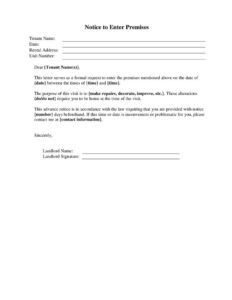
A Landlord Notice to Enter Premises is a written letter a landlord gives a tenant to announce a planned visit to a rented home before it happens. The most common reason people use it is to provide the legally required advance notice before entering for repairs, inspections, or maintenance. You can download this template free in PDF and DOCX formats with no signup required.
What Is a Landlord Notice to Enter Premises?
A Landlord Notice to Enter Premises is a formal communication from a property owner or manager to a tenant, informing them that the landlord intends to enter the rental unit on a specific date and time for a stated purpose. It documents that the tenant received proper warning before the visit, which most leases and local laws require. The notice typically names the tenant and rental address, states the reason for entry, specifies whether the tenant must be present, and confirms the number of days of advance notice given. Used correctly, it protects the tenant’s right to quiet enjoyment while giving the landlord lawful access to the property they own.
When Do You Need a Landlord Notice to Enter Premises?
Landlords commonly send this notice whenever they need lawful access to an occupied rental. Typical situations include:
- Routine or seasonal maintenance such as servicing the heating system, replacing filters, or checking smoke detectors.
- Repairs requested by the tenant or needed to address a leak, appliance failure, or safety issue.
- Property inspections at move-in, move-out, or on a periodic schedule allowed by the lease.
- Improvements or decorating like painting, flooring, or upgrading fixtures between or during tenancies.
- Showing the unit to prospective tenants, buyers, lenders, or appraisers when the property is on the market.
- Contractor or inspector access for pest control, fire safety checks, or utility work that must be coordinated in advance.
In each case, the written notice creates a clear, dated record that the tenant was told who would enter, when, and why.
What a Notice to Enter Premises Should Have
A complete and effective notice includes the tenant’s full name and the exact rental address, including the unit number. It should state the precise date and time window of the planned entry, the specific purpose of the visit, and whether the tenant needs to be home. Crucially, it must confirm the amount of advance notice being provided so it aligns with the lease and local law. Finally, it should include landlord contact information for rescheduling, plus the landlord’s name and signature to make the request formal and verifiable.
How to Fill Out a Landlord Notice to Enter Premises
- Tenant Name: Enter the full legal name of each tenant on the lease so the notice reaches the right people.
- Date: Write the date you are sending the notice, which helps establish whether the advance-notice period is met.
- Rental Address and Unit Number: Provide the complete property address and the specific unit to remove any ambiguity about which premises will be entered.
- Date of entry: State the exact day you plan to enter the unit.
- Time window: Fill in the start and end times so the tenant knows the window during which you will arrive.
- Purpose: Describe the reason clearly, for example to make repairs, decorate, or perform an inspection.
- Presence requirement: Indicate whether the work does or does not require the tenant to be home.
- Number of days: Enter the advance-notice period (for example 24 or 48 hours) required in your area.
- Contact information: Add a phone number or email so the tenant can reach you if the time is inconvenient.
- Landlord Name and Signature: Print your name and sign to formalize the notice.
How Much Notice Is Required?
The amount of advance notice a landlord must give varies widely by location. Many jurisdictions require 24 hours, while others require 48 hours or more, and some recognize shorter periods only for genuine emergencies such as a burst pipe or gas leak. The lease itself may also set a notice period, and where the lease and local law differ, the more tenant-protective standard usually applies. Because this varies, fill in the number of days field based on the rule that actually applies to your property, and keep a copy of the dated, signed notice as proof that you provided proper warning.
Delivering the Notice the Right Way
How you deliver the notice can matter as much as what it says. Acceptable methods often include handing it to the tenant in person, posting it on the door, or sending it by mail or email, but some areas restrict which methods count toward the notice period. Mailing typically adds extra days for delivery, so build that into your timeline. To avoid disputes, choose a method that creates a record, note the date and time of delivery, and retain a duplicate of the signed notice in your tenant file.
Common Mistakes to Avoid
- Giving too little notice by counting from the entry date instead of the delivery date, which can shorten the actual warning the tenant receives.
- Leaving the purpose vague rather than naming the specific repair, inspection, or showing.
- Omitting the unit number in multi-unit buildings, creating confusion about which premises are involved.
- Forgetting the signature or contact information, which makes the notice feel informal and hard to verify.
- Entering outside the stated time window or on a different day than the notice specifies.
- Sending notice for non-permitted reasons or using frequent entries in a way that disrupts the tenant’s quiet enjoyment of the home.
Frequently Asked Questions
What is a Landlord Notice to Enter Premises? It is a written letter from a landlord to a tenant announcing a planned entry into the rental unit, including the date, time, purpose, and required advance notice. It protects the tenant’s right to privacy while giving the landlord lawful access to the property.
How much advance notice do I have to give? The required period depends on your local rules and lease terms, with 24 to 48 hours being common in many areas. Genuine emergencies often allow immediate entry, but for routine visits you should fill in the notice period that applies to your property.
Does the tenant have to be home during the visit? Not always. The template includes a field to indicate whether the visit requires the tenant to be present, so you can clarify whether they should be there or whether you will let yourself in during the stated window.
Is this notice legally binding? The notice itself is a formality that documents proper warning rather than a contract. Whether your entry is lawful depends on following the notice requirements in your lease and local law, so accuracy on the date, time, and notice period matters.
How do I deliver the notice to my tenant? Common methods include in-person delivery, posting on the door, mail, or email, though some places limit which methods count. Use a method that creates a record and account for any added mailing time when calculating the notice period.
How much does this template cost? It is completely free to download from Business Forms Pro in both PDF and DOCX formats, with no signup required. You can edit it to match your property details, lease terms, and local notice rules.
This template is a general example provided for informational purposes only and is not legal advice. Landlord and tenant entry requirements vary by state, province, and municipality, and your lease may impose additional obligations. Consult a qualified attorney or your local housing authority to confirm the rules that apply to your situation.
Official resource: for the rules that apply to your situation, see HUD.
Related Forms
- Tenant Deposit Letter
- Move In Letter
- Landlord Non-Renewal Letter
- Landlord Late Rent Notice
- Move-In Letter
- Landlord Lead Disclosure Form
Browse more in Landlord Documents.