
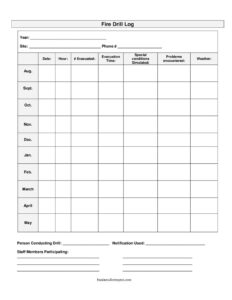
Fire Drill Log
Record fire drill dates, evacuation times, and results with this free Fire Drill Log template, available as a free download in PDF and DOCX.
PDF
DOCX
10 downloads
0
likes
Download Files
- DOCX
A Fire Drill Log is a simple record-keeping form used to document each fire evacuation drill at a building or site, including the date, time, number of people evacuated, and any problems encountered. People most commonly use it to prove that required drills were actually performed and to track improvements over a school or fiscal year. You can download this Fire Drill Log free in both PDF and DOCX formats, with no signup required.
What Is a Fire Drill Log?
A Fire Drill Log is a documentation form completed by a safety officer, facility manager, principal, or designated fire warden each time an evacuation drill is conducted. It captures the essential details of every drill on a single ongoing sheet: when it happened, who ran it, how many occupants evacuated, and what went wrong or well. Because this template is organized by month — from August through May — it is especially suited to schools, daycares, residential facilities, and other sites that must run regular drills across an academic or operating year. The completed log serves as evidence of compliance and as a practical tool for spotting recurring evacuation problems over time.
When Do You Need a Fire Drill Log?
Almost any organization that occupies a building and is responsible for occupant safety can benefit from keeping a running drill record. Common situations include:
- Schools and daycares that are required to conduct and document a set number of evacuation drills each academic year.
- Long-term care homes, assisted living, and hospitals where staff must practice moving or accounting for vulnerable residents.
- Apartment buildings and dormitories conducting periodic occupant drills.
- Offices, warehouses, and factories demonstrating an emergency action plan to inspectors or insurers.
- Fire safety inspections or audits, where an authority asks for proof that drills were held on specific dates.
- Insurance reviews, where a documented drill history can support a facility’s safety record.
What a Fire Drill Log Should Have
A complete and useful Fire Drill Log captures enough detail that anyone reviewing it later can reconstruct what happened. At a minimum it should identify the year and site, the date and hour of each drill, the number of people evacuated, the name of the person who conducted the drill, and the type of notification used. Strong logs also record the weather, any special conditions simulated (such as a blocked exit), problems encountered, and the staff members who participated. Organizing entries by month — as this template does with columns for August through May — makes it easy to confirm at a glance that drills were spread across the year rather than crammed together.
How to Fill Out a Fire Drill Log
- Enter the year the log covers and the site name or building location at the top.
- Record the contact phone # for the site or the person responsible for safety.
- For each drill, fill in the date it was held and the hour the alarm or signal was given.
- Note the # evacuated — the total count of occupants who left the building.
- Describe any special conditions simulated, such as a blocked stairwell, a missing staff member, or a smoke-filled corridor.
- Document the problems encountered, like slow exit times, confusion at assembly points, or a door that wouldn’t open.
- Record the weather, since rain, cold, or snow affects evacuation behavior.
- Write the name of the person conducting drill and the notification used (fire alarm, voice command, bell, or PA system).
- List the staff members participating and mark the correct month column — Aug. through May — to track the drill across the year.
Using the Monthly Columns Effectively
This template lays out the operating year in monthly columns running August, September, October, November, December, January, February, March, April, and May. That structure mirrors a typical school calendar and helps you confirm at a glance that drills were distributed sensibly rather than bunched into one period. As you complete each drill, mark its month so the spread is visible. If a jurisdiction requires a certain number of drills per year, the monthly layout makes it obvious whether you are on pace or behind. It also helps you vary the timing and conditions — running a drill in cold January weather tests very different challenges than a mild September morning, and the log captures both for comparison.
Turning the Log Into Action
A Fire Drill Log is most valuable when it drives improvement, not just compliance. After each drill, review the problems encountered column and assign a fix: clear a blocked exit, retrain staff on assembly points, or improve the notification signal. Compare evacuation counts and times across months to confirm that occupants are getting faster and more confident. Keep completed logs on file for the period your local authority or insurer requires, and store them where they can be produced quickly during an inspection. Over several years, the accumulated logs become a clear narrative of your site’s safety culture.
Common Mistakes to Avoid
- Leaving the # evacuated blank — without a count, you can’t verify everyone got out or measure improvement.
- Skipping the problems column when a drill goes smoothly; even “no issues” is worth recording.
- Filling in the log after the fact from memory instead of recording details right after the drill.
- Forgetting to note the notification used, which matters if an alarm system fails during a real event.
- Never varying special conditions, so drills become routine and don’t test real obstacles.
- Failing to record the person conducting the drill, which leaves accountability unclear.
Frequently Asked Questions
What is a Fire Drill Log used for? It is used to document each fire evacuation drill at a site, capturing the date, time, number of people evacuated, conditions simulated, and any problems. It provides proof that required drills were conducted and a record for spotting recurring evacuation issues.
Who should fill out the Fire Drill Log? Typically the person responsible for fire safety — a facility manager, principal, safety officer, or designated fire warden — completes the log. Whoever conducts the drill should record the details immediately afterward while they are fresh.
How often should fire drills be logged? Every drill you conduct should be logged. The required number of drills per year varies by jurisdiction and building type, so check your local fire code or the requirements set by your authority having jurisdiction.
Why does the log track months from August to May? The monthly columns reflect a typical school or operating-year calendar and help you confirm that drills are spread across the year. You can adapt the months to match your own facility’s schedule if needed.
Is this Fire Drill Log legally binding? The log itself is a record-keeping document, not a contract, but it can serve as evidence of compliance during inspections or insurance reviews. Keep completed logs on file for the period your local rules require.
Is this Fire Drill Log template free? Yes. You can download it free from Business Forms Pro in both PDF and DOCX formats, with no signup required, and edit it to match your site’s needs.
This Fire Drill Log template is a general example provided for informational purposes only and does not constitute legal, safety, or regulatory advice. Fire drill and documentation requirements vary by jurisdiction, building type, and authority having jurisdiction — consult your local fire code and a qualified fire safety professional to ensure compliance.
Related Forms
- Outgoing Mail Detailed Log
- Cash Envelope Tracker
- Yearly Project Timetable
- Auto Maintenance Log
- Nanny Daily Log
- Large-Print Packing List
Browse more in Log and Inventory.