
List of Insurance Policies
Track every life, health, car, and home policy in one place with our free List of Insurance Policies template — free download in PDF and DOCX.
PDF
DOC
7 downloads
0
likes
Download Files
- DOC
A List of Insurance Policies is a single document that records all of your active coverage — life, health, automobile, and homeowners — along with the policy numbers, insurers, premiums, and expiration dates that go with each one. People most often create one so a spouse, executor, or trusted family member can find every policy quickly in an emergency. You can download this template free in PDF and DOCX, with no signup required.
What Is a List of Insurance Policies?
A List of Insurance Policies is an organizational log that consolidates the essential details of every insurance product a household or individual holds. Rather than digging through filing cabinets or email inboxes during a crisis, you keep one master sheet that identifies each insurer, the insured party, the policy and group numbers, the term, and the coverage limits. It is not a contract and does not change your coverage — it simply documents what already exists. Families, executors, financial planners, and estate organizers use it as a quick-reference summary. Because it captures life, health, car, and homeowners policies on one form, it gives anyone reviewing your affairs an immediate snapshot of what is protected and where to call.
When Do You Need a List of Insurance Policies?
- Estate and emergency planning: So a spouse or executor can locate and claim benefits if you become incapacitated or pass away.
- Annual coverage reviews: When comparing premiums, deductibles, and limits at renewal time to spot gaps or overlap.
- After a major life event: Marriage, a new home, a new driver, or a new dependent often means updating multiple policies at once.
- Working with a financial advisor: Advisors and tax professionals frequently ask for a complete picture of your coverage.
- Filing a claim quickly: Having policy and group numbers in one place speeds up phone calls after an accident, illness, or disaster.
- Household organization: Keeping a binder or digital folder of all important documents in one accessible location.
What a List of Insurance Policies Should Have
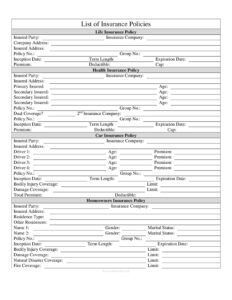
A complete list groups coverage by type and captures the details an insurer or claimant would need to act. For each policy that means the insurer’s name and address, the insured party, the policy number and group number, the inception and expiration dates, the term length, the premium, and the deductible. Coverage-specific fields matter too: bodily injury and damage limits for auto and home, fire and natural disaster coverage for a residence, and dual-coverage details for health insurance. Adding the named drivers or insured family members with their ages rounds out the record so nothing is ambiguous.
How to Fill Out a List of Insurance Policies
- Life Insurance Policy: Enter the Insured Party, Insurance Company, Company Address, and Insured Address. Record the Policy No., Group No., Inception Date, Term Length, and Expiration Date, then the Premium, Deductible, and Cap.
- Health Insurance Policy: List the Insured Party, Insurance Company, and Insured Address. Name the Primary Insured and each Secondary Insured with their Age. Add Policy No. and Group No., mark whether Dual Coverage applies, and if so enter the 2nd Insurance Company with its own Policy No. and Group No. Fill in Inception Date, Term Length, Expiration Date, Premium, Deductible, and Cap.
- Car Insurance Policy: Enter the Insured Party, Insurance Company, and Insured Address. List Drivers 1 through 4 with their Age and Premium. Add Policy No., Group No., Inception Date, Term Length, and Expiration Date. Record Bodily Injury Coverage and its Limit, Damage Coverage and its Limit, the Total Premium, and the Deductible.
- Homeowners Insurance Policy: Note the Insured Party, Insurance Company, Insured Address, Residence Type, and any Other Residences. List Name 1 and Name 2 with Gender and Marital Status, then the policy identifiers, dates, all coverage types and limits, Premium, and Deductible.
Keeping the List Accurate and Secure
An insurance list is only useful if it is current. Set a reminder to review it at each renewal, when you add a driver or dependent, or whenever you switch carriers. Because the form contains policy numbers and personal details, treat it like a sensitive financial document: store the printed copy in a locked drawer or fireproof box, and protect any digital version with a password. Tell at least one trusted person where to find it. If you keep both a paper and a digital copy, update them together so they never contradict each other.
How This Differs From the Policies Themselves
This list is a summary, not a substitute for your actual policy documents. The declarations pages, endorsements, and full contracts contain the binding terms, exclusions, and exact coverage language that govern any claim. Use the list to find and reference those documents quickly — note where each original is filed. When you call an insurer, having the policy and group numbers from the list lets the representative pull up your file immediately, but the policy itself remains the controlling document for what is and isn’t covered.
Common Mistakes to Avoid
- Leaving out expiration dates: Without them you can miss a renewal and let coverage lapse.
- Recording only one insured: Forgetting secondary insureds, additional drivers, or a second named homeowner leaves the record incomplete.
- Skipping group numbers: Many insurers need both policy and group numbers to identify your account.
- Not noting dual health coverage: If two policies apply, omitting the second insurer can delay claim coordination.
- Letting the list go stale: Old premiums and dropped policies make the document misleading.
- Storing it where no one can find it: A perfect list helps no one if your family doesn’t know it exists.
Frequently Asked Questions
What is a List of Insurance Policies used for? It is a single reference sheet that consolidates your life, health, car, and homeowners coverage in one place. The main purpose is to let you — or a spouse, executor, or advisor — quickly find policy numbers, insurers, and deadlines without searching through every file. It is especially valuable in emergencies and during estate planning.
Is this list legally binding? No. The list is an organizational record, not a contract. Your coverage is governed entirely by the actual insurance policies and their declarations pages. The list simply summarizes and points to those documents.
How much does the template cost? It is completely free to download here in both PDF and DOCX formats, with no signup or account required. You can fill out the PDF by hand or edit the DOCX version on your computer.
Do I need to update it often? Yes, review it at least once a year and after any change — a renewal, a new driver, a new dependent, a move, or a switch in carriers. Outdated premiums or dropped policies can create confusion when someone relies on the list during a claim.
Should I include dual health coverage? Absolutely. If a family member is covered by two health plans, record both the primary and the 2nd Insurance Company with their respective policy and group numbers. This helps insurers coordinate benefits and prevents claim delays.
Where should I keep the completed list? Store it somewhere secure but accessible, such as a fireproof box, a locked drawer, or a password-protected file. Because it contains policy numbers and personal details, treat it like any sensitive financial document and make sure at least one trusted person knows where it is.
This template is a general example provided for informational purposes only and is not legal, financial, tax, or insurance advice. Coverage terms, claim procedures, and requirements vary by insurer and jurisdiction — consult your insurance provider or a qualified professional for guidance specific to your situation.
Related Forms
- Time Management Log
- Travel Abroad Packing Checklist
- Project Status Report
- Home Food Storage Inventory Card
- Drivers Daily Log
- Fire Emergency Checklist
Browse more in Log and Inventory.