
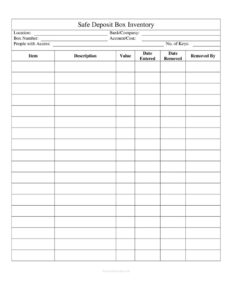
Safe Deposit Box Inventory
Track everything stored in your bank box with a free Safe Deposit Box Inventory template—record items, values, and access in a free download.
PDF
DOC
9 downloads
0
likes
Download Files
- DOC
A Safe Deposit Box Inventory is a simple record that lists every item stored inside your bank or credit union safe deposit box, along with its description, value, and the dates it went in or came out. People most often create one so loved ones or executors know exactly what is inside the box and where to find it. You can download this template free in PDF and DOCX—no signup required.
What Is a Safe Deposit Box Inventory?
A Safe Deposit Box Inventory is a written log that documents the contents of a rented safe deposit box at a bank, credit union, or storage company. It captures the box’s location and number, who is authorized to access it, how many keys exist, and a line-by-line list of each item with its description and estimated value. The owner usually maintains it, but a co-renter, attorney, or estate executor may rely on it too. Its purpose is to provide a clear, up-to-date snapshot of valuables—documents, jewelry, deeds, coins, and more—so nothing is forgotten, misplaced, or overlooked when the box is eventually opened, inherited, or closed.
When Do You Need a Safe Deposit Box Inventory?
- You just rented a new box and want a baseline record of everything you place inside it.
- You are organizing your estate so an executor or heir can quickly identify and locate valuables.
- You store important originals—wills, property deeds, birth certificates, savings bonds—and need to track which are in the box versus at home.
- You share access with a spouse, business partner, or family member and want a mutual record of contents.
- You are preparing for insurance purposes and need a documented list of jewelry, coins, or collectibles with values.
- You periodically add or remove items and want a running history of what changed and when.
What a Safe Deposit Box Inventory Should Have
A complete inventory ties the box itself to its contents and to the people who can reach them. At a minimum it should identify the institution and box, note the access and key situation, and then list each item in enough detail that someone unfamiliar with the box could recognize it. The most useful inventories include estimated values and dated entries so you can see the box’s history at a glance. Key elements include:
- Box identification: the Location, Bank/Company, and Box Number.
- Administrative details: the related Account/Cost, the People with Access, and the No. of Keys issued.
- An itemized list with each Item, its Description, and its Value.
- Tracking columns for the Date Entered, Date Removed, and Removed By.
How to Fill Out a Safe Deposit Box Inventory
- Location: Enter the branch address or the physical location of the box—for example, the bank branch on Main Street.
- Bank/Company: Write the name of the financial institution or storage company that holds the box.
- Box Number: Record the number assigned to your box so it can be matched to your rental agreement.
- Account/Cost: Note the linked account number or the annual rental cost, whichever you track.
- People with Access: List the full names of everyone authorized to open the box, including co-renters and deputies.
- No. of Keys: State how many keys exist and, ideally, who holds each one.
- Item: Name each object on its own line—”diamond ring,” “property deed,” “savings bond.”
- Description: Add identifying detail such as serial numbers, weights, certificate numbers, or distinguishing marks.
- Value: Estimate the item’s worth for insurance or estate reference.
- Date Entered / Date Removed / Removed By: Log when each item was added or taken out and who removed it.
Keeping Your Inventory Accurate and Secure
An inventory is only valuable if it stays current. Update it every time you visit the box—add new items the moment they go in and fill in the Date Removed and Removed By columns whenever something leaves. Because the document itself lists valuables and access details, store it somewhere safe but not inside the box it describes; an heir or executor needs to read it before opening the box, not after. Many people keep a copy with their estate documents, a trusted family member, or their attorney. Photographing or scanning high-value items and attaching the images to your records can make claims and identification far easier later.
How It Differs From a Home Inventory
A general home inventory covers furniture, electronics, and household goods spread across many rooms, while a Safe Deposit Box Inventory focuses narrowly on the contents of one secured box. Because box space is limited and items tend to be high in value—jewelry, deeds, certificates, rare coins—descriptions and values matter more here, and the access and key tracking fields are unique to this format. Treat the two documents as complementary rather than interchangeable.
Common Mistakes to Avoid
- Storing the only copy of the inventory inside the box, where no one can read it until the box is already open.
- Leaving the Value column blank, which weakens its usefulness for insurance and estate planning.
- Forgetting to update the log after adding or removing items, so the record drifts out of date.
- Vague descriptions like “ring” or “papers” instead of specific, identifiable details.
- Failing to list all People with Access or accurately count the No. of Keys.
- Keeping originals of irreplaceable documents only in the box without noting where copies exist.
Frequently Asked Questions
What is a Safe Deposit Box Inventory used for? It is a written record of everything stored in a bank or credit union safe deposit box, including item descriptions, values, and access details. People use it to keep track of valuables, support insurance claims, and help executors or heirs identify contents. It turns a sealed box into a documented, organized list.
How do I fill out a Safe Deposit Box Inventory? Start with the box details—location, bank or company name, box number, and the linked account or cost. Then list everyone with access and the number of keys, and finally record each item with a clear description, estimated value, and the dates it was entered or removed. Update it every time you visit the box.
Does a Safe Deposit Box Inventory need to be notarized? No, it is a personal recordkeeping document and generally does not require notarization or witnesses. Some people choose to have it signed or witnessed for estate purposes, but that is optional. Check your own situation if it forms part of formal estate planning.
Where should I store the completed inventory? Keep it somewhere accessible but secure—such as with your estate documents, a trusted relative, or your attorney—rather than inside the box it describes. The whole point is that someone can read it before the box is opened. Consider keeping a backup digital copy as well.
Is this Safe Deposit Box Inventory legally binding? It is a record rather than a contract, so it is not binding in the way an agreement is. However, it can serve as helpful evidence of ownership and contents for insurance or estate matters. Its strength depends on how accurate and current you keep it.
How much does this template cost? Nothing—this Safe Deposit Box Inventory is completely free to download in both PDF and DOCX formats with no signup required. You can print it, fill it in by hand, or edit the DOCX version on your computer. Use it as many times as you need.
This template is a general example provided for informational purposes only and is not legal, financial, or tax advice. Recordkeeping and estate requirements vary by jurisdiction and institution—consult a qualified professional for guidance specific to your situation.
Related Forms
- Key Assignment Inventory
- Office Supplies Inventory
- Perpetual Inventory Form
- Side Hustle Expenses Log
- Quotation Record
- Company Growth Chart
Browse more in Log and Inventory.