
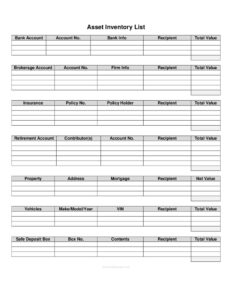
Asset Inventory
Use this free Asset Inventory template to record bank, brokerage, property, and insurance assets in one place — free download in PDF and DOCX.
PDF
DOC
5 downloads
0
likes
Download Files
- DOC
An Asset Inventory is a single document that lists everything you own — bank accounts, investments, insurance policies, retirement funds, property, vehicles, and more — along with their value and who is meant to receive them. People most often create one to support estate planning, keep family members informed, or simply track net worth in one organized place. This template is free to download in PDF and DOCX, with no signup required.
What Is an Asset Inventory?
An Asset Inventory is a structured record that catalogs a person’s or household’s financial and physical assets in one place. It is typically maintained by an individual, a couple, an executor, or a financial planner. Rather than leaving account numbers and policy details scattered across drawers, emails, and statements, the inventory consolidates them so the information is easy to find and update. It documents what each asset is, where it is held, its identifying number, its value, and — in this template — the intended recipient. This makes it a practical reference for estate planning, settling an estate, applying for benefits, or reviewing your overall financial picture at a glance.
When Do You Need an Asset Inventory?
An Asset Inventory becomes valuable any time you need a clear, complete picture of what you own and where it lives. Common situations include:
- Estate planning — to accompany a will or trust and show your executor exactly what assets exist and who should receive them.
- Settling an estate — when an executor or family member must locate and value accounts, policies, and property after a death.
- Tracking net worth — to combine bank balances, brokerage holdings, and property values minus mortgages and credit balances.
- Applying for loans or benefits — when a lender or agency asks for a summary of assets and liabilities.
- Organizing finances after marriage or divorce — to separate or combine accounts and clarify ownership.
- Emergency preparedness — so a trusted person can step in quickly if you become incapacitated.
What an Asset Inventory Should Have
A complete inventory captures enough detail that someone unfamiliar with your finances could locate and identify each asset. For every entry, that means the type of asset, the institution or location, a reference or account number, the current or net value, and the intended recipient. This template groups assets into clear categories — bank accounts, brokerage accounts, insurance policies, retirement accounts, property, vehicles, safe deposit boxes, and credit accounts — so nothing is overlooked. It distinguishes total value (gross worth) from net value (value after debts like a mortgage), which matters for an accurate financial snapshot. Dating the inventory and noting where supporting documents are stored further strengthens it.
How to Fill Out an Asset Inventory
- Bank Account: Enter the bank name and Bank Info, the Account No., the intended Recipient, and the Total Value (current balance).
- Brokerage Account: List the Firm Info, Account No., Recipient, and Total Value of the holdings in that account.
- Insurance: Record the Policy No., the Policy Holder, the Recipient (often the named beneficiary), and the Total Value or death benefit.
- Retirement Account: Note the Contributor(s), Account No., Recipient, and Total Value for each IRA, 401(k), or pension.
- Property: Enter the Address, any outstanding Mortgage, the Recipient, and the Net Value (market value minus the mortgage balance).
- Vehicles: Provide the Make/Model/Year, the VIN, the Recipient, and the Total Value.
- Safe Deposit Box: List the Box No., a description of Contents, the Recipient, and the Total Value of those contents.
- Credit: Record the Account No., the Lender Info, the Recipient responsible, and the Total Value (outstanding balance owed).
Work through each section in order, leaving blank any category that does not apply to you.
Total Value vs. Net Value
This inventory deliberately uses two different value labels, and understanding the difference keeps your numbers honest. Total Value reflects the full gross worth of an asset — for example, the balance in a bank account or the death benefit of a policy. Net Value, used for property, reflects what remains after subtracting attached debt such as a mortgage. A house worth $400,000 with a $250,000 mortgage has a net value of $150,000. Credit accounts represent liabilities rather than assets, so their balances reduce your overall financial position. When you total everything, subtract credit and other debts from your assets to arrive at a realistic net worth figure.
Keeping It Current and Secure
An Asset Inventory is only useful if it is up to date and stored safely. Because it contains account numbers, policy numbers, and a VIN, treat it as sensitive. Store the master copy in a locked drawer, a fireproof safe, or an encrypted file, and tell one trusted person where to find it. Review the inventory at least once a year and after major life events — buying a home, opening or closing an account, paying off a loan, or changing a beneficiary. Note the date of each update so anyone reading it knows how recent the figures are.
Common Mistakes to Avoid
- Recording full passwords or PINs on the inventory, which creates a security risk if the document is lost or stolen.
- Confusing total and net value — entering a property’s market price without subtracting the mortgage overstates your worth.
- Leaving the recipient blank, which defeats the purpose of the document for estate-planning use.
- Letting balances go stale by never revisiting the inventory after the first draft.
- Omitting smaller accounts or assets such as a forgotten brokerage account or a safe deposit box.
- Assuming the inventory replaces a will — it organizes information but does not legally transfer ownership.
Frequently Asked Questions
What is an Asset Inventory used for? It is used to list and organize everything you own — bank accounts, investments, insurance, retirement funds, property, vehicles, and more — in one place. People rely on it for estate planning, tracking net worth, and helping family or an executor locate assets quickly. It serves as a reference rather than a legal transfer document.
Is an Asset Inventory legally binding? No, the inventory itself does not transfer ownership or override a will, trust, or beneficiary designation. The “Recipient” column states your intent, but actual transfers are governed by your estate documents and account beneficiary forms. Keep the inventory consistent with those legal instruments.
How do I fill out the value columns? Use Total Value for the full gross amount of an asset, such as an account balance or insurance benefit. Use Net Value for property, entering the market value minus the outstanding mortgage. For credit accounts, the value is the balance you owe, which counts against your overall net worth.
Does an Asset Inventory need to be notarized? Notarization is generally not required for a personal asset inventory, since it is an informational record rather than a binding contract. Some people choose to share it with their attorney or attach it to estate documents. Check whether your specific estate-planning process calls for any additional formalities.
How often should I update it? Review and update your inventory at least once a year, and immediately after major changes such as opening or closing accounts, buying or selling property, paying off a loan, or naming a new beneficiary. Always note the date of the latest update so the figures stay meaningful.
Is this Asset Inventory template free? Yes. You can download it free in PDF and DOCX formats with no signup required. The DOCX version is fully editable so you can add or remove categories to match your own assets.
This Asset Inventory template is a general example provided for informational purposes only and is not legal, financial, or tax advice. Requirements and best practices vary by jurisdiction and personal circumstance — consult a qualified attorney or financial professional before relying on it for estate planning or other decisions.
Related Forms
- Weekly Music Practice Log
- Trip Itinerary
- Weekly Bathroom Cleaning Checklist
- Collectibles Inventory
- Company Growth Chart
- Cleaning Log By Room
Browse more in Log and Inventory.