
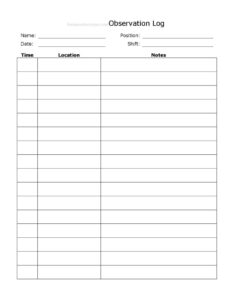
Observation Log
Record what you see clearly with a free Observation Log template — track dates, times, locations, and notes. Free download in PDF and DOCX.
PDF
DOCX
5 downloads
0
likes
Download Files
- DOCX
An Observation Log is a structured record used to document what you observe over time — capturing the date, time, location, and details of each event in one place. People most often use it to create a reliable, chronological account they can refer back to later, whether for a classroom study, a workplace safety review, or behavioral monitoring. This template is completely free to download in both PDF and DOCX formats, with no signup required.
What Is an Observation Log?
An Observation Log is a simple document that organizes individual observations into dated, time-stamped entries. It is used by teachers, researchers, caregivers, supervisors, security personnel, scientists, and clinicians to write down exactly what they saw, when, and where — along with any relevant context. Rather than relying on memory, the observer records each event as it happens, building a factual timeline that can be reviewed, compared, or shared. The log documents observable facts (what occurred) and may separate those facts from interpretations (what they might mean). Because it is dated and sequential, an Observation Log provides accountability and continuity, making patterns and changes easier to spot across many entries.
When Do You Need an Observation Log?
Observation Logs are useful any time consistent, recorded watching is required. Common situations include:
- Classroom and education: A teacher or aide tracking a student’s behavior, participation, or progress over several weeks.
- Research and field studies: Documenting animal behavior, plant growth, or environmental conditions during a study.
- Workplace safety: Recording near-misses, hazards, or compliance checks observed on a job site.
- Healthcare and caregiving: Noting a patient’s symptoms, mood, sleep, or response to treatment throughout the day.
- Security and facilities: Logging activity, incidents, or unusual events during a shift or patrol.
- Childcare and parenting: Tracking developmental milestones, eating, or sleeping patterns for a young child.
Types of Observation Logs
While the format stays similar, the focus shifts with the setting. A behavioral observation log centers on actions and triggers; a scientific field log emphasizes measurable conditions; a safety observation log records hazards and corrective actions; and a medical or care log documents symptoms and responses over time. This template works for all of them — you simply adapt the notes column to your purpose.
What an Observation Log Should Have
A complete, useful Observation Log includes a few core elements that make each entry meaningful and verifiable:
- Date and time of each observation, so events can be placed in sequence.
- Location or setting where the observation took place.
- Observer’s name for accountability and follow-up questions.
- Subject or focus being observed (a person, group, process, or condition).
- A clear description of what was actually seen or heard.
- Optional notes or actions for interpretation, follow-up, or recommendations.
Keeping these columns consistent across every entry is what turns a pile of notes into a dependable record.
How to Fill Out an Observation Log
Follow these steps to complete each entry accurately:
- Add a title and purpose at the top, identifying the project, class, study, or shift the log covers.
- Enter the observer’s name so it is clear who recorded the entries.
- Record the date for the observation, using a consistent format throughout.
- Note the time the observation began (and ended, if relevant), since timing often matters as much as the event itself.
- Write the location or setting — the room, site, habitat, or area where you observed.
- Identify the subject or focus being observed, such as a student, patient, animal, or process.
- Describe what you observed in plain, factual language: what happened, what was said or done, and any measurements.
- Add interpretations or follow-up in a separate notes column, clearly distinguished from the factual description.
- Sign or initial the entry if your setting requires verification, then move to the next blank row for the following observation.
Tips for Writing Objective Observations
The value of an Observation Log depends on the quality of what you write. Aim to record facts — what you can see, hear, or measure — and keep your assumptions in a separate notes field. For example, write “child sat alone and did not respond to two questions” rather than “child was sad.” Record entries as soon as possible after the event, while details are fresh, and use specific times instead of vague phrases like “this morning.” If you measure anything, include units. Consistency matters: use the same terms and categories across entries so you can later compare them and detect real patterns rather than differences in wording.
Storing and Reviewing Your Logs
An Observation Log is most powerful when reviewed over time. Keep completed logs in a dated folder, whether printed or digital, and back up electronic copies. When a log contains personal or sensitive information — such as details about a student, patient, or employee — store it securely and limit access to those who need it, following any privacy rules that apply to your field. Periodically read through past entries to summarize trends, which can inform decisions, reports, or conversations with colleagues, families, or supervisors.
Common Mistakes to Avoid
- Mixing facts with opinions — keep observed events separate from your interpretations.
- Leaving out the date or time, which makes entries impossible to place in sequence.
- Filling it in from memory days later, when important details have already faded.
- Using vague language like “a lot” or “sometimes” instead of specific, countable details.
- Skipping the observer’s name, so no one knows who recorded an entry or can answer questions.
- Being inconsistent with terms, categories, or formats from one entry to the next.
Frequently Asked Questions
What is an Observation Log used for? It is used to document observations in a dated, organized way so you have a reliable record to refer back to. People use it in classrooms, research, healthcare, workplaces, and security to track behavior, conditions, or events over time. The log helps reveal patterns that single observations would miss.
How do I fill out an Observation Log? Add a title and the observer’s name, then for each entry record the date, time, location, the subject being observed, and a factual description of what you saw. Keep interpretations in a separate notes column. Complete each entry as soon as possible after the observation for accuracy.
What’s the difference between an observation and an interpretation? An observation is something you can directly see, hear, or measure, such as “the employee did not wear gloves.” An interpretation is your conclusion about why, such as “the employee was careless.” Good logs record observations factually and keep interpretations clearly separate.
Is an Observation Log a legal document? On its own it is simply a record, but in some fields it may be referenced in reviews, investigations, or reports. To strengthen its reliability, record entries promptly, stick to facts, and have the observer sign or initial them. Always follow your organization’s documentation policies.
How much does this Observation Log template cost? It is completely free to download from Business Forms Pro in both PDF and DOCX formats, with no signup or payment required. You can print it as-is or edit the DOCX version to match your specific setting.
Can I customize the Observation Log for my needs? Yes. The DOCX version lets you rename columns, add fields, or adjust the layout for a classroom, lab, job site, or care setting. Tailor the description and notes sections to capture exactly what matters for your purpose.
This Observation Log template is provided as a general example for informational purposes only and does not constitute legal, medical, or professional advice. Documentation and privacy requirements vary by jurisdiction and field — consult a qualified professional to ensure your records meet the standards that apply to your situation.
Related Forms
- Beauty Salon Equipment And Furniture Inventory Card
- Side Hustle Expenses Log
- Prospect List
- Donations Tracker Thermometer
- Meeting Minutes
- Collectibles Inventory
Browse more in Log and Inventory.