
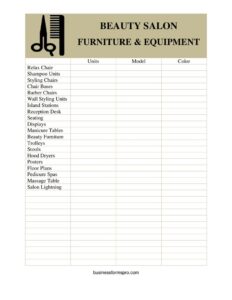
Beauty Salon Equipment And Furniture Inventory Card
Track every styling chair, dryer, and station with this free Beauty Salon Equipment and Furniture Inventory Card template — free download in PDF and DOCX.
PDF
DOCX
4 downloads
0
likes
Download Files
- DOCX
The Beauty Salon Equipment and Furniture Inventory Card is a simple record sheet for listing every chair, station, dryer, and fixture inside your salon. Owners and managers most often use it to know exactly what they own, where it sits, and what condition it is in. It is free to download in both PDF and DOCX formats, with no signup required.
What Is a Beauty Salon Equipment and Furniture Inventory Card?
A Beauty Salon Equipment and Furniture Inventory Card is a structured log that captures the major physical assets used to run a salon. It typically records the quantity of each item, plus identifying details like model and color, so the list reflects the real floor rather than a vague memory. The card covers service-area pieces such as styling chairs, shampoo units, and hood dryers, alongside furnishings like the reception desk, seating, and display units. Salon owners, managers, and bookkeepers issue and maintain it to support insurance claims, lease handovers, resale valuations, and routine maintenance planning. Because it is item-specific rather than generic, the card doubles as a quick reference whenever someone needs to count, locate, or describe a piece of salon equipment.
When Do You Need a Beauty Salon Equipment and Furniture Inventory Card?
- Opening or relocating a salon — to confirm every styling chair, manicure table, and pedicure spa arrived and was installed before the doors open.
- Filing an insurance policy or claim — insurers want a documented list with quantities, models, and colors to value relax chairs, massage tables, and salon lighting.
- Buying or selling a salon — a buyer needs a verified asset list, and a seller needs proof of what is included in the sale.
- Annual stocktakes and audits — to reconcile what is physically present against the books for chair bases, trolleys, and stools.
- Lease move-out or landlord handover — to separate your owned furniture from fixtures attached to the building.
- Maintenance and replacement planning — to flag worn shampoo units or aging hood dryers before they fail mid-service.
What a Salon Inventory Card Should Have
A complete card should clearly separate each asset type and give enough detail to identify it without guesswork. At minimum it needs the item name, the number of units, and distinguishing attributes such as model and color. For a salon specifically, that means dedicated lines for relax chairs, shampoo units, styling chairs, chair bases, barber chairs, wall styling units, island stations, reception desk, seating, displays, manicure tables, general beauty furniture, trolleys, stools, hood dryers, posters, floor plans, pedicure spas, massage tables, and salon lighting. Leaving room for notes on condition and location turns a flat count into a working reference document.
How to Fill Out a Beauty Salon Equipment and Furniture Inventory Card
- Start with the high-traffic service furniture: enter the number of Styling Chairs, Barber Chairs, and Relax Chairs under Units, then record each Model and Color.
- Log the Shampoo Units and their matching Chair Bases, noting any model differences across stations.
- Count the Wall Styling Units and Island Stations, which are often the most valuable fixed assets on the floor.
- Record the Reception Desk, waiting-area Seating, and retail Displays at the front of house.
- Move to nail and treatment areas: list Manicure Tables, Pedicure Spas, and any Massage Table.
- Add the mobile and support items — Trolleys, Stools, and general Beauty Furniture — with quantities.
- Note the Hood Dryers by model and color, since these vary in age and value.
- Finish with the ambiance and décor lines: Posters, Floor Plans, and Salon Lighting fixtures.
Work station by station, left to right, so nothing on the floor is skipped. When in doubt, take a quick photo to attach to the card for later reference.
Tips for Keeping the Inventory Accurate
An inventory card is only as useful as it is current. Update it every time you add, replace, or retire a piece — for example when a worn shampoo unit is swapped out or a new island station is installed. Many salons keep one master card and re-verify it during a slow week each quarter. Recording the model and color is not busywork: it lets you reorder matching pieces, identify exactly which barber chair failed warranty, and prove ownership if items are mixed up during a renovation. Store a dated copy digitally as a backup, since a single paper card can be lost or damaged in a busy environment. A consistent naming convention for each station also makes recounts faster.
Inventory Card vs. Asset Register
This card is a practical floor-level snapshot, not a full accounting asset register. The inventory card tells you what is physically present and how it looks — counts, models, and colors of chairs, dryers, and stations. A formal asset register adds purchase dates, costs, depreciation, and serial numbers for tax and bookkeeping. Many salons use the inventory card as the front-line count that feeds into a more detailed register kept by their accountant. For day-to-day operations, insurance summaries, and handovers, the card is usually enough on its own.
Common Mistakes to Avoid
- Leaving the Units column blank — a model and color with no quantity makes the count meaningless during an audit.
- Ignoring color and model details — without them you cannot tell matching styling chairs apart or reorder the right replacement.
- Forgetting the small items — trolleys, stools, and posters add up, and skipping them understates the value of the salon.
- Mixing owned items with leased fixtures — note which wall styling units or lighting belong to the landlord to avoid disputes at move-out.
- Never updating after changes — an inventory that ignores a swapped hood dryer or new pedicure spa quickly becomes unreliable.
- Keeping only a single paper copy — without a digital backup, one spill or misplaced card erases the whole record.
Frequently Asked Questions
What is a Beauty Salon Equipment and Furniture Inventory Card used for? It is used to list and count the salon’s physical assets — chairs, shampoo units, stations, dryers, and furniture — along with their model and color. Owners rely on it for insurance, stocktakes, sales, and maintenance planning. It gives a clear, shareable picture of everything on the floor.
How do I fill it out? Walk through the salon station by station, entering the number of units for each item and recording its model and color. Cover service furniture first, then reception and retail, then nail and treatment areas, and finish with décor and lighting. Adding a photo or condition note makes each entry more useful.
Is this inventory card legally binding? On its own it is simply a record, not a contract. However, it can be referenced or attached to a binding document such as a sale agreement or lease handover, in which case its accuracy matters. Always have both parties confirm the list before signing anything that relies on it.
Does it need to be notarized or witnessed? No, a standard inventory card does not require notarization or witnesses. If it forms part of a salon sale or lease transfer, the parties may choose to sign and date it for clarity. For routine internal use, a simple dated record is sufficient.
How much does this template cost? Nothing — it is a free download in both PDF and DOCX formats with no signup required. You can print the PDF for a clipboard walkthrough or edit the DOCX to add your own item rows. Use it as often as you need across multiple locations.
Can I add items that are not on the list? Yes. The DOCX version is editable, so you can add lines for items like wash basins, towel warmers, or color bars that are specific to your salon. Keep the same Units, Model, and Color structure so the card stays consistent and easy to read.
This template is provided as a general example for informational purposes only and is not legal, financial, insurance, or tax advice. Inventory, insurance, and asset-record requirements vary by jurisdiction and policy — consult a qualified professional before relying on this card for any formal purpose.
Related Forms
- Amateur Radio Station Log
- Vehicle Maintenance Log
- Basic Inventory Card
- Computer Fault List
- Price List
- Circuit Breakers
Browse more in Log and Inventory.