
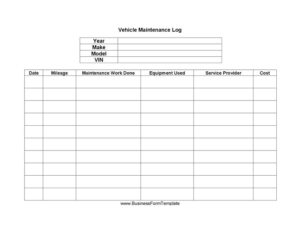
Vehicle Maintenance Log
Track service history, mileage, and repair costs with our free Vehicle Maintenance Log template — download in PDF or DOCX, no signup required.
PDF
1 downloads
0
likes
Download Files
A Vehicle Maintenance Log is a simple record sheet for tracking every service, repair, and inspection performed on a car, truck, van, or fleet vehicle. People use it most often to keep an organized service history that protects warranty coverage and boosts resale value. You can download this template free in both PDF and DOCX formats, with no signup required.
What Is a Vehicle Maintenance Log?
A Vehicle Maintenance Log is a structured document that records the maintenance and repair activity for a single vehicle over time. It captures identifying details like year, make, model, and VIN, along with a dated, line-by-line history of every service performed, the mileage at the time, who did the work, what equipment or parts were used, and how much it cost. Vehicle owners, fleet managers, mechanics, and rental companies all rely on it to prove that scheduled maintenance was completed on time. Whether you maintain one family car or a fleet of delivery trucks, the log creates a single, trustworthy source of truth for the vehicle’s mechanical history.
When Do You Need a Vehicle Maintenance Log?
This log is useful any time you want a reliable, written record of a vehicle’s care. Common situations include:
- Protecting a manufacturer warranty — many warranties require proof that scheduled oil changes and inspections were performed on time.
- Selling a used vehicle — a complete service history reassures buyers and supports a higher asking price.
- Managing a business fleet — tracking maintenance across multiple vehicles to avoid breakdowns and plan budgets.
- Following a preventive maintenance schedule — logging mileage so you know when the next tire rotation, brake check, or fluid flush is due.
- Claiming tax deductions or reimbursement — keeping itemized repair costs for business or self-employment records.
- Tracking a leased or rented vehicle — documenting condition and upkeep before the return inspection.
What a Vehicle Maintenance Log Should Have
A complete log starts with the vehicle’s permanent identifiers and then captures a repeatable set of fields for every service entry. The identifying section should list the year, make, model, and VIN so the record is tied to one specific vehicle. Each maintenance entry should record the date, the mileage at the time of service, a description of the maintenance work done, any equipment or parts used, the service provider who performed it, and the cost. Together these fields create a chronological history that answers what was done, when, by whom, and at what price — the four questions every buyer, mechanic, or warranty department wants answered.
How to Fill Out a Vehicle Maintenance Log
- Year: Enter the model year of the vehicle, found on the registration or driver’s door jamb.
- Make: Write the manufacturer, such as Toyota, Ford, or Honda.
- Model: Record the specific model name, like Camry, F-150, or Civic.
- VIN: Copy the 17-character Vehicle Identification Number exactly — check it against the dashboard plate or registration.
- Date: For each service, enter the date the work was completed.
- Mileage: Note the odometer reading at the time of service so you can track intervals.
- Maintenance work done: Describe the service clearly — for example, “oil and filter change,” “front brake pads replaced,” or “tire rotation.”
- Equipment used: List parts, fluids, or tools used, such as “5W-30 synthetic oil” or “OEM brake pads.”
- Service provider: Record who performed the work — a dealership, an independent shop, or yourself for DIY jobs.
- Cost: Enter the total amount paid, including parts and labor, to keep a running expense record.
Building a Preventive Maintenance Routine
The real value of a maintenance log comes from using it proactively rather than just recording the past. Compare the mileage column against your owner’s manual recommended intervals to anticipate the next due service. Many owners color-code or highlight recurring items — oil changes every few thousand miles, tire rotations at each rotation interval, and timing belt or transmission service at major milestones. By scanning previous entries, you can spot patterns, such as a part that fails repeatedly, and address the underlying issue before it leaves you stranded. For fleets, reviewing the log monthly helps schedule downtime efficiently and forecast parts orders. A well-kept log turns reactive repairs into planned, lower-cost maintenance.
Paper, Spreadsheet, or App?
This template works well as a printed sheet kept in the glove box, a fillable DOCX you update on a computer, or a starting point for a spreadsheet. A paper copy is convenient at the shop and survives a dead phone battery, while a digital version is easy to back up and search. Whichever format you choose, keep the same fields consistent across every entry so the history stays comparable. If you manage several vehicles, use one log per VIN to keep records clean and avoid mixing service histories.
Common Mistakes to Avoid
- Skipping entries: A log with gaps undermines warranty claims and buyer confidence — record every service, even minor ones.
- Forgetting the mileage: Without the odometer reading, you can’t track service intervals accurately.
- Entering the wrong VIN: A mistyped VIN can disconnect the record from the vehicle; double-check all 17 characters.
- Vague descriptions: “Service” tells you nothing later — note exactly what was done and which parts were used.
- Losing receipts: The cost field is most useful when backed by invoices, so file or attach them.
- Mixing vehicles on one log: Keep a separate log for each VIN to avoid confusing service histories.
Frequently Asked Questions
What is a Vehicle Maintenance Log used for? It is used to keep an organized, dated record of every service and repair performed on a vehicle. Owners rely on it to maintain warranty coverage, plan preventive maintenance, support resale value, and track repair expenses. It is essentially the vehicle’s medical chart.
How do I fill out a Vehicle Maintenance Log? First record the vehicle’s year, make, model, and VIN at the top. Then, for each service, add a new line with the date, mileage, work performed, equipment or parts used, the service provider, and the cost. Update it every time the vehicle is serviced to keep the history complete.
Does a maintenance log need to be notarized or signed? No. A Vehicle Maintenance Log is an internal record, not a legal contract, so it does not require notarization or witnesses. Some owners ask the service provider to initial or attach an invoice to each entry for added credibility, but this is optional.
Is a maintenance log required to keep my warranty valid? Manufacturers generally require proof that scheduled maintenance was performed, and a detailed log plus receipts is one of the best ways to provide it. Requirements vary by manufacturer and warranty type, so review your specific warranty terms and keep supporting invoices alongside the log.
Can I use this log for multiple vehicles or a fleet? Yes, but it works best to use one separate log per vehicle so each VIN has its own clean history. For a fleet, keep a folder or digital file with one log per vehicle, which makes it easy to review service status and budget for upcoming maintenance.
How much does this template cost? Nothing — it is completely free to download from Business Forms Pro in both PDF and DOCX formats, with no signup or account required. You can print it for the glove box or edit the DOCX version on your computer.
This template is a general example provided for informational purposes only and is not legal, financial, or tax advice. Maintenance and warranty requirements vary by manufacturer and jurisdiction. Consult your owner’s manual, warranty terms, or a qualified professional for guidance specific to your vehicle.
Related Forms
- Fire Emergency Checklist
- Daily Music Practice Log
- Bill Payment Reminder
- Vehicle Repair Log
- Trip Itinerary
- Petsitter Daily Log
Browse more in Log and Inventory.