
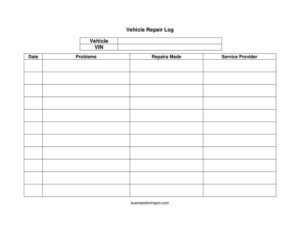
Vehicle Repair Log
Track every repair on your car or fleet with this free Vehicle Repair Log template, available as a free PDF and DOCX download with no signup.
PDF
DOCX
3 downloads
0
likes
Download Files
- DOCX
A Vehicle Repair Log is a simple record that documents every repair and service performed on a vehicle, including what went wrong, what was fixed, and who did the work. People most commonly use it to keep an organized maintenance history that protects resale value and supports warranty or insurance claims. It’s free to download here in both PDF and DOCX formats, with no signup required.
What Is a Vehicle Repair Log?
A Vehicle Repair Log is a running record of all repairs and mechanical work carried out on a specific car, truck, van, or piece of fleet equipment. It is typically maintained by a vehicle owner, a fleet manager, a service department, or a small business that depends on its vehicles. The log captures the vehicle’s identity, the date of each visit, the reported problem, the repair that was performed, and the name of the service provider who completed it. Together these entries build a chronological history that proves how a vehicle has been cared for over time, making it easier to spot recurring issues, plan budgets, and demonstrate diligence when selling or filing a claim.
When Do You Need a Vehicle Repair Log?
Almost anyone who owns or manages a vehicle benefits from keeping a written repair history. A Vehicle Repair Log proves especially valuable in these situations:
- Selling a used vehicle — a documented repair history reassures buyers and can justify a higher asking price.
- Managing a fleet — businesses tracking multiple delivery trucks, service vans, or company cars need a clear record for each unit.
- Filing warranty or insurance claims — manufacturers and insurers often request proof that required repairs and maintenance were performed.
- Diagnosing recurring problems — a log reveals patterns, such as a brake issue or electrical fault that keeps coming back.
- Budgeting for repair costs — reviewing past entries helps you anticipate upcoming expenses and decide when a vehicle is no longer worth fixing.
- Tax and expense reporting — self-employed drivers and businesses use the log to support deductible vehicle maintenance expenses.
What a Vehicle Repair Log Should Have
A complete and useful repair log should clearly identify the vehicle and document each repair in enough detail to be meaningful months or years later. At minimum it should include the vehicle description, its VIN for unambiguous identification, the date of each repair, a description of the reported problem, the specific repairs that were made, and the service provider who performed the work. Many users also add the mileage at the time of service, the cost, and any parts replaced. The more consistent and detailed your entries, the more valuable the log becomes as a complete maintenance record.
How to Fill Out a Vehicle Repair Log
- Vehicle: Enter the year, make, and model of the vehicle (for example, “2018 Toyota Camry”). If you maintain logs for several vehicles, give each its own sheet so entries don’t get mixed up.
- VIN: Record the 17-character Vehicle Identification Number, found on the dashboard near the windshield or inside the driver’s door jamb. This uniquely identifies the vehicle and prevents confusion between similar models.
- Date: Write the date the repair was performed or the vehicle was dropped off. Keeping entries in chronological order makes the history easy to follow.
- Problems: Describe the symptom or issue that prompted the visit, such as “grinding noise when braking” or “check engine light on.” Be specific so you can later spot recurring faults.
- Repairs made: Note what was actually done to fix the problem — for instance, “replaced front brake pads and rotors” or “replaced oxygen sensor.” Include parts replaced if known.
- Service provider: Record the shop, dealership, or technician who performed the work, including a phone number if you want quick reference for follow-up.
Tips for Keeping an Accurate Repair Record
Update the log immediately after each repair while details are fresh, and staple or scan your receipts and invoices to back up each entry. Adding the odometer reading next to the date turns the log into a mileage-based maintenance timeline, which is especially helpful for scheduled services like oil changes, timing belts, and transmission flushes. Use consistent wording for recurring problems so they’re easy to search and compare. If you manage a fleet, store all logs in one folder — digital or physical — and review them periodically to identify vehicles that are costing more than they’re worth to keep on the road.
Repair Log vs. Maintenance Schedule
A repair log and a maintenance schedule serve related but different purposes. A maintenance schedule looks forward, listing the routine services a vehicle needs at certain mileage or time intervals, such as oil changes and tire rotations. A Vehicle Repair Log looks backward, documenting what has actually been done — including unplanned repairs and breakdowns. Many owners keep both: the schedule tells them what’s coming up, and the log proves what’s already been handled. Combining them gives a complete picture of a vehicle’s health and helps you make smarter decisions about repairs, trade-ins, and replacements.
Common Mistakes to Avoid
- Leaving the VIN blank — without it, the log may not be tied conclusively to the right vehicle, which weakens its value during a sale or claim.
- Vague problem descriptions — “car not working” tells you nothing later; describe the actual symptom.
- Skipping entries — a log with gaps loses credibility and may miss the recurring issues you’re trying to track.
- Not recording the service provider — you may need to return for warranty work or ask follow-up questions.
- Mixing multiple vehicles on one sheet — keep a separate log per vehicle to avoid confusion.
- Failing to keep receipts — the log is strongest when backed by invoices that confirm the work and cost.
Frequently Asked Questions
What is a Vehicle Repair Log used for? It is used to document every repair performed on a vehicle, including the problem, the fix, the date, and the service provider. This creates a maintenance history that supports resale value, warranty claims, and budgeting. It also helps owners spot recurring mechanical issues over time.
How do I fill out a Vehicle Repair Log? Enter the vehicle description and VIN at the top, then add a new row for each repair with the date, the reported problem, the repairs made, and the service provider. Keep entries in chronological order and update the log right after each service. Attaching receipts makes each entry stronger.
Is a Vehicle Repair Log a legal document? It is primarily a record-keeping tool rather than a binding legal contract, but it can serve as supporting evidence during a sale, an insurance claim, or a warranty dispute. Its usefulness depends on accuracy and consistency. Keeping receipts alongside the log strengthens its credibility.
Do I need to include the VIN? Including the VIN is strongly recommended because it uniquely identifies the vehicle and ties the repair history to that specific car or truck. This is especially important when selling a vehicle or maintaining logs for several vehicles. You can find the VIN on the dashboard or the driver’s door jamb.
Can I use one log for my whole fleet? It’s better to keep a separate log for each vehicle so entries stay clear and easy to review. You can store all the individual logs together in one binder or folder for fleet management. This approach lets you compare costs across vehicles without mixing up records.
How much does this Vehicle Repair Log template cost? It is completely free to download from Business Forms Pro in both PDF and DOCX formats, with no signup required. You can print it for handwritten use or fill it in digitally with the editable DOCX version. Use and reuse it for as many vehicles as you need.
This Vehicle Repair Log template is provided as a general example for informational purposes only and does not constitute legal, financial, or professional automotive advice. Warranty, insurance, and record-keeping requirements vary by manufacturer and jurisdiction. Consult a qualified professional for guidance specific to your situation.
Related Forms
- Change Log
- General Journal
- Auto Maintenance Log
- Flood Emergency Checklist
- Beer Cider Tasting Log
- Weekly Music Practice Log
Browse more in Log and Inventory.