
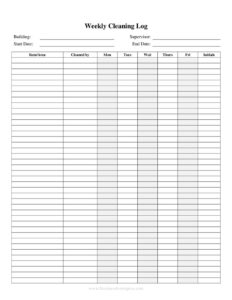
Weekly Cleaning Log
Track and verify daily cleaning tasks with this free Weekly Cleaning Log template, available as a free download in PDF and DOCX formats.
PDF
DOCX
8 downloads
0
likes
Download Files
- DOCX
A Weekly Cleaning Log is a simple tracking sheet used to record which cleaning tasks were completed, when, and by whom over the course of a week. People most often use it to prove that scheduled cleaning routines are actually being followed in workplaces, kitchens, restrooms, and shared spaces. It’s free to download here in both PDF and DOCX formats, with no signup required.
What Is a Weekly Cleaning Log?
A Weekly Cleaning Log is a structured record that lists cleaning tasks down one side and the days of the week across the top, allowing staff to initial or check off each task as it’s finished. It is typically issued by a facilities manager, business owner, supervisor, or homeowner and completed by the people who perform the cleaning. The log documents the date, the specific task, the area cleaned, the person responsible, and any supervisor sign-off. Its purpose is to create accountability, maintain consistent hygiene standards, and provide written evidence that routine maintenance is happening on schedule. In regulated environments such as food service or healthcare, it also supports compliance during inspections.
When Do You Need a Weekly Cleaning Log?
This log is useful any time cleaning needs to be tracked consistently rather than left to memory. Common scenarios include:
- Restaurants and commercial kitchens verifying that surfaces, equipment, and floors are sanitized daily for health inspections.
- Office buildings and coworking spaces documenting that restrooms, break rooms, and high-touch surfaces are cleaned on a set rotation.
- Schools, daycares, and gyms maintaining hygiene records for shared equipment, mats, and play areas.
- Medical and dental offices tracking disinfection of treatment rooms, waiting areas, and reception counters.
- Rental properties and Airbnb turnovers showing that units were thoroughly cleaned between guests.
- Cleaning companies giving clients a transparent, signed record of completed service visits.
Types of Cleaning Logs
While this template focuses on a weekly view, cleaning records come in several formats. A daily log captures task-by-task detail on a single shift. A weekly log, like this one, balances detail with an at-a-glance overview of the whole week. A monthly log tracks deep-cleaning tasks that happen less often, such as vent cleaning or carpet shampooing. Many organizations use a combination: a weekly log for routine duties and a separate schedule for periodic deep cleans. Choosing the weekly format keeps the sheet manageable while still showing patterns and gaps.
What a Weekly Cleaning Log Should Have
A complete and useful Weekly Cleaning Log includes a few essential elements:
- A header identifying the business, department, or location being cleaned.
- The week’s date range so each sheet covers a clear period.
- A list of specific cleaning tasks or areas down the left column.
- Columns for each day of the week (Monday through Sunday).
- Space for initials or a checkmark confirming completion.
- A field for the cleaner’s name and a supervisor verification or sign-off line.
- Optional notes section for issues, supplies needed, or skipped tasks.
How to Fill Out a Weekly Cleaning Log
- Enter the location and week. At the top, write the business name, the specific area or department, and the date range the log covers (for example, the Monday and Sunday dates).
- List the tasks. In the left column, write each cleaning task or zone—such as “mop floors,” “sanitize counters,” “empty trash,” or “clean restrooms.”
- Identify the days. Confirm the day columns are labeled correctly across the top of the grid.
- Mark completion. As each task is finished, the cleaner places their initials or a checkmark in the cell where the task row meets the correct day column.
- Record the cleaner’s name. Each person completing tasks should add their name so initials can be matched to a responsible individual.
- Add notes. Use the notes area to flag anything unusual, like a broken fixture, low supplies, or a task that couldn’t be completed.
- Obtain sign-off. At the end of the day or week, a supervisor reviews the log and signs to verify the work was inspected and approved.
Tips for Getting the Most From Your Cleaning Log
Keep blank copies posted on a clipboard near the cleaning supplies so the log is filled out in real time rather than from memory at the end of the week. Be specific with task names—”wipe door handles and light switches” is far more verifiable than a vague “tidy up.” Store completed logs in a binder or scanned folder by date so you can produce records quickly during an inspection or client review. If different shifts share responsibility, color-coding initials or assigning a unique mark per person makes accountability clear. Review the notes column weekly to spot recurring problems, such as a supply that always runs out or a task that’s consistently skipped.
Common Mistakes to Avoid
- Backfilling the log. Filling in a whole week at once defeats the purpose and creates inaccurate records.
- Vague task descriptions. Generic entries make it impossible to confirm exactly what was cleaned.
- Using checkmarks without initials. A check shows a task was done but not who did it, weakening accountability.
- Skipping the supervisor sign-off. Without verification, the log is just an unconfirmed to-do list.
- Not dating the sheet. Undated logs are nearly useless during audits or disputes.
- Losing completed logs. Failing to file and retain sheets means you can’t prove compliance later.
Frequently Asked Questions
What is a Weekly Cleaning Log used for? It is used to record and verify that scheduled cleaning tasks are completed each day of the week. Businesses rely on it for accountability, hygiene compliance, and to demonstrate to inspectors or clients that routine cleaning is actually being performed.
How do I fill out a Weekly Cleaning Log? List your cleaning tasks down the left side and mark each one with initials or a checkmark under the day it was completed. Add the location, date range, cleaner’s name, any notes, and a supervisor signature to verify the work.
Is a Weekly Cleaning Log legally required? It depends on your industry and location. Food service, healthcare, and childcare settings often have hygiene documentation requirements, and a cleaning log helps meet them, but rules vary by jurisdiction—check your local health and safety regulations.
Who should sign the cleaning log? The person who performs each task should initial it, and a supervisor or manager typically reviews and signs the completed log to confirm the work meets standards. This two-step verification strengthens the record’s reliability.
How long should I keep completed cleaning logs? Retention periods vary by industry and local regulation, but many businesses keep them for at least one to two years for inspection and liability purposes. When in doubt, follow the guidance set by your health authority or compliance program.
Is this Weekly Cleaning Log template free? Yes. You can download it completely free in both PDF and DOCX formats with no signup required, and edit the tasks and columns to match your specific cleaning routine.
This Weekly Cleaning Log template is provided as a general example for informational purposes only and is not legal, health, or compliance advice. Cleaning and recordkeeping requirements vary by industry and jurisdiction—consult a qualified professional or your relevant regulatory authority to ensure your records meet applicable standards.
Related Forms
- Job Application Tracker
- Social Security Options Planner
- Individual Computer Inventory
- Daily Music Practice Log
- Employee Covid Attestation Log
- Retirement Income Sources
Browse more in Log and Inventory.