
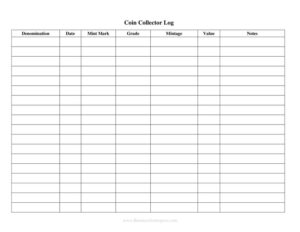
Coin Collector Log
Track your coin collection with a free Coin Collector Log template — record dates, mint marks, grades, and values. Free download in PDF and DOCX.
PDF
DOCX
4 downloads
0
likes
Download Files
- DOCX
A Coin Collector Log is a simple record sheet for cataloging the coins in your collection, capturing each coin’s denomination, year, mint mark, condition, and value in one organized place. The most common reason hobbyists use it is to keep an accurate, up-to-date inventory for insurance, resale, and tracking what they still need to complete a set. You can download this Coin Collector Log free in PDF and DOCX with no signup required.
What Is a Coin Collector Log?
A Coin Collector Log is a tracking document used by numismatists, hobbyists, and dealers to record the details of each coin they own. It typically lists the coin’s country, denomination, year, mint mark, grade or condition, quantity, purchase price, current estimated value, and storage location. The log functions as both an inventory and a history of your collecting activity — showing what you bought, when, where, and for how much. Whether you keep it as a printed binder page or a digital spreadsheet, the goal is the same: a single trusted reference so you never lose track of a coin’s identity, provenance, or worth. It also makes valuing the collection far easier when you sell, insure, or pass it on.
When Do You Need a Coin Collector Log?
A log becomes valuable the moment your collection grows beyond what you can remember. Common situations include:
- Building a set — tracking which dates and mint marks you already own so you know exactly what is still missing.
- Insurance documentation — providing an itemized inventory with values for a homeowner’s or specialty collectibles policy.
- Buying and selling — recording purchase prices and current values to calculate gains, losses, and fair asking prices.
- Estate planning — leaving heirs a clear, organized record of what the collection contains and what it may be worth.
- Coin shows and trades — carrying a quick reference so you can avoid buying duplicates and spot good deals on coins you need.
- Grading and authentication — noting which coins have been professionally graded and which slabs they came back in.
What a Coin Collector Log Should Have
A complete entry captures enough detail to identify a coin uniquely and document its value. The essential elements are the coin’s country or origin, denomination (such as cent, nickel, quarter, or dollar), year of issue, and mint mark (for example P, D, S, or none). Beyond identification, a good log records the grade or condition, the quantity if you hold more than one of the same coin, the date acquired, the source or dealer, the purchase price, and the current estimated value. A storage location field — album page, slab number, safe, or box — helps you physically find any coin quickly. A notes column rounds it out for varieties, errors, toning, or provenance details that affect value.
How to Fill Out a Coin Collector Log
Work through one row per coin and keep your entries consistent:
- Coin / description: Write the coin name and country, such as “US Lincoln Cent” or “Canadian Silver Dollar.”
- Denomination: Record the face value — cent, dime, quarter, half dollar, and so on.
- Year: Enter the year struck, exactly as it appears on the coin.
- Mint mark: Note the mint letter (P, D, S, W, or CC) or write “none” if absent.
- Grade / condition: Use a consistent scale — “Good,” “Fine,” “Uncirculated,” or a numeric grade like MS-65 if professionally graded.
- Quantity: Enter how many of this exact coin you hold.
- Date acquired: Log when you obtained it for cost-basis tracking.
- Source / purchase price: Record where you got it and what you paid.
- Current value: Add your best estimate from a recent price guide or recent sale.
- Storage location & notes: Indicate where the coin is kept and add any details about errors, varieties, or toning.
Tips for Estimating and Updating Values
Coin values shift with metal prices, demand, and grading, so a log is only as useful as it is current. Set a routine — quarterly or annually — to revisit your value column using a reputable price guide or recent auction results. Record values as ranges if you are unsure, and date your valuations so you remember how fresh they are. For bullion coins, remember that the melt value tracks the spot price of silver or gold and can change daily, while numismatic premiums depend on rarity and condition. Keep grading conservative; over-grading inflates your totals and creates problems when you sell. If a coin has been professionally graded and slabbed, note the certification number so the value is independently verifiable.
Organizing Your Log for Larger Collections
As a collection grows, organization matters as much as the data itself. Many collectors sort their log by series (all Lincoln cents together, all Morgan dollars together), then by year and mint mark within each series. This mirrors how albums and folders are arranged and makes gaps obvious at a glance. If you keep a digital DOCX version, you can sort and filter by any column; the printable PDF works well as a binder insert tucked alongside the coins themselves. Consider keeping a separate “want list” derived from the gaps in your log so you can shop efficiently. Back up digital copies and store a printed copy in a safe place separate from the coins.
Common Mistakes to Avoid
- Inconsistent grading: Mixing grading systems or estimating optimistically makes value totals unreliable.
- Skipping the mint mark: Two coins of the same year can differ dramatically in value based solely on mint mark, so always record it.
- Forgetting purchase details: Without the date acquired and price paid, you cannot calculate gains or losses accurately.
- Not updating values: A log with years-old values gives a misleading picture for insurance or sale.
- Cleaning coins before logging: Cleaning can drastically lower value — note original condition rather than altering coins.
- Keeping only one copy: Losing the log to a spill, fire, or hard-drive failure means losing your inventory entirely.
Frequently Asked Questions
What is a Coin Collector Log used for? It is used to inventory and track every coin in your collection in one organized place. Collectors rely on it to monitor values, document purchases for insurance, identify gaps in a set, and keep a clear record for resale or estate purposes.
How do I fill out a Coin Collector Log? Create one row per coin and fill in the description, denomination, year, mint mark, grade, quantity, date acquired, source, purchase price, current value, and storage location. Keep your grading and date formats consistent so the log is easy to read and sort.
How do I find the value of my coins? Use a current numismatic price guide, recent auction results, or dealer listings for the same coin in the same grade. Remember that bullion coins also carry a melt value tied to live metal prices, and that professionally graded coins generally command verifiable premiums.
Should I record the mint mark and grade separately? Yes — both significantly affect value and identification. The mint mark distinguishes otherwise identical coins struck at different facilities, while the grade reflects condition; recording them in separate fields keeps your data precise and sortable.
Is this Coin Collector Log free to download? Yes. You can download this Coin Collector Log free in both PDF and DOCX formats with no signup required. Print it as a binder insert or edit the DOCX version on your computer to suit your collection.
Can I use this log for insurance purposes? A detailed, current log is a strong supporting document for insuring a collection because it itemizes each coin and its value. Check with your insurer about their specific documentation and appraisal requirements, as coverage rules vary by provider and policy.
This Coin Collector Log template is provided as a general example for informational purposes only and is not financial, tax, insurance, or appraisal advice. Coin values and insurance requirements vary, so consult a qualified numismatist, appraiser, or insurance professional before relying on this log for valuation or coverage decisions.
Related Forms
- Hotel Maintenance Request
- Bill Payment Reminder
- Employee Computer Accounts Tracker
- Project To Do List
- Cleaning Log By Room
- Perpetual Inventory Form
Browse more in Log and Inventory.