
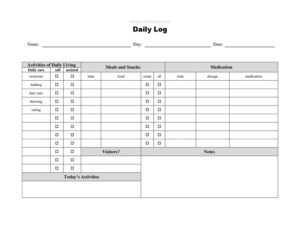
Elder Care Daily Log
Track meals, medications, mood, and activities with our free Elder Care Daily Log template — a clear caregiver record available as a free download in PDF and DOCX.
PDF
DOCX
0
likes
Download Files
- DOCX
An Elder Care Daily Log is a simple form caregivers use to record the daily health, meals, medications, mood, and activities of an older adult under their care. People most often use it to keep a consistent, shareable record across multiple caregivers or family members so nothing is missed between shifts. You can download it free in PDF and DOCX, with no signup required.
What Is an Elder Care Daily Log?
An Elder Care Daily Log is a structured caregiving record that captures what happened during a single day of care for an elderly person. It is typically filled out by a family caregiver, a hired home aide, or staff at an assisted living or in-home care arrangement. The log documents routine details — meals eaten, fluids taken, medications given, sleep, bathroom activity, mood, mobility, and any notable incidents. Its purpose is continuity: when several people share caregiving duties, a written log ensures the next person knows exactly what has already been done. It also creates a running history that can help spot patterns, support doctor visits, and reassure distant family members.
When Do You Need an Elder Care Daily Log?
This log is useful any time more than one person is involved in care, or when daily details matter to a senior’s health and safety. Common situations include:
- Shared family caregiving: When siblings or relatives rotate caring for an aging parent and need a handoff record between shifts.
- Hiring a home health aide: To document the care a paid caregiver provides and keep families informed.
- Post-hospital recovery: When an older adult returns home after surgery or illness and needs close monitoring of meals, medication, and symptoms.
- Managing chronic conditions: For tracking blood pressure, blood sugar, mood, or pain levels over time in conditions like diabetes or dementia.
- Medication management: To confirm each dose was given at the correct time and avoid missed or doubled doses.
- Preparing for doctor visits: A log gives the physician an accurate picture of recent days rather than relying on memory.
What an Elder Care Daily Log Should Have
A complete log balances enough detail to be useful with enough simplicity to be filled out quickly. Strong logs include the date and the caregiver’s name, the senior’s basic identifying details, and time-stamped entries for meals and fluids. They should capture each medication along with the dose and time given, sleep and rest periods, bathroom and hygiene activity, mood and behavior, physical activity or mobility, and a free-text notes area for anything unusual. A section for the next caregiver or for follow-up reminders makes handoffs smoother. The clearer the structure, the more reliably busy caregivers will actually complete it day after day.
How to Fill Out an Elder Care Daily Log
- Enter the date and caregiver name: Start each new log with the day’s date and who is recording, so entries are never confused across shifts.
- Record the senior’s name: Include the name of the person receiving care, especially if you care for more than one individual.
- Log meals and fluids: Note what was eaten at breakfast, lunch, dinner, and snacks, plus how much was consumed and water or fluid intake.
- Track medications: List each medication, its dose, the time given, and your initials to confirm it was administered.
- Note sleep and rest: Record nighttime sleep quality and any naps taken during the day.
- Document bathroom and hygiene: Track toileting, bathing, and grooming as relevant to the person’s care plan.
- Describe mood and behavior: Write down whether the person seemed calm, confused, anxious, or cheerful, and any changes.
- Record activity and mobility: Note walks, exercises, social time, or assistance needed with movement.
- Add notes and observations: Use the free-text area for symptoms, falls, appetite changes, or questions for the doctor, then sign off for the next caregiver.
Tips for Keeping a Useful Daily Log
The best logs are written in real time, not from memory at the end of a shift. Keep the form on a clipboard or in a binder in a consistent, easy-to-reach spot, and ask every caregiver to use the same one. Be specific with times — “took 8 a.m. medication” is far more useful than “morning meds.” Note both the positive and the concerning, since a good day is part of the pattern too. If you spot a sudden change — refusing food, new confusion, a fall, or unusual drowsiness — flag it clearly so the next person and any visiting nurse or physician sees it immediately. Over weeks, the accumulated logs become a valuable record for medical appointments and care reviews.
Sharing the Log With Family and Providers
Many families keep the daily log in a shared binder or scan completed pages to a group chat or cloud folder so distant relatives stay informed. When taking an older adult to a doctor, bring the most recent week of logs; physicians appreciate concrete details about appetite, sleep, mood, and medication adherence. If you employ a paid caregiver, the log also serves as a simple record of the care delivered. Keep in mind that health information is sensitive — store completed logs securely and share them only with people who genuinely need to see them.
Common Mistakes to Avoid
- Filling it out at the end of the day: Memory fades; record entries as events happen.
- Skipping medication times: Always note the exact time and dose to prevent missed or doubled doses.
- Being too vague: “Ate okay” tells the next caregiver little — note what and how much.
- Forgetting the caregiver name: Without a name, follow-up questions have nowhere to go.
- Ignoring mood and behavior: Emotional and cognitive changes can be early signs worth tracking.
- Using different forms each shift: Inconsistent formats make patterns hard to spot — standardize on one log.
Frequently Asked Questions
What is an Elder Care Daily Log used for? It is used to record an older adult’s daily meals, medications, mood, sleep, activity, and any notable events. The log creates continuity between caregivers and a written history that helps with medical appointments and care decisions.
Who should fill out the daily log? Whoever is providing care that day should complete it — a family member, a hired home aide, or care staff. When caregiving is shared, each person fills in their own entries and signs off so the next caregiver knows what has been done.
How often should I complete the log? Ideally throughout the day as events happen, with a fresh sheet started each day. Recording in real time produces a far more accurate record than trying to remember everything later.
Is this log a medical or legal document? No, it is a personal caregiving record, not an official medical chart or legal document. It can be a helpful reference to bring to doctor visits, but it does not replace professional medical records or advice.
How much does the template cost? Nothing — it is completely free to download here in both PDF and DOCX formats with no signup required. You can print the PDF for a clipboard or edit the DOCX to match your loved one’s specific care routine.
Can I customize the log for specific health needs? Yes. Use the editable DOCX version to add columns for blood pressure, blood sugar, pain levels, or any condition-specific tracking your care plan requires, then keep the layout consistent across days.
This template is a general example provided for informational purposes only and is not medical, legal, or professional caregiving advice. Care needs and any applicable regulations vary by situation and jurisdiction — consult a qualified healthcare provider or care professional for guidance specific to your circumstances.
Related Forms
- Book Inventory
- Bird Strike Form
- Maintenance Log
- Covid Disinfecting Checklist
- Purse Inventory
- Social Security Options Planner
Browse more in Log and Inventory.