
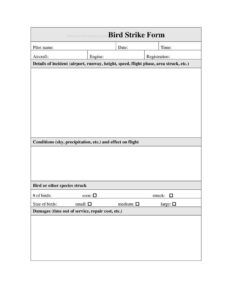
Bird Strike Form
Document aircraft wildlife strikes accurately with our free Bird Strike Form template, available as a free download in PDF and DOCX formats.
PDF
DOCX
1 downloads
0
likes
Download Files
- DOCX
A Bird Strike Form is a structured report used to document a collision between an aircraft and a bird or other wildlife. The most common reason people use it is to record the details of a wildlife strike promptly and consistently so the event can be reported to the appropriate aviation authority and analyzed for safety. It is free to download here in both PDF and DOCX formats, with no signup required.
What Is a Bird Strike Form?
A Bird Strike Form is a standardized record that pilots, ground crews, airport operations staff, and maintenance technicians use to capture the facts of a wildlife strike involving an aircraft. It documents when and where the strike occurred, the species (if known), the phase of flight, any damage to the aircraft, and the operational consequences. These reports feed into national and international wildlife-strike databases that help airports, regulators, and operators understand strike trends and improve mitigation. The form serves as both an internal incident record and the basis for any formal report required by an aviation authority. A clear, complete form makes follow-up investigation, repair tracking, and trend analysis far easier.
When Do You Need a Bird Strike Form?
You should complete a Bird Strike Form any time an aircraft makes contact with a bird or other wildlife, or when there is strong evidence one occurred. Typical situations include:
- A pilot observes or hears a strike during takeoff, climb, approach, or landing and needs to log it.
- Maintenance crews discover blood, feathers, or impact damage on an airframe, engine, or windshield during a post-flight inspection.
- Airport operations staff find bird remains on a runway, taxiway, or apron and suspect a strike occurred.
- An air traffic controller or ground worker witnesses a bird interacting with a departing or arriving aircraft.
- A flight is delayed, diverted, or aborted because of confirmed or suspected wildlife ingestion.
- An operator needs to submit data to a wildlife-strike database or comply with internal safety-management reporting requirements.
What a Bird Strike Form Should Have
A complete Bird Strike Form captures enough detail to identify the event, support a regulatory submission, and contribute meaningfully to safety analysis. Key elements include the date and local time of the strike, the airport or location, the aircraft registration and type, the operator, and the phase of flight. It should record the runway or area involved, the altitude and speed if known, weather and light conditions, and the species or description of the wildlife. Equally important are the parts of the aircraft struck, the extent of any damage, the effect on the flight, and the reporter’s name and contact details. Space for narrative remarks lets the reporter add context that structured fields cannot capture.
How to Fill Out a Bird Strike Form
- Enter the date and time of the strike, using local time and a clear time zone reference.
- Record the location — the airport name and code, or the geographic position and altitude if the strike happened en route.
- Fill in aircraft details: registration (tail number), make and model, engine type, and the operator or airline.
- Note the phase of flight (taxi, takeoff roll, climb, en route, descent, approach, or landing roll) and the runway used.
- Describe the wildlife: species if identifiable, approximate size, and the number of birds seen or struck.
- Document conditions — weather, sky condition, light (day, dawn, dusk, night), and visibility.
- Indicate the parts struck (windshield, radome, wing, engine, landing gear, fuselage, etc.) and describe the damage to each.
- State the effect on the flight: none, aborted takeoff, precautionary landing, engine shutdown, or diversion.
- Add the reporter’s name, role, and contact information, then use the remarks field for any additional narrative.
Reporting and Submitting Strike Data
In most regions, completed bird strike reports are submitted to a national aviation authority or a centralized wildlife-strike database. Reporting may be voluntary or mandatory depending on the jurisdiction, the operator, and whether damage occurred. Even minor or no-damage strikes are valuable to report, because aggregated data drives habitat management, airfield deterrents, and engine-design improvements. Keep a copy of every form for your own safety-management records, and route the original through your organization’s established reporting channel. When in doubt about whether an event qualifies, err on the side of reporting it — a thorough record is always preferable to a missing one. Check the specific reporting timelines and forms required by your local authority before you submit.
Tips for Accurate Strike Reporting
Fill out the form as soon as possible while details are fresh, and photograph any damage or remains before they are cleaned up or removed. If you collect feather or tissue samples, follow your organization’s procedures so the species can be identified by a qualified lab — accurate species data dramatically improves the usefulness of the report. Note even small details, such as the exact runway intersection or the bird’s flight direction, because they help identify patterns. When several people witness the same event, designate one person to complete the master form to avoid conflicting reports.
Common Mistakes to Avoid
- Delaying the report until memory fades, which leads to vague or inaccurate details.
- Leaving the species blank when a description, size estimate, or photo could still aid identification.
- Skipping no-damage strikes, even though they are important for trend analysis.
- Omitting the phase of flight or runway, which are central to airfield risk mapping.
- Failing to record the aircraft registration and engine type, making it hard to link the report to maintenance records.
- Not photographing or preserving evidence before the area is cleared.
Frequently Asked Questions
What is a Bird Strike Form used for? It is used to document a collision between an aircraft and a bird or other wildlife, capturing when, where, and how the strike occurred along with any resulting damage. The completed form supports internal safety records and any report required by an aviation authority. It also feeds wildlife-strike databases that help reduce future strikes.
Who should fill out the Bird Strike Form? Anyone who witnesses or discovers evidence of a strike can complete it, including pilots, ground crews, maintenance technicians, and airport operations staff. The reporter should record their name, role, and contact details so investigators can follow up. When multiple people observe the same event, one person should complete the master report.
Do I need to report a strike if there was no damage? Yes, reporting no-damage strikes is strongly encouraged because the data is valuable for identifying patterns and improving mitigation. Many strikes that cause no immediate damage still reveal hazards at a particular runway or time of day. Always check your local authority’s specific reporting requirements.
How quickly should the form be completed? Complete it as soon as practical after the strike, while the details are still fresh and any evidence is available. Prompt reporting improves accuracy and gives investigators the best chance to identify the species. If you cannot finish every field immediately, capture the time-sensitive details first.
Is this Bird Strike Form legally binding? The form is a reporting and record-keeping document rather than a contract, so it is not binding in the legal sense. However, accurate completion may be required to satisfy regulatory or operator reporting obligations in some jurisdictions. Follow your organization’s procedures and your local authority’s rules.
How much does this Bird Strike Form template cost? It is completely free to download from Business Forms Pro in both PDF and DOCX formats, with no signup required. You can edit the DOCX version to match your operator’s or airport’s specific reporting fields. Use it as a starting point and adapt it to the official form your authority requires.
This Bird Strike Form template is a general example provided for informational purposes only and is not legal, regulatory, or aviation-safety advice. Reporting requirements and official forms vary by jurisdiction and authority — consult your aviation regulator or a qualified safety professional to ensure compliance.
Related Forms
- Geocache Log
- Password Record
- Flood Emergency Checklist
- Inventory Cards — Black And White
- Drivers Daily Log
- Nanny Daily Log
Browse more in Log and Inventory.