
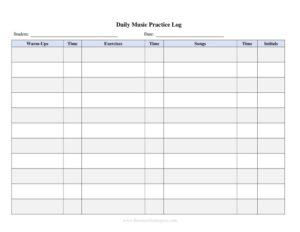
Daily Music Practice Log
Track your daily music practice with this free Daily Music Practice Log template — log time, songs, and progress, free download in PDF and DOCX.
PDF
DOCX
4 downloads
0
likes
Download Files
- DOCX
A Daily Music Practice Log is a simple worksheet for recording what you practiced, for how long, and how it went each day, and it’s the most reliable way for any musician to turn scattered practice into measurable progress. The most common reason people use one is to stay consistent and see improvement over weeks and months instead of relying on memory. It’s free to download here in both PDF and DOCX formats, with no signup required.
What Is a Daily Music Practice Log?
A Daily Music Practice Log is a tracking sheet that documents each practice session for a singer or instrumentalist. It’s typically used by students, hobbyists, teachers, and parents of young learners to capture the date, the amount of time spent, the pieces or exercises worked on, and notes about what improved or still needs attention. Rather than a formal record, it functions as a personal accountability and reflection tool. By writing down scales, etudes, repertoire, and warm-ups alongside the minutes invested, a musician can spot patterns, recognize neglected areas, and build the steady habit that drives real growth on any instrument or voice.
When Do You Need a Daily Music Practice Log?
A practice log is useful any time you want structure and proof of effort behind your music study. Common situations include:
- Music lessons: A teacher assigns weekly practice goals and reviews your log to gauge consistency and target feedback.
- Exam or recital prep: You’re building toward a graded exam, audition, or performance and need to track repertoire readiness day by day.
- Self-taught learners: You’re learning guitar, piano, or voice on your own and want to stay disciplined without an instructor checking in.
- Parents tracking a child’s progress: A guardian logs minutes to encourage routine and demonstrate practice for a school music program.
- Skill challenges: You’ve committed to a 30-day or 100-day practice streak and want a visible record of every session.
- Multi-instrument players: You split time across several instruments and need to balance attention across each one.
What a Daily Music Practice Log Should Have
A complete practice log captures enough detail to make each session meaningful when you look back. Core elements include the date of the session and the total time spent practicing. It should list the specific pieces, songs, or exercises worked on, plus any warm-ups, scales, or technical drills. A dedicated space for goals keeps each session focused, while a notes or progress section records breakthroughs, trouble spots, and tempos achieved. Many logs add a rating for how the session felt and a running weekly total. Together these fields turn vague practice into trackable data you can review and act on.
How to Fill Out a Daily Music Practice Log
- Enter the date. Record the calendar day of the session so you can track frequency and streaks over time.
- Note the start and end time or total minutes. Log how long you practiced; even 15 focused minutes is worth recording.
- List your warm-up. Write down the scales, arpeggios, long tones, or technical exercises you began with.
- Record the pieces or songs. Name each piece, etude, or song you worked on, including the section or measures if you focused on a passage.
- Write your goal for the session. Capture what you aimed to accomplish, such as a faster tempo, cleaner shifts, or memorization.
- Add progress notes. Describe what improved, where you struggled, and the tempo or fingering you settled on.
- Rate the session. Use a quick score or word (great, okay, frustrating) to track how it felt.
- Tally weekly time. At week’s end, add up total minutes to see your overall investment.
Tips for Getting the Most From Your Practice Log
The log is only as useful as the habits around it. Keep the sheet next to your instrument or music stand so filling it in becomes part of the routine, not an afterthought. Be specific in your notes — “slurred bars 12 to 16 at 80 bpm cleanly” tells you far more next week than “worked on the song.” Set small, achievable goals for each session rather than vague intentions, and revisit your previous entry before you begin so you pick up exactly where you left off. Reviewing a full week or month at once reveals which pieces you’ve been avoiding and where your time is actually going, helping you rebalance practice toward weaker areas.
Practice Log vs. a Simple Calendar
Some musicians just mark an X on a calendar for each day they practice, and that’s better than nothing for building a streak. A Daily Music Practice Log goes further: it captures what you did and how it went, not just that you showed up. That extra detail is what lets a teacher give targeted feedback and lets you diagnose plateaus. Use a calendar to motivate consistency and a practice log to actually direct and refine your work — many players keep both side by side.
Common Mistakes to Avoid
- Logging only minutes: Time alone doesn’t show progress — always note what you worked on and what changed.
- Being too vague: “Practiced piano” is useless later; name the piece, the measures, and the tempo.
- Skipping the goal: Sitting down without a target turns practice into aimless playing of familiar parts.
- Filling it in days later: Memory fades fast; complete the log right after the session for accuracy.
- Ignoring weak spots: Logs reveal neglected pieces — don’t keep replaying what you already do well.
- Never reviewing past entries: The real value comes from reading back and adjusting your plan.
Frequently Asked Questions
What is a Daily Music Practice Log used for? It’s used to record each music practice session — the date, duration, pieces worked on, goals, and progress notes. Musicians, students, and teachers use it to build consistency, focus their effort, and measure improvement over time.
How do I fill out a music practice log? Enter the date and how long you practiced, list your warm-ups and the pieces you worked on, write a goal for the session, and add notes on what improved or needs work. Filling it in immediately after practicing keeps the details accurate and useful.
How much should I practice each day? There’s no universal number — quality and focus matter more than raw minutes. Many teachers suggest consistent daily sessions, even short ones, are far more effective than occasional long marathons, and a log helps you find a sustainable routine.
Is this practice log only for a specific instrument? No, it works for any instrument or voice. The fields for time, pieces, warm-ups, goals, and notes apply equally to piano, guitar, violin, drums, singing, or any other musical study.
Can a music teacher use this log with students? Yes, teachers often hand out a practice log so students record sessions between lessons. Reviewing the log helps the teacher see how the week went and give targeted feedback at the next lesson.
How much does this practice log cost? This Daily Music Practice Log template is completely free to download here in both PDF and DOCX formats, with no signup required. You can print it for daily handwriting or edit the DOCX version to customize the fields for your own routine.
This Daily Music Practice Log template is provided as a general example for informational purposes only and is not professional teaching, coaching, or other advice. Practice needs and methods vary by individual, instrument, and instructor — consult a qualified music teacher for guidance tailored to your goals.
Related Forms
- Software Inventory
- Inventory Report
- Quarterly Sales Record
- Company Growth Chart
- Key Assignment Inventory
- Side Income Log
Browse more in Log and Inventory.