
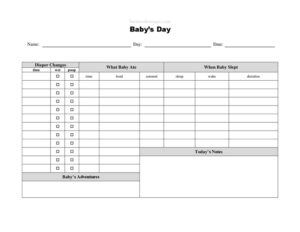
Baby Care Daily Log
Track feedings, diapers, naps, and more with this free Baby Care Daily Log template — organized, easy to share, and a free download in PDF or DOCX.
PDF
DOCX
0
likes
Download Files
- DOCX
A Baby Care Daily Log is a simple tracking sheet parents, nannies, and daycare providers use to record an infant’s feedings, diaper changes, naps, and other daily activities in one place. People most often reach for it to keep caregivers on the same page and to share an accurate picture of the day with the other parent or the pediatrician. It’s free to download here in PDF and DOCX, with no signup required.
What Is a Baby Care Daily Log?
A Baby Care Daily Log is a structured daily record that captures the essential rhythms of a baby’s day: when and how much they ate, how many wet and dirty diapers they had, when they slept, and any notable moods, medications, or milestones. It’s typically used by parents, grandparents, babysitters, nannies, and childcare centers as a shared communication tool. Rather than relying on memory at the end of a long, sleep-deprived day, the log creates a written timeline you can review at a glance. That timeline helps everyone caring for the child stay coordinated and gives doctors concrete information when questions about feeding, weight, or sleep come up.
When Do You Need a Baby Care Daily Log?
This log fits any situation where consistency and clear hand-offs matter. Common uses include:
- Newborn care at home — tracking feedings and diapers in the early weeks when pediatricians want counts of wet and soiled diapers.
- Handing off to a nanny or babysitter — so the sitter knows the last feeding time and you get a full report when you return.
- Daycare communication — centers often send home a daily sheet summarizing naps, bottles, and diaper changes.
- Coordinating between two parents — especially with shift work or separate households, a shared log prevents double-dosing medicine or missing a feeding.
- Doctor visits — bringing a week of logged data to a checkup makes it easy to discuss feeding amounts, sleep patterns, or reflux concerns.
- Tracking a medical issue — monitoring fevers, medication times, or output when a baby is recovering from illness.
What a Baby Care Daily Log Should Have
A complete log covers the building blocks of a baby’s day without being so detailed that it’s burdensome to fill in. The essentials are: the date and the baby’s name; a feeding section noting times, type (breast or bottle), and amounts; a diaper section distinguishing wet from dirty; a sleep section logging nap start and end times; a space for medications or vitamins with dose and time; and a free-text notes area for mood, milestones, or anything unusual. Many parents also like a daily summary line that totals feedings and diaper counts, plus a spot for the caregiver’s name when more than one person looks after the child.
How to Fill Out a Baby Care Daily Log
- Enter the date and baby’s name at the top so each sheet stands alone and can be filed or compared later.
- Record the caregiver’s name if multiple people care for the baby, so any follow-up question goes to the right person.
- Log each feeding with the time, whether it was breast or bottle, and the amount in ounces or minutes per side.
- Note every diaper change, marking whether it was wet, dirty, or both, with the time.
- Track sleep by writing the start and end time of each nap and the night sleep, so you can see total rest at a glance.
- Add medications or vitamins, recording the name, dose, and exact time given to avoid accidental repeat doses.
- Use the notes section for mood, temperature readings, first smiles, tummy time, or anything the next caregiver should know.
- Total the day in the summary line, tallying feedings and diaper counts before filing the sheet.
Tips for Getting Useful Data From Your Log
The log is only as helpful as it is consistent, so pick a routine that fits your day. Keep the sheet somewhere central — taped to the fridge or clipped to a board near the changing area — so it’s effortless to jot an entry the moment something happens rather than reconstructing it later. If you have a printed copy, a pen on a string nearby removes the last bit of friction. Use the same units every time (always ounces, or always minutes) so the numbers are comparable from day to day. When you hand off care, take thirty seconds to point out the last feeding and last diaper so the next person starts with the full picture. Over a week or two, patterns in feeding amounts and nap length become visible, which is exactly the kind of information a pediatrician finds valuable.
Printable Sheet vs. Tracking App
Apps are convenient, but a printed Baby Care Daily Log has real advantages. A paper sheet works when your phone is across the room or dead, it doesn’t require a sitter to download anything or learn your login, and it’s easy to hand to a grandparent or a doctor. Many families use both: an app for quick taps and a printed log as the master record a daycare or babysitter can fill in. Because this template comes in DOCX, you can also customize it — add a bath column, a pumping section for caregivers expressing milk, or extra rows for a second baby — then print as many copies as you need.
Common Mistakes to Avoid
- Logging only some feedings — partial data makes totals meaningless, so record every feeding even the short ones.
- Mixing units — switching between ounces and milliliters or breast minutes and bottle ounces makes the day hard to interpret.
- Forgetting the date — an undated sheet is nearly useless once it’s filed with others.
- Not noting medication times precisely — vague timing raises the risk of an accidental double dose between caregivers.
- Skipping the notes field — important context like a low-grade fever or fussiness gets lost without it.
- Not sharing the log at hand-off — the sheet only prevents gaps if the incoming caregiver actually reads it.
Frequently Asked Questions
What is a Baby Care Daily Log used for? It’s used to record a baby’s feedings, diaper changes, naps, medications, and general mood throughout the day. Parents and caregivers use it to stay coordinated, hand off care smoothly, and share accurate information with the pediatrician. It turns scattered memories into a clear, reviewable timeline.
How do I fill out a Baby Care Daily Log? Start by writing the date, the baby’s name, and the caregiver’s name, then record each event as it happens. Note the time and amount for feedings, mark diapers as wet or dirty, and log nap start and end times. Add any medications with the dose and time, and use the notes section for anything unusual.
How often should I record entries? Record each event as it happens rather than batching them at the end of the day, since real-time entries are far more accurate. With newborns this may mean updating the log every couple of hours. As your baby’s routine settles, you may find a few summary entries per day are enough.
Can a babysitter or daycare use this log too? Yes — that’s one of its most common uses. A shared sheet lets a sitter, nanny, or daycare provider record the day so you get a complete report when you take over. Because it’s printable, no app or account is needed for anyone to fill it in.
Should I bring the log to doctor visits? Bringing a week or two of logged data is genuinely helpful at checkups. It gives the pediatrician concrete information about feeding amounts, sleep patterns, and diaper output, which can support discussions about weight gain, reflux, or general development.
Is this Baby Care Daily Log free? Yes. You can download it free in both PDF and DOCX with no signup required. Use the PDF for quick printing or edit the DOCX to add custom columns such as bath time, pumping, or a second child before you print.
This template is a general example provided for informational purposes only and is not medical advice. Care recommendations, feeding amounts, and medication schedules vary by child and situation — always consult your pediatrician or a qualified healthcare professional for guidance specific to your baby.
Related Forms
- Log Sheet
- Change Log
- Pre-Trip Vehicle Inspection Checklist
- Inventory Cards Management System — BW
- Website Password Tracker
- Maintenance Log Form
Browse more in Log and Inventory.