
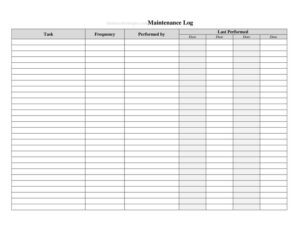
Maintenance Log Form
Track repairs, servicing, and inspections with our free Maintenance Log Form template, available as a free PDF and DOCX download.
PDF
DOCX
0
likes
Download Files
- DOCX
A Maintenance Log Form is a simple record that documents every repair, inspection, and service performed on a piece of equipment, a vehicle, a building, or any other asset over time. People most often use it to keep a clear, dated history of upkeep so nothing falls through the cracks and warranty or compliance requirements stay satisfied. It’s free to download here in both PDF and DOCX formats, with no signup required.
What Is a Maintenance Log Form?
A Maintenance Log Form is a structured document used to track the ongoing care of an asset. Facility managers, fleet supervisors, building owners, equipment operators, and homeowners all rely on it to capture what was done, when, by whom, and at what cost. Each entry typically records the date, a description of the work, the technician or vendor responsible, parts used, and the next scheduled service. Over time, the log becomes a complete maintenance history that supports warranty claims, resale value, regulatory inspections, and preventive scheduling. Whether it’s printed and posted near a machine or stored as a digital file, the form turns scattered notes into one organized, reviewable record.
When Do You Need a Maintenance Log Form?
A maintenance log is valuable any time an asset needs regular, documented care. Common situations include:
- Vehicle and fleet upkeep — recording oil changes, tire rotations, brake service, and mileage to protect resale value and meet fleet policies.
- Equipment and machinery servicing — logging lubrication, calibration, filter changes, and repairs on production or shop equipment.
- Building and facility management — tracking HVAC service, plumbing repairs, elevator inspections, and fire-system checks across a property.
- Rental property maintenance — documenting appliance repairs and routine upkeep that landlords must perform between tenants.
- Warranty compliance — proving that scheduled maintenance was performed so a manufacturer honors a warranty claim.
- Safety and regulatory audits — supplying inspectors with a dated history of preventive maintenance and corrective actions.
Types of Maintenance to Record
Not all maintenance is the same, and a good log distinguishes between categories so you can analyze patterns. Preventive maintenance is scheduled work performed to avoid breakdowns, such as routine inspections and part replacements. Corrective maintenance addresses a fault that has already occurred, like fixing a failed motor. Predictive maintenance uses readings or condition data to time service before failure. Noting which type each entry belongs to helps managers spot recurring problems, justify budgets, and decide whether an aging asset should be repaired or replaced.
What a Maintenance Log Form Should Have
A complete maintenance log includes enough detail that anyone reviewing it later can understand exactly what happened. The essentials are an asset or equipment identifier, the date of service, a clear description of the work performed, the name of the technician or vendor, parts or materials used, labor and parts cost, the current meter or mileage reading where relevant, and the date of the next scheduled service. A status or notes column for follow-up items rounds out the record. Including a running header that names the asset and its location keeps multi-page logs from being mixed up.
How to Fill Out a Maintenance Log Form
- Identify the asset. At the top, enter the equipment name, ID or serial number, and its location so the log is tied to one specific item.
- Record the date. Enter the date the maintenance was performed, using a consistent format throughout the log.
- Note the meter reading. Add mileage, hours, or cycle count if the asset tracks usage, which helps schedule the next service.
- Describe the work. Write a specific description — for example, “replaced air filter and topped coolant” rather than just “service.”
- Indicate the type. Mark whether the task was preventive, corrective, or predictive.
- List parts and materials. Record part numbers and quantities used so inventory and reorders stay accurate.
- Enter the cost. Log labor and parts costs to track spending against each asset.
- Add the technician. Name the person or vendor who completed the work and have them initial the entry.
- Schedule the next service. Note the date or meter reading when the next maintenance is due, then add any follow-up notes.
Tips for Keeping an Accurate Log
The value of a maintenance log depends on how consistently it’s kept. Record each task immediately after completing it rather than relying on memory at the end of the week. Keep the log in a predictable place — clipped to the equipment, in a binder, or in a shared digital folder — so anyone can update it. Use the same units and terminology every time to make the history searchable and comparable. For fleets or large facilities, consider one log per asset rather than a single combined sheet, which makes it far easier to review a specific item’s history. Finally, archive completed logs rather than discarding them; a multi-year record often becomes your strongest evidence during audits or warranty disputes.
Common Mistakes to Avoid
- Vague descriptions — entries like “fixed it” provide no useful history; always specify what was done.
- Skipping the date or meter reading — without these, you can’t calculate service intervals or prove timing.
- Leaving costs blank — missing cost data undermines budgeting and repair-versus-replace decisions.
- Forgetting to schedule the next service — the log loses its preventive power if no future date is set.
- Combining unrelated assets — mixing several machines on one sheet makes individual histories hard to follow.
- Not identifying the technician — an unsigned entry can’t be verified or questioned later.
Frequently Asked Questions
What is a Maintenance Log Form used for? It is used to document every service, repair, and inspection performed on an asset over time. This creates a dated history that supports warranty claims, preventive scheduling, audits, and resale value. It works for vehicles, equipment, buildings, and many other assets.
How do I fill out a Maintenance Log Form? Start by identifying the asset at the top, then add a row for each service with the date, meter reading, a clear description of the work, parts used, cost, and the technician’s name. Finish each entry by noting the next scheduled service date. Update the log immediately after each task for accuracy.
Is a Maintenance Log Form legally binding? A maintenance log is a record-keeping document rather than a contract, so it is not binding in the way an agreement is. However, it can serve as important evidence in warranty disputes, insurance claims, or regulatory inspections. Accurate, signed entries make the log more credible.
Who should keep the maintenance log? Typically the person or team responsible for the asset keeps it — a facility manager, fleet supervisor, equipment operator, landlord, or homeowner. The key is that whoever performs or oversees the work updates the log promptly and stores it where others can access it.
How often should I update the log? Update it every time maintenance is performed, including small tasks like topping off fluids or replacing a filter. Recording entries right away prevents forgotten details and keeps service intervals accurate. Reviewing the log periodically also helps you plan upcoming preventive work.
Is this Maintenance Log Form free to download? Yes. You can download this Maintenance Log Form for free in both PDF and DOCX formats with no signup required. The DOCX version is fully editable so you can add columns or rename fields to match your specific asset.
This Maintenance Log Form template is provided as a general example for informational purposes only and is not legal, financial, or compliance advice. Record-keeping and inspection requirements vary by industry and jurisdiction, so consult a qualified professional to ensure your maintenance documentation meets applicable standards.
Related Forms
- Daily Music Practice Log
- Evidence Log
- Edit Log
- Cash Register Log
- Auction Buy List
- Computer Update Tracker
Browse more in Log and Inventory.