
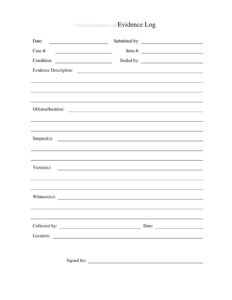
Evidence Log
Track and document physical evidence with our free Evidence Log template, available as a free download in PDF and DOCX for clear chain-of-custody records.
PDF
DOCX
5 downloads
0
likes
Download Files
- DOCX
An Evidence Log is a structured record used to document every item of physical or digital evidence collected, stored, and transferred during an investigation. The single most common reason people use one is to maintain an unbroken chain of custody so that evidence remains credible and admissible. You can download this Evidence Log template free in PDF and DOCX formats — no signup required.
What Is an Evidence Log?
An Evidence Log is a controlled document that records the identity, condition, location, and handling history of each piece of evidence connected to a case, incident, or inquiry. It is typically maintained by law enforcement officers, private investigators, security teams, corporate compliance departments, school administrators, or HR investigators. The log documents what the evidence is, when and where it was collected, who collected it, and every person who has handled or accessed it since. Its purpose is to demonstrate that evidence has not been lost, altered, contaminated, or tampered with from the moment of collection through final disposition. A complete, well-kept log protects the integrity of an investigation and supports the reliability of conclusions drawn from the evidence.
When Do You Need an Evidence Log?
An Evidence Log becomes essential any time the source and handling of an item must be provable. Common situations include:
- Law enforcement investigations — documenting items recovered at a crime or accident scene from collection through court presentation.
- Internal corporate investigations — tracking documents, devices, or records gathered during a fraud, theft, or misconduct inquiry.
- Security and loss-prevention work — logging recovered merchandise, surveillance footage, or seized items.
- HR and workplace complaints — preserving emails, photographs, or physical objects relevant to a harassment or policy violation case.
- Insurance and claims investigations — recording damaged property, photographs, and supporting materials tied to a claim.
- School or campus incidents — documenting confiscated items or evidence relevant to disciplinary proceedings.
Types of Evidence You Might Log
The same log structure works for many categories of evidence. Physical evidence includes weapons, tools, clothing, and recovered property. Documentary evidence covers contracts, letters, printed records, and handwritten notes. Digital evidence includes hard drives, phones, USB devices, and exported files. Biological or trace evidence — handled only by trained personnel — may also be referenced in a log even when stored separately. Whatever the type, the log captures the same core facts so the item can be identified and its history reconstructed at any later date.
What an Evidence Log Should Have
A reliable Evidence Log captures enough detail to identify each item and trace every transfer. Key elements include a unique item or exhibit number, a clear description of the item, the case or incident reference, the date and time of collection, the location where it was found, and the name of the collecting individual. It should also include a running chain-of-custody section recording each transfer: who released the item, who received it, the date and time, and the reason. Fields for storage location, condition notes, and final disposition complete the record. Signatures at each handoff add accountability and make the document harder to dispute.
How to Fill Out an Evidence Log
Because this is a flexible template, complete it consistently for every item. Follow these steps:
- Enter case identifiers. At the top, record the case or incident number, the agency or organization name, and the investigator or officer of record.
- Assign an item number. Give each piece of evidence a unique exhibit or item number so it can never be confused with another.
- Describe the item. Write a clear, objective description — make, model, color, serial number, quantity, and any distinguishing marks.
- Record collection details. Note the date, time, and exact location where the item was found or received.
- Name the collector. Enter the full name and signature of the person who collected the item.
- Log the storage location. Identify the locker, bag number, room, or sealed container where the item is held.
- Document each transfer. In the chain-of-custody section, record who released and received the item, the date, time, and purpose for every handoff.
- Note condition and disposition. Record the item’s condition on receipt and its final outcome — returned, destroyed, or retained.
Protecting the Chain of Custody
The strength of an Evidence Log lies in its continuity. Every time an item changes hands, the transfer must be recorded immediately — not reconstructed from memory hours later. Use tamper-evident bags or sealed containers and write the seal number on the log. Limit access to authorized personnel and store the log alongside, but secured separately from, the evidence itself. If a correction is needed, draw a single line through the error, initial it, and write the correction beside it; never erase or use correction fluid, as that can cast doubt on the entire record. A gap in the chain, even a small one, can undermine the value of otherwise solid evidence.
Tips for Reliable Record-Keeping
Use ink, write legibly, and record times in a consistent format such as a 24-hour clock. Be specific rather than general — “black Samsung phone, IMEI 35XXXXXX” is far stronger than “a phone.” Keep entries factual and avoid opinions or conclusions in the description fields. Photograph items before and after collection where appropriate, and reference the photo numbers in the log. Review the completed log against the physical inventory periodically to confirm nothing is missing or misfiled.
Common Mistakes to Avoid
- Leaving gaps in the chain of custody — every transfer must be recorded, or the evidence may be questioned.
- Vague descriptions that cannot distinguish one item from another similar one.
- Backdating or estimating times instead of recording them at the moment of action.
- Erasing or overwriting entries rather than making a single-line correction with initials.
- Missing signatures at one or more handoff points.
- Storing the log with no backup, risking total loss if the original is damaged or misplaced.
Frequently Asked Questions
What is an Evidence Log used for? It is used to document the identity, location, and complete handling history of evidence so its integrity can be proven. By recording every transfer, it establishes an unbroken chain of custody. This makes the evidence more reliable and defensible if it is later reviewed or presented.
How do I fill out an Evidence Log? Start with the case identifiers, then assign each item a unique number and write a clear description. Record the collection date, time, location, and collector, then log every transfer in the chain-of-custody section. Finish by noting the storage location and final disposition for each item.
Who should maintain the Evidence Log? Typically a designated evidence custodian, investigator, or officer of record is responsible for the log. Limiting maintenance to authorized personnel reduces the risk of errors and disputes. Each person who handles an item should sign for it at the time of transfer.
Is an Evidence Log legally binding? The log itself is a record rather than a contract, but it can carry significant weight in legal and disciplinary proceedings. Its credibility depends on completeness, accuracy, and an unbroken chain of custody. Always follow your organization’s procedures and any applicable rules of evidence.
Do entries need to be signed? Signatures at each transfer are strongly recommended because they assign accountability and make the record harder to challenge. Many agencies require both the releasing and receiving party to sign and date each handoff. Confirm the signing requirements set by your own organization.
How much does this template cost? This Evidence Log template is completely free to download from Business Forms Pro in both PDF and DOCX formats. There is no signup, subscription, or payment required. You can edit the DOCX version to match your case-numbering system and procedures.
This Evidence Log template is provided as a general example for informational purposes only and does not constitute legal advice. Evidence-handling requirements and rules of admissibility vary by jurisdiction and organization. Consult a qualified legal professional or follow your agency’s official procedures to ensure compliance.
Related Forms
- Credit Card Rewards Tracker
- Comic Book Inventory
- Pre-Trip Vehicle Inspection Checklist
- Computer Inventory
- Wilderness Emergency Checklist
- Pool Maintenance Log
Browse more in Log and Inventory.