
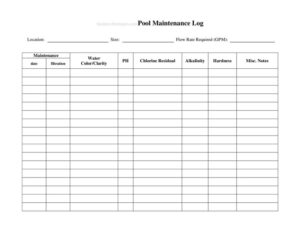
Pool Maintenance Log
Track water chemistry, cleaning, and equipment checks with our free Pool Maintenance Log template, available as a free download in PDF and DOCX.
PDF
DOCX
9 downloads
0
likes
Download Files
- DOCX
A Pool Maintenance Log is a simple record used to track water testing, chemical adjustments, cleaning tasks, and equipment checks for a swimming pool or spa. People most often use it to keep water safe, balanced, and crystal clear by logging readings consistently over time. It’s free to download here in both PDF and DOCX formats, with no signup required.
What Is a Pool Maintenance Log?
A Pool Maintenance Log is a structured sheet where the person caring for a pool records each service visit and the condition of the water. It is used by homeowners, property managers, hotels, apartment complexes, gyms, and professional pool-service companies. The log documents date and time of service, chemical readings such as pH and chlorine, products added, cleaning performed, and equipment inspected. By capturing this information in one place, the log creates a running history that makes it easy to spot trends, prove routine upkeep, and hand off responsibilities. It turns guesswork into a repeatable routine and helps anyone, even a part-time helper, keep a pool healthy and swim-ready.
When Do You Need a Pool Maintenance Log?
A maintenance log is valuable any time a pool is used regularly or maintained by more than one person. Common situations include:
- Residential pools: Homeowners who want a consistent weekly routine and a record of when chemicals were last added.
- Commercial and public pools: Hotels, community centers, and apartments that must demonstrate routine sanitation and water testing.
- Pool-service businesses: Technicians servicing multiple properties who need proof of each visit for clients.
- Seasonal openings and closings: Tracking the steps taken to open a pool in spring or winterize it in fall.
- Troubleshooting cloudy or green water: Reviewing past readings to identify when balance slipped and what corrected it.
- Property transfers and rentals: Giving a new owner or tenant a clear history of how the pool has been maintained.
What a Pool Maintenance Log Should Have
A complete pool log captures both the chemistry and the physical upkeep of the pool. At minimum it should include the service date and time, the technician or person performing the work, and the key water chemistry readings: pH, free chlorine, total alkalinity, calcium hardness, cyanuric acid (stabilizer), and water temperature. It should also list any chemicals added with their amounts, the cleaning tasks completed (skimming, brushing, vacuuming, emptying baskets), and equipment checks such as filter pressure, pump operation, and the backwash schedule. A notes column is essential for recording observations like cloudy water, algae, debris, or repairs needed. Together these fields give a full snapshot of each visit.
How to Fill Out a Pool Maintenance Log
- Enter the date and time: Record when you performed the service so readings can be tracked chronologically.
- Add the technician or attendant name: Note who did the work, especially when several people share the task.
- Test and record water chemistry: Using a test kit or strips, log pH, free and total chlorine, total alkalinity, calcium hardness, and cyanuric acid.
- Note water temperature: Warmer water consumes chlorine faster, so temperature gives context to your readings.
- List chemicals added: Write each product and the exact amount, such as ounces of chlorine or pounds of pH increaser.
- Mark cleaning tasks: Check off skimming, brushing walls, vacuuming, and emptying the skimmer and pump baskets.
- Inspect equipment: Record filter pressure, confirm the pump runs properly, and log whether you backwashed.
- Write notes: Capture anything unusual—debris, algae spots, low water level, or parts that need replacement.
Understanding the Key Water Readings
The numbers in a pool log only help if you know the general target ranges. As a rule of thumb, pH is usually kept between roughly 7.2 and 7.8, free chlorine between about 1 and 3 parts per million, and total alkalinity around 80 to 120 ppm, while calcium hardness and stabilizer have their own typical bands. These targets can vary with pool type, sanitizer system, and local water, so always follow the guidance from your test-kit manufacturer or pool professional. Logging the readings consistently is what makes them useful: a single measurement tells you the moment, but a column of dated entries reveals whether chlorine is dropping too fast, whether pH keeps drifting, or whether a recent dose of chemicals actually moved the numbers into range.
Tips for a Reliable Maintenance Routine
Test at the same time of day and from the same spot in the pool so your readings stay comparable. Keep the log near your test kit or store the DOCX version on a shared drive so multiple caretakers can update it. For commercial pools, more frequent testing—often several times a day during peak use—is common, while a backyard pool may only need testing a few times a week. Record chemical amounts precisely rather than estimating; this prevents over-dosing and lets you reproduce a successful adjustment later. Finally, review the log monthly to catch slow trends, such as rising stabilizer levels, before they become a problem.
Common Mistakes to Avoid
- Skipping entries: Gaps in the log make it impossible to see trends or prove upkeep.
- Recording readings without amounts added: Without the dose, you can’t connect a chemical to the result it produced.
- Testing inconsistently: Different times or locations produce misleading comparisons.
- Ignoring equipment checks: Logging chemistry but never noting filter pressure can hide a failing filter.
- Vague notes: Writing “looks fine” instead of specifics gives the next person nothing to act on.
- Not dating each row: Undated entries lose nearly all their value for tracking history.
Frequently Asked Questions
What is a Pool Maintenance Log used for? It is used to record the routine care of a pool, including water testing, chemical additions, cleaning, and equipment inspections. The log creates a dated history that helps keep water balanced and provides proof of regular maintenance for owners, managers, or service clients.
How often should I fill out a pool maintenance log? Residential pools are typically logged a few times per week, while busy commercial or public pools may be tested and recorded several times a day. Test more frequently during heavy use, hot weather, or after heavy rain, since these conditions change water chemistry faster.
What water readings should the log track? The most important readings are pH, free chlorine, total alkalinity, calcium hardness, cyanuric acid (stabilizer), and water temperature. Recording these together gives a full picture of water balance and helps you decide what chemicals to add.
Is this Pool Maintenance Log free to download? Yes. You can download the template here at no cost in both PDF and DOCX formats, with no signup or account required. Use the PDF for quick printing or the DOCX to customize columns for your specific pool.
Can I customize the log for my pool or business? Absolutely. The DOCX version lets you add or remove columns, insert your company name, or adjust the testing frequency to match your routine. This makes it easy to standardize across multiple properties or technicians.
Does a pool maintenance log need to follow specific regulations? Private residential pools generally have no logging requirement, but public and commercial pools may be subject to local health-department rules on testing and recordkeeping. Requirements vary by location, so check with your local health authority to confirm what your facility must document.
This Pool Maintenance Log template is a general example provided for informational purposes only and is not professional, legal, or health-and-safety advice. Pool care requirements and chemical target ranges vary by pool type, equipment, and local regulations—consult your test-kit manufacturer, a qualified pool professional, or your local health authority for guidance specific to your situation.
Related Forms
- Project Timeline
- Asset Inventory
- Coffee Shop Items Inventory Card
- Yearly Multiple Project Timetable
- Large-Print Packing List
- Phone Message Log
Browse more in Log and Inventory.