
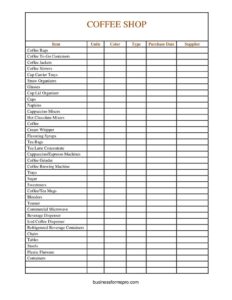
Coffee Shop Items Inventory Card
Track supplies, equipment, and ingredients with this free Coffee Shop Items Inventory Card template, available as a free download in PDF and DOCX.
PDF
DOC
4 downloads
0
likes
Download Files
- DOC
A Coffee Shop Items Inventory Card is a single-item tracking record used to log the supplies, ingredients, and equipment that keep a café running. Most owners reach for it to know exactly what’s on hand, when it was bought, and from whom — so reordering never becomes a guessing game. It’s free to download in PDF and DOCX, with no signup required.
What Is a Coffee Shop Items Inventory Card?
A Coffee Shop Items Inventory Card is a structured form that captures the key details of one inventory item — its name, quantity, supplier, and purchase information — alongside the full menu of coffee-shop categories it might belong to. It is typically used by café owners, baristas, shift managers, or purchasing staff to document what is in stock and to support reordering decisions. Rather than relying on memory, the card creates a paper or digital trail for each item, from a box of coffee stirrers to a commercial espresso machine. Whether you run a busy drive-through, a neighborhood roastery, or a small kiosk, the card standardizes how stock is recorded so anyone on the team can read and update it.
When Do You Need a Coffee Shop Items Inventory Card?
- Weekly stock counts: Before placing supplier orders, log quantities of cups, lids, napkins, and to-go containers so you reorder the right amounts.
- Opening a new café: Build a master list of equipment such as blenders, grinders, and beverage dispensers to track what you’ve purchased and what’s outstanding.
- Onboarding new staff: Hand a new manager a clear record of what’s stocked and where supplies come from.
- Spotting fast-moving items: Identify whether flavoring syrups, sugar, or coffee bags run out faster than expected and adjust order frequency.
- Equipment maintenance and warranty: Record purchase dates and suppliers for machines like the toaster, commercial microwave, or cappuccino machine to track service intervals and warranties.
- Loss or shrinkage checks: Compare logged quantities against actual counts to catch waste, spoilage, or unrecorded usage.
What a Coffee Shop Inventory Card Should Have
A useful inventory card balances item-level detail with the broad categories a café handles. At minimum it should identify the specific item, the quantity in units, and where it came from. Beyond that, a complete card distinguishes between consumable supplies (cups, napkins, stirrers), ingredients (coffee, tea bags, syrups, sweeteners), durable equipment (grinders, blenders, dispensers), and furniture (tables, chairs, stools). Including purchase dates and supplier names turns the card from a simple count into a reordering and budgeting tool. Color and type fields help separate similar items — for example, hot cups versus cold cups, or regular versus decaf coffee — so counts stay accurate.
How to Fill Out a Coffee Shop Items Inventory Card
- Item: Write the exact name of the product or piece of equipment, such as “12 oz to-go cups” or “espresso machine.”
- Units: Record the quantity on hand, using a consistent unit (boxes, cases, individual pieces, or pounds).
- Color: Note any color distinction, useful for cups, lids, stirrers, or branded packaging.
- Type: Specify the variant — hot vs. cold, regular vs. decaf, small vs. large — to avoid mixing similar items.
- Purchase Date: Enter the date the item was bought; this supports freshness tracking and warranty records.
- Supplier: List the vendor or distributor so reordering is quick.
- Category lines: Use the labeled rows — Coffee Bags, Coffee To-Go Containers, Coffee Jackets, Coffee Stirrers, Cup Carrier Trays, Straw Organizers, Glasses, Cup Lid Organizer, Cups, Napkins, Cappuccino Mixers, Hot Chocolate Mixers, Coffee, Cream Whipper, Flavoring Syrups, Tea Bags, Tea Latte Concentrate, machines, Trays, Sugar, Sweeteners, Mugs, Blenders, Toaster, Commercial Microwave, Beverage Dispenser, Iced Coffee Dispenser, Refrigerated Beverage Containers, Chairs, Tables, Stools, Plastic Flatware, and Containers — to enter the count for each relevant line.
Organizing Items by Category
The card groups everything a café stocks into recognizable families, which makes counting faster and reporting clearer. Disposables and packaging include cups, lids, napkins, stirrers, straws, jackets, carrier trays, and plastic flatware — high-turnover items you’ll count most often. Ingredients and mixes cover coffee, tea bags, tea latte concentrate, cappuccino and hot chocolate mixers, flavoring syrups, sugar, and sweeteners. Equipment spans cappuccino/espresso machines, coffee grinders and brewing machines, blenders, toasters, the commercial microwave, beverage dispensers, iced coffee dispensers, and refrigerated containers. Front-of-house items like chairs, tables, stools, glasses, and mugs round out the list. Counting by category lets you total quickly and helps you separate frequent reorders from one-time capital purchases.
Tips for Keeping Counts Accurate
Count items in the same order every time so nothing is skipped, and always count when the shop is closed or slow to avoid mid-shift movement. Store the cards in a binder or a shared spreadsheet keyed to category, and set a recurring schedule — weekly for disposables and ingredients, monthly or quarterly for equipment and furniture. Note the par level (the minimum you want on hand) next to high-use items so any team member can flag a reorder. When new stock arrives, update the purchase date and supplier immediately rather than relying on memory later.
Common Mistakes to Avoid
- Inconsistent units: Mixing “boxes” and “individual cups” on the same item makes totals meaningless.
- Skipping the supplier field: Without it, reordering means hunting through old invoices.
- Ignoring purchase dates: Perishable ingredients like cream, syrups, or concentrate can spoil unnoticed.
- Lumping similar items together: Counting all cups as one line hides shortages of a specific size or type.
- Counting during open hours: Stock moving in real time leads to miscounts and shortages.
- Letting cards go stale: An inventory record only helps if it’s updated on a regular, predictable schedule.
Frequently Asked Questions
What is a Coffee Shop Items Inventory Card used for? It is used to record and track the supplies, ingredients, equipment, and furniture in a café on a single item-level form. Owners and managers use it for stock counts, reordering, budgeting, and identifying waste. It keeps everyone on the team working from the same accurate record.
How do I fill out the inventory card? Start by naming the item and recording its quantity in units, then add color, type, purchase date, and supplier. Use the labeled category lines — cups, syrups, machines, furniture, and more — to enter counts for everything relevant to your shop. Update the card whenever stock arrives or is counted.
Is this inventory card free to download? Yes. The Coffee Shop Items Inventory Card is completely free to download in both PDF and DOCX formats, with no signup or payment required. You can print it for in-shop use or edit the DOCX version to match your specific menu and supplies.
How often should I update the card? Most cafés count fast-moving disposables and ingredients weekly, while equipment and furniture are typically reviewed monthly or quarterly. Consistency matters more than frequency — pick a schedule your team can stick to and always update purchase details when new stock arrives.
Can I customize the categories for my shop? Yes. Because the template is available in editable DOCX format, you can rename, remove, or add lines to match your exact menu and equipment. Many shops adjust the ingredient and equipment lines to reflect seasonal drinks or specialty gear.
Does this form need to be signed or notarized? No. An inventory card is an internal operational record, not a legal contract, so it does not require signatures or notarization. That said, some shops add a “counted by” initial and date for accountability during stock counts.
This template is provided as a general example for informational purposes only and does not constitute legal, financial, tax, or business advice. Inventory and recordkeeping practices vary by business and jurisdiction — consult a qualified professional for guidance specific to your café.
Related Forms
- Monthly Project Timetable
- Pledge Log
- Job Application Tracker
- Credit History Record
- Side Income Log
- General Journal
Browse more in Log and Inventory.