
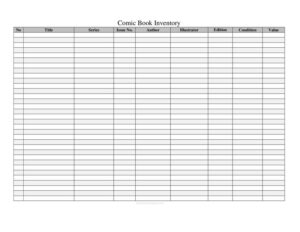
Comic Book Inventory
Track and catalog your collection with this free Comic Book Inventory template, recording titles, issues, condition, and value for free download.
PDF
DOC
7 downloads
0
likes
Download Files
- DOC
A Comic Book Inventory is a simple tracking sheet collectors use to catalog every issue they own, recording details like title, series, issue number, condition, and estimated value in one organized place. Most people reach for it when their stack of comics outgrows their memory and they need a reliable record for insurance, selling, or simply knowing what’s already in the box. You can download it free in PDF and DOCX, with no signup required.
What Is a Comic Book Inventory?
A Comic Book Inventory is a structured log that documents the individual comics in a collection, capturing the identifying details and condition of each issue. Hobbyists, dealers, estate executors, and insurance-conscious collectors all use it to keep an accurate, up-to-date picture of what they hold. Rather than relying on guesswork or scattered notes, the inventory consolidates each comic’s title, series, issue number, creators, edition, grade, and worth into rows you can sort and total. It serves as both a personal reference and proof of ownership. Whether you collect a handful of key issues or thousands of back issues, the inventory turns a casual pile into a documented, valued collection you can manage with confidence.
When Do You Need a Comic Book Inventory?
An inventory becomes useful the moment your collection is too large to track in your head. Common situations include:
- Insuring a collection — providing an itemized list with values to support a homeowners or specialty collectibles policy.
- Selling or trading — handing buyers a clear list of titles, issue numbers, conditions, and asking prices.
- Settling an estate — helping executors or heirs identify and fairly value comics left behind.
- Preventing duplicate purchases — checking before a convention or shop visit so you don’t buy issues you already own.
- Tracking appreciation — monitoring how the value of key issues changes over time.
- Organizing storage — knowing which long box or short box holds a particular series.
Types of Collectors Who Use One
The same template flexes to fit very different needs. A casual reader might log only the runs they care about, while a serious investor tracks graded slabs and first appearances with precise valuations. Comic shop owners use inventories to manage stock and pricing, and online sellers rely on them to list items consistently across marketplaces. Estate handlers, meanwhile, use the sheet to capture an unfamiliar collection quickly before appraisal. Regardless of scale, the inventory’s fields stay relevant.
What a Comic Book Inventory Should Have
A complete inventory makes every entry easy to identify and verify at a glance. The essentials include a sequential reference number, the comic’s title and series, the specific issue number, the creative team behind it, the edition or printing, an honest condition grade, and an estimated value. Together these elements let you locate a comic, distinguish it from similar issues, and justify its worth. Leaving room for totals at the bottom also helps you see the collection’s overall value.
How to Fill Out a Comic Book Inventory
- No. — Assign a sequential number to each entry so you can reference and count items easily; this also doubles as a storage index if you label boxes.
- Title — Write the comic’s name as printed on the cover, such as The Amazing Spider-Man.
- Series — Note the series or volume if the title has been relaunched (for example, Volume 2 or the publication-year run) to avoid confusion.
- Issue No. — Record the exact issue number, including annuals or special designations like #1 or #300.
- Author — Enter the writer credited for the story.
- Illustrator — List the primary artist or penciler; key artists can affect value.
- Edition — Specify the printing or variant (first print, second print, direct edition, variant cover).
- Condition — Grade the comic honestly using a standard scale such as Mint, Near Mint, Very Fine, Fine, Good, or Poor.
- Value — Add your estimated market value based on recent sales or a price guide, then total the column.
Grading and Valuing Your Comics
Condition drives value more than almost anything else, so be consistent and realistic in the Condition column. Many collectors use the standard descriptive scale (Mint down to Poor) or the numeric 0.5–10 scale used by professional grading services. Note visible flaws like spine ticks, creases, or color fading so the grade has context. For the Value field, base figures on recent comparable sales rather than wishful thinking, and revisit values periodically since markets shift with films, anniversaries, and demand. If a particular issue is especially valuable, consider professional grading, which seals and certifies the comic and can both protect and increase its worth. Keeping your value estimates current makes the inventory far more useful for insurance and selling.
Protecting and Storing Your Collection
An inventory is most valuable when it reflects comics that are actually well preserved. Store issues in acid-free bags with backing boards, keep them upright in sturdy long or short boxes, and shelter them from sunlight, humidity, and temperature swings. Use the No. field to mirror your physical organization so any listed comic can be pulled in seconds. Keep a backup copy of the completed inventory — a saved DOCX file or a photo of the printed sheet — somewhere separate from the collection itself, which is exactly what an insurer will want if a claim ever arises.
Common Mistakes to Avoid
- Overgrading condition — Inflating a comic’s grade leads to disputes with buyers and inaccurate insurance figures.
- Skipping the series or volume — Many titles have been relaunched, so issue #1 alone can be ambiguous without the volume.
- Ignoring edition and printing — A first print and a later reprint of the same issue can differ greatly in value.
- Letting values go stale — Outdated prices undercut the inventory’s usefulness for insurance and sales.
- Leaving entries incomplete — Blank fields make it hard to identify or verify a specific comic later.
- Keeping only one copy — Without a backup, a fire or flood could destroy both the comics and their record.
Frequently Asked Questions
What is a Comic Book Inventory used for? It is used to catalog and track every comic in a collection, recording details such as title, series, issue number, condition, and value. Collectors rely on it for insurance documentation, selling, estate purposes, and avoiding duplicate purchases.
How do I fill out the condition field? Use a recognized grading scale such as the descriptive Mint-to-Poor system or the numeric 0.5–10 scale, and grade honestly based on visible wear. Noting flaws like spine creases or fading gives the grade helpful context for buyers and insurers.
How should I estimate a comic’s value? Base your figure on recent comparable sales or a current price guide rather than asking price, and account for condition and edition. Because markets fluctuate, review and update your values periodically, especially for key issues.
Do I need professional grading to use this inventory? No. The template works fine with your own honest condition assessments. Professional grading is optional and most worthwhile for high-value or key issues, where certification can protect and potentially increase value.
Is this Comic Book Inventory template really free? Yes. You can download it free in both PDF and DOCX formats with no signup required, and edit or print it as many times as you need for personal or business use.
Can I use this for insurance documentation? Yes, an itemized inventory with conditions and values is exactly what many insurers want when covering a collection. Keep a backup copy stored separately from the comics and update values over time to keep coverage accurate.
This template is a general example provided for informational purposes only and does not constitute legal, financial, tax, or appraisal advice. Valuation methods, insurance requirements, and grading standards vary, so consult a qualified professional or appraiser for guidance specific to your collection.
Related Forms
- Equipment Inventory
- Depreciable Assets Log
- Covid Disinfecting Checklist
- New Car Inventory Card
- Collectibles Inventory
- Perpetual Inventory Form
Browse more in Log and Inventory.