
Corporate Minutes
Free corporate minutes template to document board and shareholder meeting resolutions clearly; download in PDF or DOCX with no signup required.
PDF
DOCX
3 downloads
0
likes
Download Files
- DOCX
Corporate minutes are the official written record of what happened at a company’s board or shareholder meeting, including who attended and what resolutions were adopted. People most often use a corporate minutes template to create a clean, consistent record that satisfies their bylaws and demonstrates that decisions were made properly. You can download this corporate minutes template free in PDF or DOCX, with no signup required.
What Are Corporate Minutes?
Corporate minutes are a formal summary of the proceedings of a corporate meeting, typically prepared by the corporate secretary or another appointed recorder. They document the type of meeting, the date and time, the people present, the reading of prior minutes, and any resolutions the directors or shareholders adopted. Minutes are not a word-for-word transcript; instead, they capture the key actions and decisions so they can be referenced later. Most corporations are required by their bylaws or by state law to keep minutes in a corporate records book. Properly maintained minutes show that the company observes corporate formalities, which helps preserve the legal separation between the business and its owners.
When Do You Need Corporate Minutes?
Corporations create minutes whenever a formal meeting takes place and decisions are made. Common situations include:
- Annual shareholder meetings — to record the election of directors, approval of financial statements, and other yearly business.
- Regular board of directors meetings — to document operational decisions, budget approvals, and officer appointments.
- Special meetings — called to address a single urgent matter such as a major purchase, loan, or contract.
- Approving significant transactions — opening bank accounts, authorizing officers to sign agreements, or issuing stock.
- Adopting or amending bylaws — recording structural changes to how the company is governed.
- Demonstrating compliance — when an auditor, lender, investor, or court asks for evidence that a decision was properly authorized.
Types of Corporate Meetings Minutes Cover
The same minutes format adapts to different meeting types. Board of directors minutes record management-level decisions and oversight matters. Shareholder minutes document votes by the owners, such as electing directors or approving mergers. Special meeting minutes are limited to the specific purpose stated in the meeting notice. Identifying the meeting type at the top of the document keeps your records organized and makes it easy to retrieve the right minutes when a question arises later.
What Corporate Minutes Should Include
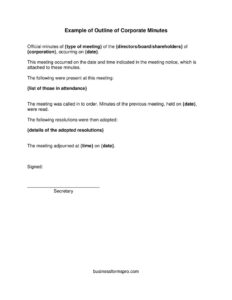
Complete and useful minutes generally contain the type of meeting and the entity name, the date and time it occurred, a reference to the meeting notice, the names of everyone present, confirmation that the previous meeting’s minutes were read or approved, the text or summary of each resolution adopted, and the time the meeting adjourned. The document should be dated and, where required, signed by the secretary or recorder. Accuracy and clarity matter more than length — anyone reading the minutes months later should understand exactly what was decided and by whom.
How to Fill Out Corporate Minutes
- Enter the type of meeting (for example, annual, regular, or special) and specify whether it is a meeting of the directors, board, or shareholders.
- Fill in the corporation’s full legal name exactly as it appears in the formation documents.
- Record the date the meeting occurred, and confirm that it matches the date and time stated in the meeting notice attached to these minutes.
- Under attendance, write the list of those in attendance, including officers, directors, shareholders, and any guests or counsel present.
- Note that the meeting was called to order, then enter the date of the previous meeting whose minutes were read or approved.
- In the resolutions section, enter the details of the adopted resolutions, summarizing each motion, who made and seconded it, and the outcome of the vote.
- Finally, record the time and date the meeting adjourned, then have the secretary sign and date the completed minutes.
Storing and Maintaining Your Minutes
Once finalized, minutes are typically approved at the next meeting and then filed in the corporate records book or digital equivalent. Keep them in chronological order alongside the related meeting notices, since the minutes reference an attached notice. Many corporations retain minutes permanently because they may be needed to prove past authorizations during audits, financing, due diligence in a sale, or litigation. Consistency is key: using the same template each time makes the full history easy to follow and shows that the company maintains its formalities reliably year after year.
How Minutes Differ From a Written Consent
Minutes document decisions made at an actual meeting, while a written consent (or unanimous written consent) records decisions made without holding a meeting, signed by directors or shareholders instead. Both create valid records, but they serve different situations. Use minutes when a meeting genuinely takes place; use a consent when everyone agrees to act in writing without convening. Knowing the difference helps you choose the right document and keep your records accurate.
Common Mistakes to Avoid
- Writing a transcript instead of a summary — minutes should capture decisions and key discussion, not every spoken word.
- Leaving out who was present — attendance affects whether a quorum existed and whether votes were valid.
- Omitting the resolution details — vague entries like “various matters discussed” provide no proof of what was authorized.
- Failing to attach or reference the meeting notice — the minutes state the notice is attached, so include it.
- Not approving minutes at the next meeting — approval confirms the record is accurate.
- Delaying preparation — drafting minutes long after the meeting risks forgotten details and errors.
Frequently Asked Questions
What are corporate minutes used for? Corporate minutes are used to create an official record of what occurred at a board or shareholder meeting, including attendance and the resolutions adopted. They serve as evidence that decisions were made properly and in accordance with the company’s bylaws. Lenders, investors, auditors, and courts may request them to confirm that a particular action was authorized.
How do I fill out this corporate minutes template? Start by entering the meeting type, the corporation’s name, and the meeting date, then list everyone in attendance. Record that the meeting was called to order, note the previous meeting’s date, summarize each resolution adopted, and finish with the adjournment time. The secretary or recorder then signs and dates the completed minutes.
Do corporate minutes need to be notarized? Notarization is generally not required for corporate minutes. They are usually signed by the corporate secretary or the meeting’s recorder and kept in the corporate records book. Requirements can vary, so check your bylaws and your state’s rules if you are unsure whether any additional formality applies.
Who is responsible for preparing the minutes? The corporate secretary typically prepares and maintains the minutes, though any designated recorder may take them during the meeting. Whoever drafts the minutes should ensure they accurately reflect attendance, resolutions, and timing. The minutes are usually reviewed and approved at the following meeting.
Are corporate minutes legally required? Many states and most corporate bylaws require corporations to keep minutes of their meetings as part of maintaining proper records. Failing to keep minutes can weaken the corporate veil and create problems during audits or disputes. Because requirements vary by jurisdiction and entity type, confirm what applies to your specific corporation.
Is this corporate minutes template free to download? Yes. You can download this corporate minutes template completely free in both PDF and DOCX formats, with no signup or payment required. The editable DOCX version lets you customize the headings and resolution sections to fit your meeting before printing or filing.
This corporate minutes template is provided as a general example for informational purposes only and is not legal, financial, or tax advice. Recordkeeping requirements vary by state and by entity type, so consult a qualified attorney or corporate professional to ensure your minutes meet the rules that apply to your corporation.
Related Forms
- Request Transcript
- Correct Credit Report
- Individual RSVP Form
- 6 S Work Sign
- Driving Directions
- Military Time Chart
Browse more in Miscellaneous.