
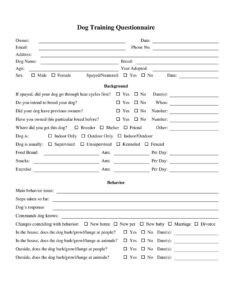
Dog Training Behavior Questionnaire
Download a free Dog Training Behavior Questionnaire template to assess a dog's history, habits, and goals before training—free PDF and DOCX download.
PDF
DOC
2 downloads
0
likes
Download Files
- DOC
A Dog Training Behavior Questionnaire is an intake form that dog trainers, behaviorists, and rescues use to gather a dog’s full history, daily habits, and problem behaviors before the first training session. It’s most commonly used to understand a dog’s background and tailor a training plan to that specific animal, and you can download it free here in both PDF and DOCX formats with no signup required.
What Is a Dog Training Behavior Questionnaire?
A Dog Training Behavior Questionnaire is a structured intake document completed by a dog’s owner and reviewed by a professional trainer or behavior consultant. It captures essential details such as the dog’s breed, age, medical history, diet, household environment, and the specific behaviors that prompted the owner to seek help. The form documents not only what the dog does, but the context surrounding each behavior—when it happens, how often, and how the owner currently responds. By collecting this information upfront, trainers save valuable session time, avoid repeating questions, and build a baseline they can measure progress against. It functions as both an assessment tool and a written record for the training relationship.
When Do You Need a Dog Training Behavior Questionnaire?
This questionnaire is useful any time a professional needs a clear picture of a dog before working with it. Common scenarios include:
- Onboarding a new client — a trainer sends the form before the first consultation to prepare a customized approach.
- Addressing problem behaviors — owners report issues like leash pulling, jumping, barking, separation anxiety, or aggression toward people or other dogs.
- Rescue and shelter intake — staff document a surrendered or rescued dog’s known history and temperament for adopters and foster families.
- Board-and-train or daycare admission — facilities collect behavior and health details to keep staff and other dogs safe.
- Switching trainers or programs — a new professional uses the questionnaire to understand what methods have already been tried.
- Group class enrollment — instructors screen dogs for reactivity or special needs before placing them in a class setting.
What a Dog Training Behavior Questionnaire Should Have
A complete questionnaire balances factual data with behavioral observation. It should capture the dog’s identification details (name, breed, age, sex, and whether spayed or neutered), relevant medical and dietary history, and the household environment including other pets and family members. Just as important are the behavioral sections: a description of the issues the owner wants to address, the situations that trigger them, the dog’s typical reactions, and any prior training. Strong forms also ask about the owner’s goals and expectations, so the trainer can set realistic milestones. Space for the trainer’s own notes and an owner signature acknowledging the information is accurate rounds out a thorough document.
How to Fill Out a Dog Training Behavior Questionnaire
Work through the form section by section, answering as honestly and specifically as possible:
- Owner contact information. Enter your name, address, phone number, and email so the trainer can follow up.
- Dog details. Record the dog’s name, breed or breed mix, age, sex, weight, and spay/neuter status.
- Health background. List vaccinations, current medications, known medical conditions, allergies, and your veterinarian’s contact details.
- Diet and routine. Describe what and how often the dog eats, exercise habits, and daily schedule.
- Household environment. Note who lives in the home, the presence of children, and any other pets.
- Behavior history. Describe the specific behaviors you want to change—give examples, when they started, and how often they occur.
- Triggers and responses. Identify what sets off each behavior and how you currently react to it.
- Prior training. List any classes, methods, or tools you’ve used and the results.
- Goals. State what success would look like for you and your dog.
- Signature and date. Sign to confirm the information is accurate.
Why Accurate Behavior Details Matter
The quality of a training plan depends almost entirely on the accuracy of the information in this form. Vague answers like “my dog is bad on walks” give a trainer little to work with, while a precise note—”lunges and barks at other dogs within about ten feet on the sidewalk, calmer in open parks”—immediately points toward a leash-reactivity protocol. Be especially candid about any bite history, growling, or resource guarding; withholding these details can put trainers, family members, and other dogs at risk and may lead to an unsuitable program. Trainers are professionals who have seen the full range of canine behavior, so there is no benefit to downplaying problems. The more context you provide about your dog’s environment, routine, and emotional state, the faster a trainer can identify patterns and design an effective, humane plan.
Using the Questionnaire to Track Progress
Beyond intake, this form becomes a baseline reference throughout the training relationship. A trainer can revisit the original responses after a few weeks to measure how a dog’s reactions and frequency of problem behaviors have changed. Keep a copy for your own records, and consider noting dates beside key answers so you can see how long an issue has persisted. If you ever move, change trainers, or board your dog, having this completed document ready saves everyone time and gives the next professional an instant, organized history.
Common Mistakes to Avoid
- Leaving sections blank — incomplete medical or behavior fields force the trainer to chase missing details later.
- Minimizing aggression or bite history — this is a safety issue and should always be disclosed fully.
- Being too vague — describe behaviors with specific examples, frequency, and context rather than general labels.
- Forgetting the dog’s routine — diet, exercise, and sleep patterns often explain behavior more than owners expect.
- Setting unrealistic goals — be honest about your time and consistency so milestones stay achievable.
- Skipping the signature or date — an unsigned form may not serve as a reliable record.
Frequently Asked Questions
What is a Dog Training Behavior Questionnaire used for? It is an intake tool that lets a trainer or behaviorist understand a dog’s history, environment, and problem behaviors before starting work. The information helps build a tailored, effective training plan and serves as a written baseline to measure progress over time.
How do I fill out a Dog Training Behavior Questionnaire? Complete each section in order—owner details, dog details, health, diet and routine, household, behavior history, triggers, prior training, and goals—then sign and date it. Answer with specific examples rather than general statements so the trainer gets an accurate picture.
Should I disclose my dog’s aggression or bite history? Yes, always. Honest disclosure of growling, biting, or resource guarding is essential for the safety of trainers, family members, and other animals, and it ensures your dog is placed in an appropriate program. Withholding this information can lead to an unsafe or ineffective plan.
Is this questionnaire a legally binding document? No, it is an informational intake form, not a contract. Some trainers may pair it with a separate service agreement or liability waiver that does carry legal weight, but the questionnaire itself simply records the dog’s history and your goals.
How much does this template cost? It is completely free to download from Business Forms Pro in both PDF and DOCX formats, with no signup required. You can edit the DOCX version to add your business logo or adjust the fields to suit your practice.
Can I customize the form for my training business? Absolutely. The DOCX version is fully editable, so you can add questions about specific methods you use, insert your branding, or remove sections that do not apply. Many trainers tailor the questionnaire to match the species, breeds, or behavior issues they specialize in.
This template is provided as a general example for informational purposes only and does not constitute professional, veterinary, behavioral, or legal advice. Dog behavior and training needs vary by individual animal, and requirements or best practices may differ by region—consult a qualified veterinarian or certified trainer for guidance specific to your situation.
Related Forms
- Confirming Interview
- Production Goal Sign
- Do Not Adjust Thermostat Sign
- Letter to Legislator Giving Support
- Restaurant Shift Schedule
- Driving Directions With Map
Browse more in Miscellaneous.