
Job Rejection Letter
Decline a job offer politely with our free Job Rejection Letter template — keep the door open for future roles. Free download in PDF and DOCX.
DOCX
0
likes
Download Files
- DOCX
A Job Rejection Letter — more accurately a candidate’s letter declining a job offer — is a short, professional note you send to an employer to turn down a position you’ve been offered. People most often use it to decline an offer gracefully while preserving the relationship for future opportunities. It’s free to download here in both PDF and DOCX, with no signup required.
What Is a Job Rejection Letter?
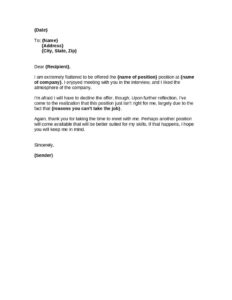
A Job Rejection Letter is a courteous written message sent by a job applicant to a hiring manager or recruiter to formally decline an offer of employment. While employers also send rejection letters to candidates, this particular template is written from the candidate’s perspective — thanking the company for the offer, expressing genuine appreciation for the interview, and politely stating that you won’t be accepting the role. The letter documents your decision in writing, prevents confusion about whether you intend to start, and leaves a positive final impression. A well-crafted version reflects professionalism, gratitude, and tact, which matters because hiring circles are smaller than they seem.
When Do You Need a Job Rejection Letter?
There are many situations where sending a brief, polished decline is the right move rather than simply going silent:
- You received and accepted a better offer from another company and need to formally decline this one.
- After further reflection, the role, responsibilities, or company culture don’t feel like the right fit for you.
- The compensation, benefits, or relocation requirements don’t match your needs or expectations.
- Your personal circumstances changed — a family situation, health matter, or a decision to stay in your current job.
- The commute, work schedule, or remote-work arrangement no longer works for your life.
- You want to decline politely while keeping the door open in case a more suitable position opens up later.
In each case, a written letter or email is more respectful than a phone-tag voicemail and gives the employer clear, documented notice so they can move forward with other candidates.
What a Job Rejection Letter Should Have
A strong decline letter is brief but complete. It should include the date, the recipient’s name and contact details, and a respectful greeting. The opening should thank the company and acknowledge the offer by name. The core of the letter clearly states that you are declining, ideally with a short, gracious reason that does not burn bridges. It should close with continued appreciation, an expression of interest in future possibilities if appropriate, and your signature. Above all, the tone should be warm, concise, and free of complaints or criticism — even if your reasons for declining are negative, the letter is not the place to air them.
How to Fill Out a Job Rejection Letter
Follow these steps to complete the template field by field:
- Enter the {Date} you are sending the letter at the top.
- In the To: block, add the recipient’s {Name}, {Address}, and {City, State, Zip} — typically the hiring manager or recruiter who extended the offer.
- Open with the greeting Dear {Recipient}, using the person’s proper title and last name for a professional tone.
- Fill in the {name of position} you were offered and the {name of company} so there is no ambiguity about which offer you are addressing.
- Complete the {reasons you can’t take the job} field with a brief, diplomatic explanation — for example, accepting another opportunity or deciding the role isn’t the right fit. Keep it honest but tactful.
- Review the closing lines, which thank the interviewer and invite future contact, then sign as the {Sender} with your full name.
Read it once more for warmth and clarity before sending it by email or printed letter.
How to Word Your Reasons Tactfully
The single most delicate part of the letter is the {reasons you can’t take the job} line. You do not owe the employer an exhaustive explanation, and you should never criticize the team, the interviewer, or the salary in writing. Safe, gracious phrasings include “I have decided to pursue an opportunity that more closely aligns with my long-term goals,” “after careful consideration, I’ve chosen to remain in my current role,” or simply “this position isn’t the right fit for me at this time.” Brevity is a courtesy — a vague but polite reason is perfectly acceptable. If you genuinely admired the company, say so; that sincerity is what makes them want to call you again later.
Letter vs. Email and Timing
A printed letter feels formal and is appropriate for senior roles or traditional industries, while a well-written email is faster and increasingly standard. Either format works as long as the content is professional. Timing matters more than format: send your decline as soon as you’ve made a firm decision, ideally within a day or two of the deadline the employer gave you. Prompt notice lets the company extend the offer to another candidate without losing them. If you’ve been communicating by phone, it’s gracious to call first and then follow up with the written letter to confirm your decision in writing.
Common Mistakes to Avoid
- Going silent and never responding — declining without a word damages your reputation and may close future doors.
- Over-explaining or listing complaints about the company, the role, or the salary in the reason line.
- Naming the competing employer or disclosing the exact salary you accepted elsewhere.
- Sending the letter weeks late, after the employer has already been waiting for an answer.
- Forgetting to thank the interviewer or acknowledge the time the team invested in you.
- Leaving template placeholders like {name of position} or {Recipient} unfilled in the final version.
Frequently Asked Questions
What is a Job Rejection Letter? In this template it is a letter a candidate sends to an employer to politely decline a job offer. It thanks the company, clearly states that you won’t be accepting the position, and leaves the relationship on good terms. It serves as written confirmation of your decision.
How do I fill out the Job Rejection Letter? Add the date, the recipient’s name and address, and a respectful greeting, then insert the position title and company name. Briefly and tactfully fill in your reason for declining, then close with thanks and your signature. Keep the entire letter short and gracious.
Do I have to give a reason for declining the offer? No, you are not obligated to provide a detailed explanation. A brief, diplomatic reason — such as accepting another opportunity or deciding the role isn’t the right fit — is courteous and usually sufficient. Avoid criticism and keep the tone positive.
Is a Job Rejection Letter legally binding? Declining an offer you have not signed or accepted generally carries no legal obligation, since no employment contract has been formed. However, if you previously signed an acceptance, review any terms before declining. When in doubt about a signed agreement, consult a professional.
Should I send it by email or mail? Either is acceptable. Email is faster and works well for most roles, while a printed letter feels more formal for senior or traditional positions. If you’ve been speaking by phone, a quick call followed by a written confirmation is the most considerate approach.
How much does this template cost? Nothing — this Job Rejection Letter template is completely free to download in PDF and DOCX formats with no signup required. You can edit the DOCX version in your word processor and customize the wording before sending.
This template is a general example provided for informational purposes only and does not constitute legal, career, or employment advice. Employment customs and any contractual obligations vary by situation and jurisdiction — if you have signed an offer or have questions about your obligations, consult a qualified professional.
Related Forms
- Babysitting Instructions
- Dressing Room Numbers
- Visitor Badges
- Entry Form White
- Membership Cancellation Form
- Backstage Pass
Browse more in Miscellaneous.