
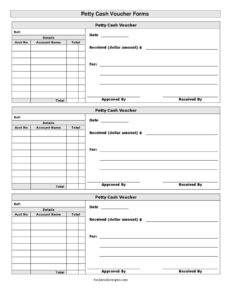
Petty Cash Voucher
Download a free Petty Cash Voucher template in PDF and DOCX to record small cash payments, track receipts, and keep your petty cash fund balanced.
PDF
DOC
4 downloads
1
likes
Download Files
- DOC
A petty cash voucher is a simple slip used to record a small cash payment made from a company’s petty cash fund. People most often reach for one when an employee buys low-cost items — postage, office supplies, parking, refreshments — and needs to document where the cash went. You can download this petty cash voucher free in both PDF and DOCX, with no signup required.
What Is a Petty Cash Voucher?
A petty cash voucher is an internal accounting document that authorizes and records the disbursement of cash from a petty cash fund for a minor, everyday expense. It is typically prepared by the person requesting reimbursement, signed by an approver, and signed again by the person who actually receives the cash. The voucher captures the amount paid, the reason for the payment, the account it should be charged to, and the date. Once completed, it serves as the supporting record that explains a reduction in the cash drawer, and it is reconciled against the fund when the petty cash is replenished and balanced.
When Do You Need a Petty Cash Voucher?
Any time cash leaves the petty cash box, a voucher should be filled out so the fund stays accountable. Common situations include:
- Reimbursing an employee who paid out of pocket for stamps, envelopes, or printer paper.
- Paying a courier, delivery driver, or parking attendant in cash on the spot.
- Buying refreshments, coffee, or snacks for a meeting or client visit.
- Covering small repairs, cleaning supplies, or hardware-store items under the fund limit.
- Petty travel costs such as a taxi fare, toll, or transit ticket.
- Recording any cash advance given to a staff member for a minor errand, to be settled with a receipt later.
In short, the voucher exists for the small, frequent transactions that are too minor for a check or purchase order but still need a paper trail.
What a Petty Cash Voucher Should Have
A complete voucher leaves no question about who spent what, when, and why. The essentials are a unique reference number, the date of the payment, a clear description of the purchase, the general ledger account number and name it should be posted to, and the exact dollar amount disbursed. Just as important are the two approvals: the signature of the person authorizing the payment and the signature of the person receiving the cash. Together these fields create accountability on both sides of the transaction and make end-of-period reconciliation straightforward. Attaching the original store receipt to the voucher strengthens the record considerably.
How to Fill Out a Petty Cash Voucher
- Ref: Assign a sequential reference number (for example PC-001) so the voucher can be tracked and matched to the fund log.
- Date: Enter the date the cash was actually paid out, not the date the receipt was issued if they differ.
- Details: Describe the expense plainly — “postage for client mailing” or “coffee for board meeting” — specific enough to justify the spend later.
- Acct No: Record the general ledger or expense account number the cost should be charged to.
- Account Name: Write the matching account name, such as Office Supplies or Travel, so bookkeeping is unambiguous.
- Total: Enter the full amount of the purchase.
- Received (dollar amount): State the exact cash handed over, both in figures and, where space allows, in words.
- For: Note the purpose or recipient if it adds clarity beyond the details line.
- Approved By: Have the authorizing manager or fund custodian sign.
- Received By: The person taking the cash signs to confirm receipt.
Reconciling and Replenishing the Fund
Petty cash works on the imprest system: the fund starts at a set float, say $200, and at any moment the cash on hand plus the total of all outstanding vouchers should equal that float. When the cash runs low, the custodian gathers every voucher, sums the amounts, and requests a top-up equal to the total spent. The vouchers are then posted to their respective expense accounts and the box is brought back to its full float. Keeping vouchers numbered sequentially and filed by date makes this monthly or weekly count fast and reduces the chance of a missing slip throwing the balance off.
Tips for a Tidy Petty Cash System
Set a clear maximum amount that can be paid from petty cash for any single transaction, and require a check or card for anything above it. Always staple the receipt to the voucher, and store completed vouchers in the box until reconciliation so the count is self-explaining. Limit who holds the key and who can approve disbursements — separating the person who approves from the person who receives, where practical, adds a healthy control. Review the fund regularly to confirm the float size still matches your spending patterns.
Common Mistakes to Avoid
- Leaving the details or “for” line vague, so no one can tell what the money bought months later.
- Skipping the receipt — a voucher without supporting documentation is hard to verify and easy to dispute.
- Forgetting one or both signatures, which undermines the approval and receipt trail.
- Reusing or duplicating reference numbers, which breaks sequential tracking.
- Posting to the wrong account number, throwing off expense reports.
- Letting cash leave the box without a voucher at all, guaranteeing the fund won’t balance.
Frequently Asked Questions
What is a petty cash voucher used for? It records a small cash payment made from a company’s petty cash fund and shows the amount, purpose, account, and approvals. It acts as the supporting document that explains why cash left the drawer. Each voucher is later reconciled against the fund when it is replenished.
How do I fill out a petty cash voucher? Enter a reference number and date, describe the expense in the details and “for” fields, record the account number and name, and write the total and the amount received. Then have the approver and the recipient sign. Attaching the receipt completes the record.
Does a petty cash voucher need to be signed? Yes — at minimum it should carry the signature of the person who approved the payment and the person who received the cash. These two signatures create accountability on both ends of the transaction. Some organizations also require the custodian to initial it.
Do I need to attach a receipt? It is strongly recommended. The original receipt verifies the amount and the purpose, making reconciliation and any later audit far simpler. If no receipt is available, a written note explaining why should be attached instead.
How much does this template cost? Nothing — it is completely free to download here in both PDF and DOCX formats, with no signup required. You can print it as-is or open the editable version to add your company name, logo, or account list.
Is a petty cash voucher a legal document? It is primarily an internal accounting and control record rather than a formal legal contract. That said, properly completed vouchers form part of your financial records and can support tax filings and audits. Keep them filed with your other accounting documentation.
This petty cash voucher template is a general example provided for informational purposes only and is not legal, financial, or tax advice. Accounting and record-keeping requirements vary by jurisdiction and organization — consult a qualified accountant or financial professional for guidance specific to your situation.
Official resource: for the rules that apply to your situation, see the Consumer Financial Protection Bureau.
Related Forms
- Debt Payment Organizer
- Account Reconciliation Form
- Coffee Cash Envelope
- Kids Cash Envelope
- Debt Worksheet
- Travel Cash Envelope
Browse more in Money.