
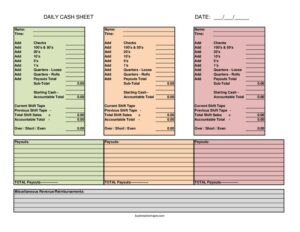
Daily Cash Sheet (3 shifts)
Download a free Daily Cash Sheet template for 3 shifts to count drawers, reconcile sales, and track over/short — free PDF and DOCX download.
PDF
XLSX
16 downloads
0
likes
Download Files
- XLSX
A Daily Cash Sheet (3 shifts) is a reconciliation form used to count cash, tally payouts, and compare a register’s actual money against its expected sales across morning, afternoon, and evening shifts. The most common reason businesses use it is to catch register discrepancies the same day they happen rather than weeks later. You can download this Daily Cash Sheet free in both PDF and DOCX formats — no signup required.
What Is a Daily Cash Sheet (3 Shifts)?
A Daily Cash Sheet is a worksheet that records every dollar passing through a register or cash drawer during a business day. The three-shift version splits the day into separate counting periods, so each person who handles the drawer is accountable for their own time on the register. It documents the breakdown of bills and coins, checks taken in, cash paid out, starting cash, and the running tape totals from the point-of-sale system. The bottom line is the over/short figure — the gap between what the register reports it should hold and what is physically counted. Managers, cashiers, and bookkeepers all rely on it to verify daily takings and prepare the bank deposit.
When Do You Need a Daily Cash Sheet (3 Shifts)?
Any operation that runs multiple shifts and accepts cash benefits from a structured daily count. Typical situations include:
- A restaurant or cafe handing off the same drawer between breakfast, lunch, and dinner crews.
- A retail store with morning, mid-day, and closing cashiers who each need individual accountability.
- A bar or convenience store reconciling cash at every shift change to pin down exactly when a shortage occurred.
- A franchise location required to submit daily cash reports to a regional or corporate office.
- A small business owner preparing the nightly bank deposit and matching it to register tapes.
- An auditor or manager investigating recurring over/short patterns tied to a specific shift or employee.
What a Daily Cash Sheet Should Have
A complete daily cash sheet captures three things for each shift: who counted, what was physically in the drawer, and what the system says should have been there. That means a detailed denomination breakdown (bills and coins), a line for checks received, the starting cash float, all payouts removed from the drawer, current and previous shift register tapes, total shift sales, and any miscellaneous revenue or reimbursements. The most important output is the over/short/even line, which reveals at a glance whether the count balances. Space for the counter’s name and the time of the count ties responsibility to each shift so discrepancies can be traced.
How to Fill Out a Daily Cash Sheet (3 Shifts)
- Enter the name of the person counting the drawer and the time the count is taken so the shift is clearly identified.
- Count the cash by denomination: record the value of 100’s & 50’s, 20’s, 10’s, 5’s, 1’s, and quarters, then add any checks taken in.
- Add these to reach a sub-total of everything physically in the drawer.
- Total all cash removed during the shift in the payouts total line, and itemize them under payouts and total payouts.
- Subtract the starting cash float that was placed in the drawer at the start of the shift.
- Calculate the accountable total — the cash the shift actually generated after removing the float.
- Record the current shift tape and previous shift tape register readings, then derive total shift sales.
- Add any miscellaneous revenue/reimbursements, then compare the accountable total to expected sales to enter the final over/short/even figure.
Understanding the Over/Short Line
The over/short/even result is the single most useful number on the sheet. A reading of “even” means the drawer balanced perfectly. “Over” means there was more money than the register expected — often a sign of incorrect change given or an unrecorded sale. “Short” means money is missing, which can stem from giving too much change, ringing items wrong, voids, or theft. Small variances of a few cents are normal and usually caused by rounding. Persistent or large shortages tied to one shift are worth investigating. Because the three-shift layout isolates each counting period, you can identify exactly when a discrepancy appeared instead of guessing across an entire day.
Tips for Accurate Daily Counts
Always count the drawer in a quiet, interruption-free spot and have a second person verify large totals when possible. Reset the starting cash float to the same amount at the beginning of every shift so the math stays consistent. Keep receipts for every payout — a vendor paid in cash, a refund, or petty cash withdrawal — and staple them to the sheet so the payouts total can be proven. Record the register tape readings at the exact moment of the count, not before serving the last customer. File completed sheets by date so you can spot trends and reconcile them against your monthly bookkeeping.
Common Mistakes to Avoid
- Forgetting to subtract the starting cash float, which inflates the accountable total and creates a false “over.”
- Leaving payouts undocumented, so cash that legitimately left the drawer looks like a shortage.
- Mixing up the current and previous shift tape readings, throwing off total shift sales.
- Miscounting coin rolls or skipping the quarters line entirely.
- Not writing the counter’s name and time, making it impossible to trace a discrepancy to a shift.
- Treating every small over/short as theft instead of recognizing routine rounding differences.
Frequently Asked Questions
What is a Daily Cash Sheet used for? It is used to count and reconcile the money in a register against expected sales each day. The three-shift format lets each cashier be accountable for their own time, making it easier to find and fix discrepancies promptly and to prepare an accurate bank deposit.
How do I calculate over/short? Total your physical cash and checks, subtract the starting cash float, add miscellaneous revenue, and account for payouts to get your accountable total. Compare that to the shift sales from your register tapes — a positive difference is “over,” a negative one is “short,” and a match is “even.”
Why split the sheet into three shifts? Splitting the day into separate counts isolates each cashier’s drawer activity. If a shortage appears, you can see exactly which shift it occurred in rather than reviewing an entire day’s transactions, which speeds up investigation and reinforces individual accountability.
Do small over/short amounts mean someone is stealing? Not usually. Variances of a few cents to a dollar are typically caused by rounding or honest change-making errors. Repeated or large shortages tied to a specific person or shift are what warrant a closer look.
Is this Daily Cash Sheet free to download? Yes. You can download the Daily Cash Sheet (3 shifts) template completely free in both PDF and DOCX formats with no signup required. Use the PDF for quick printing or the DOCX to customize the fields for your business.
Can I customize the denominations or fields? Absolutely. The DOCX version is fully editable, so you can adjust the bill and coin lines, add a column for credit card totals, rename payout categories, or insert your business name and logo to fit your specific register setup.
This Daily Cash Sheet template is a general example provided for informational purposes only and is not financial, accounting, or tax advice. Cash-handling and recordkeeping requirements vary by business and jurisdiction — consult a qualified accountant or bookkeeping professional for guidance specific to your operation.
Official resource: for the rules that apply to your situation, see the Consumer Financial Protection Bureau.
Related Forms
- Tip Jar Labels
- Accounts Receivable Aging
- Debt Repayment Plan
- Credit Change Notice
- Roommate Expense Tracker
- Advertising Budget
Browse more in Money.