
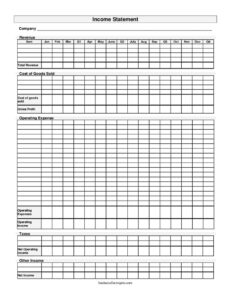
Income Statement
Download a free Income Statement template in PDF and DOCX to track monthly and quarterly revenue, expenses, and net income — free template, no signup.
PDF
DOC
0
likes
Download Files
- DOC
An income statement is a financial report that summarizes a company’s revenue, expenses, and resulting profit or loss over a defined period. People most often use it to see whether a business actually made money during a month, quarter, or year. This income statement template is free to download in both PDF and DOCX formats, with monthly columns that roll up into quarterly and annual totals.
What Is an Income Statement?
An income statement — also called a profit and loss statement (P&L) — is one of the three core financial statements, alongside the balance sheet and cash flow statement. It is prepared by a business owner, bookkeeper, or accountant to show how revenue is converted into profit after subtracting the costs of running the business. The statement starts with total revenue at the top, deducts the cost of goods sold to reach gross profit, then subtracts operating expenses, taxes, and adjusts for other income to arrive at net income. This template organizes those line items by month (Jan through Dec), groups them into quarters (Q1–Q4), and produces totals so you can read performance at a glance.
When Do You Need an Income Statement?
This document is useful whenever someone needs to understand whether a business is profitable and where its money goes. Common scenarios include:
- Monthly bookkeeping reviews — closing the books and checking each month’s revenue against expenses.
- Quarterly reporting — summarizing Q1 through Q4 results for partners, investors, or a board.
- Year-end tax preparation — handing your accountant a clean annual profit and loss to support a return.
- Applying for a loan or line of credit — lenders frequently request recent income statements.
- Pitching investors or selling a business — buyers and backers evaluate profitability trends over time.
- Budgeting and forecasting — comparing actual results to projections to adjust spending.
Types of Income Statements
There are two common formats. A single-step income statement groups all revenue together and all expenses together, then subtracts one from the other. A multi-step income statement — the structure this template follows — separates the calculation into stages: gross profit, operating income, and finally net income. The multi-step format is more informative because it shows the margin at each level, which helps you pinpoint whether a profit problem comes from pricing, production costs, or overhead.
What an Income Statement Should Have
A complete income statement clearly identifies the business and the reporting period, then walks through each profit calculation in order. The essential elements in this template are the company name, total revenue, cost of goods sold, gross profit, operating expenses, operating income, taxes, other income, and net income. Monthly columns and quarterly subtotals make the figures easy to audit and compare. Every section should reconcile — gross profit must equal revenue minus cost of goods sold, and net income must reflect every deduction and addition above it. Consistency in how you classify items from period to period is what makes the statement trustworthy and comparable.
How to Fill Out an Income Statement
- Enter the company name and the period the statement covers at the top.
- List each revenue source by item, then record amounts in the monthly columns: jan, feb, mar (which sum to Q1), apr, may, june (Q2), july, aug, sep (Q3), and oct, nov, dec (Q4).
- Add the quarters to produce total revenue for the year.
- Enter cost of goods sold — the direct costs of producing what you sell.
- Subtract it from total revenue to calculate gross profit.
- Record operating expense items such as rent, salaries, utilities, and marketing.
- Subtract operating expenses from gross profit to get operating income.
- Enter taxes, then compute net operating income.
- Add any other income (interest, one-time gains) and finalize net income.
Reading the Numbers After You Fill It In
Once the statement is complete, the value comes from interpreting it. Compare gross profit to total revenue to find your gross margin — a falling margin usually signals rising production costs or discounting. Track operating income across the four quarters to see whether overhead is growing faster than sales. Net income is the bottom line, but it can be distorted by unusual items captured in other income, so review that line separately. Looking at month-over-month and quarter-over-quarter trends often reveals seasonality and lets you plan staffing, inventory, and cash needs more accurately.
How It Differs from a Balance Sheet
An income statement covers a period of time and answers “did the business make a profit?” A balance sheet captures a single point in time and answers “what does the business own and owe?” The two work together: net income from the income statement flows into retained earnings on the balance sheet. Keeping them separate but reconciled gives a fuller picture of financial health, which is why lenders and investors usually ask for both.
Common Mistakes to Avoid
- Mixing personal and business expenses — only business activity belongs on the statement.
- Misclassifying cost of goods sold as operating expense — this distorts your gross profit and margin.
- Forgetting to total the quarters — quarterly subtotals must add up to total revenue.
- Recording revenue when cash is received instead of when it is earned — choose a consistent accounting method.
- Omitting taxes or other income — leaving lines blank overstates true net income.
- Changing categories between periods — inconsistent classification makes comparisons meaningless.
Frequently Asked Questions
What is an income statement used for? It is used to measure a company’s profitability over a period by subtracting expenses, cost of goods sold, and taxes from revenue. Business owners use it for bookkeeping, lenders use it to assess creditworthiness, and accountants use it to prepare tax returns.
How do I fill out this income statement template? Enter your company name and period, then record revenue by month so the quarterly and annual totals populate. Subtract cost of goods sold to get gross profit, deduct operating expenses and taxes, add any other income, and the bottom line is your net income.
What is the difference between gross profit and net income? Gross profit is revenue minus the cost of goods sold, showing how profitable your core product or service is. Net income is what remains after also subtracting operating expenses and taxes and adding other income — it is the true bottom-line profit.
Do I need an accountant to prepare one? You can complete a straightforward income statement yourself using this template, especially for internal reviews. For tax filings, loan applications, or audited statements, it is wise to have an accountant verify the figures and classifications.
Is an income statement the same as a profit and loss statement? Yes. “Income statement” and “profit and loss statement” (or P&L) refer to the same report. The terms are used interchangeably across accounting software and financial reporting.
How much does this template cost? It is completely free to download in both PDF and DOCX formats, with no signup required. You can edit the DOCX version to add your own line items or adjust the layout to match your business.
This income statement template is a general example provided for informational purposes only and does not constitute legal, financial, accounting, or tax advice. Accounting standards and reporting requirements vary by jurisdiction and business type — consult a qualified accountant or financial professional before relying on this document.
Official resource: for the rules that apply to your situation, see the Consumer Financial Protection Bureau.
Related Forms
- Payment Calculator per $10000
- Tax Refund Planner
- Home Budget Cuts Worksheet
- Travel Cash Envelope
- Fixed Expenses Worksheet
- Petty Cash
Browse more in Money.