
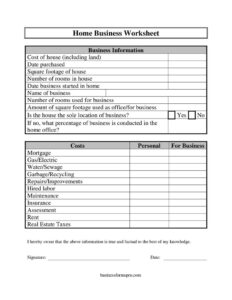
Home Business Worksheet
Download a free Home Business Worksheet template to track home office square footage and expenses for your tax deduction — free PDF and DOCX download.
PDF
DOCX
1 downloads
0
likes
Download Files
- DOCX
A Home Business Worksheet is a simple organizing document that helps you record the size of your home office and the household expenses tied to running a business from home. Most people use it to gather the numbers needed to calculate a home office tax deduction or to keep tidy records for an accountant. You can download it free in PDF and DOCX, with no signup required.
What Is a Home Business Worksheet?
A Home Business Worksheet is a one-page record used by self-employed people, freelancers, and small business owners who operate out of their residence. It captures two kinds of information: the physical space used for business (square footage and number of rooms) and the recurring costs of maintaining the home (mortgage or rent, utilities, insurance, repairs, and taxes). By documenting these figures in one place, the worksheet makes it easier to determine what portion of household expenses can reasonably be attributed to the business. It is not a tax form itself, but a worksheet that feeds into deduction calculations and gives your accountant clean, organized source data at filing time.
When Do You Need a Home Business Worksheet?
This worksheet is useful any time the line between household and business expenses needs to be measured. Common situations include:
- You run a freelance, consulting, or e-commerce business from a spare room and want to claim a home office deduction.
- Your accountant or tax preparer asks you to summarize home office square footage and annual home expenses.
- You are starting a business in your home and want to establish a clear record from the date the business began.
- You operate out of multiple locations and need to document what percentage of business is conducted in the home office.
- You are reviewing whether the home office method or actual-expense method gives a better result.
- You want organized records on hand in case of an audit or a request for supporting documentation.
What a Home Business Worksheet Should Have
A complete worksheet ties space to cost. The essentials are the business information (name of business and date business started in the home), the space measurements (square footage of the house, square footage used for business, number of rooms in the house, and number of rooms used for business), and the home and ownership details (cost of house including land, date purchased, and assessment). It should also list the recurring expenses — mortgage or rent, real estate taxes, insurance, gas/electric, water/sewage, garbage/recycling, maintenance, repairs/improvements, and hired labor — with space to split each amount between business and personal use. Finally, it needs a certification: a signature, the date, and a statement swearing the information is true.
How to Fill Out a Home Business Worksheet
- Enter the Business Information, including the Name of business and the Date business started in home.
- Answer whether the house is the sole location of business. If no, write the percentage of business conducted in the home office.
- Record the Square footage of house and the amount of square footage used as office/for business; this ratio drives most calculations.
- Fill in the Number of rooms in house and the Number of rooms used for business as an alternate measure.
- Provide ownership details: Cost of house (including land), Date purchased, and the property Assessment.
- List each expense — Mortgage or Rent, Real Estate Taxes, Insurance, Gas/Electric, Water/Sewage, Garbage/Recycling, Maintenance, Repairs/Improvements, and Hired labor — splitting amounts into For Business and Personal columns.
- Total your Costs, then sign and add the Date beneath the truth-and-accuracy statement.
Understanding the Business-Use Percentage
The heart of this worksheet is the business-use percentage — the share of your home that counts as workspace. The most common approach divides the square footage used for business by the total square footage of the house. For example, a 200-square-foot office in a 2,000-square-foot home produces a 10 percent business-use figure. Some people instead use the room count, dividing rooms used for business by total rooms when rooms are roughly equal in size. Whichever method you choose, that percentage is then applied to shared expenses like utilities, insurance, and mortgage interest to estimate the deductible portion. Direct expenses that benefit only the office — such as a repair to the office room itself — may be fully attributable to the business. Keeping the For Business and Personal columns clearly separated avoids confusion later.
Direct vs. Indirect Expenses
It helps to think of your costs in two buckets. Direct expenses apply only to the business space, such as painting the office or installing a dedicated outlet there. Indirect expenses benefit the whole home — mortgage, rent, real estate taxes, insurance, and utilities — and are typically allocated using your business-use percentage. The Repairs/Improvements and Hired labor lines often include both types, so note whether each item served the office, the whole house, or only personal areas. This distinction is exactly what an accountant needs, and recording it on the worksheet now saves a great deal of back-and-forth at tax time.
Common Mistakes to Avoid
- Measuring the office area inaccurately — base square footage on actual usable workspace, not a rough guess.
- Claiming space that is not used regularly and exclusively for business, which can undermine a deduction.
- Mixing personal and business amounts in the same column instead of splitting them clearly.
- Forgetting to note the percentage of business done in the home when the home is not the sole location.
- Leaving out the purchase cost, date purchased, or assessment, which matter for depreciation-related figures.
- Signing without double-checking totals, or skipping the signature and date that certify accuracy.
Frequently Asked Questions
What is a Home Business Worksheet used for? It is used to organize the square footage and household expenses of a home-based business so you can calculate a home office deduction or hand clean records to your tax preparer. It consolidates space measurements and recurring costs onto a single page. It is a planning and record-keeping tool, not an official filing form.
How do I calculate the business-use percentage? Divide the square footage used for business by the total square footage of the house, then multiply by 100. Alternatively, divide the number of rooms used for business by the total number of rooms if rooms are similar in size. This percentage is applied to shared home expenses to estimate the deductible portion.
Does this worksheet need to be notarized? No. The signature and truth statement are a personal certification that the figures are accurate, but notarization is not required for a worksheet you keep with your own records. Your accountant simply needs the information to be honest and well documented.
Is a Home Business Worksheet a tax form? No, it is a supporting worksheet that feeds into your actual tax forms. The numbers you compile here help complete the relevant home office sections of your return. Always transfer the figures to the correct official forms or let a tax professional do so.
What records should I keep with it? Keep receipts, utility bills, mortgage or rent statements, insurance documents, and repair invoices that support each amount on the worksheet. Retaining this documentation protects you if your figures are ever questioned. Store everything together for the tax year it covers.
How much does this template cost? Nothing — it is completely free to download in both PDF and DOCX formats with no signup required. You can fill it in on a computer using the DOCX version or print the PDF and complete it by hand. Reuse it each year to track changes in your home business expenses.
This template is a general example provided for informational purposes only and is not legal, financial, or tax advice. Tax rules and deduction requirements vary by jurisdiction and change over time. Consult a qualified tax professional or accountant before relying on these figures for your return.
Official resource: for the rules that apply to your situation, see the Consumer Financial Protection Bureau.
Related Forms
- Balance Sheet
- Advertising Budget
- Utilities Annual Use Tracker With Budget
- Gas Cash Envelope
- Investment Record
- Gifts Cash Envelope
Browse more in Money.