
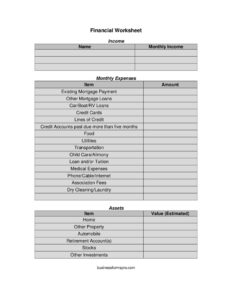
Financial Worksheet
Track income, expenses, and assets with our free Financial Worksheet template — organize your finances and download free in PDF or DOCX.
PDF
DOCX
2 downloads
0
likes
Download Files
- DOCX
A Financial Worksheet is a simple document for listing your monthly income, your monthly expenses, and your major assets in one place so you can see your complete financial picture. People most often use it to prepare a household budget, apply for a loan or mortgage relief, or take stock before a big financial decision. You can download it free in PDF or DOCX with no signup required.
What Is a Financial Worksheet?
A Financial Worksheet is an organized snapshot of your finances that brings together what you earn, what you spend, and what you own. It is typically completed by an individual or household, though small business owners and people working with a lender or financial counselor use it too. The worksheet documents monthly cash flow on one side — income against recurring obligations like mortgage payments, car loans, credit cards, and living costs — and a list of assets and their estimated values on the other. Its purpose is to translate scattered numbers into a clear, comparable format so you can identify surpluses, shortfalls, and net worth. It is a planning and disclosure tool, not a binding contract.
When Do You Need a Financial Worksheet?
This worksheet is useful any time you need a clear, honest look at your finances. Common situations include:
- Applying for a loan or mortgage: Lenders frequently ask borrowers to itemize income, debts, and assets before approving financing or restructuring an existing loan.
- Requesting mortgage assistance or forbearance: Hardship and loan-modification programs often require a worksheet showing your monthly income against your monthly expenses.
- Building or revising a household budget: Seeing food, utilities, transportation, and phone/cable/internet costs side by side reveals where money actually goes.
- Calculating net worth: Listing your home, automobile, retirement accounts, stocks, and other investments alongside your debts shows what you truly own.
- Planning a major purchase or life change: Buying a car, having a child, or changing jobs all benefit from a fresh look at cash flow and reserves.
- Meeting with a financial counselor or attorney: A completed worksheet gives professionals the facts they need to advise you efficiently.
What a Financial Worksheet Should Have
A complete worksheet captures three balanced categories. First, income: your name and total monthly income from all sources. Second, monthly expenses: each recurring obligation listed as an item with its amount, including housing, debts, and living costs. Third, assets: each thing of value with an honest estimate. To be genuinely useful, every figure should be current, monthly amounts should be consistent (convert annual or weekly numbers to monthly), and estimates should reflect realistic market values rather than wishful thinking. When the three categories are filled in completely, you can subtract expenses from income to find monthly cash flow and compare total assets to total debts.
How to Fill Out a Financial Worksheet
- Enter your name at the top so the worksheet is clearly identified, especially if you are submitting it to a lender.
- Total your monthly income. Add wages, self-employment earnings, and any other regular income, converting everything to a monthly figure.
- List housing and debt expenses. Record your existing mortgage payment, other mortgage loans, car/boat/RV loans, credit cards, and lines of credit, entering each item and its amount.
- Note any past-due accounts. Flag credit accounts past due more than five months, since lenders treat these as serious.
- Add living expenses. Fill in food, utilities, transportation, child care/alimony, loan and/or tuition, medical expenses, phone/cable/internet, association fees, and dry cleaning/laundry.
- Sum your monthly expenses and compare the total to your monthly income.
- List your assets. Estimate the value of your home, other property, automobile, retirement account(s), stocks, and other investments.
- Review and date the worksheet so it reflects your situation as of today.
Income, Expenses, and Assets Explained
The worksheet’s value comes from how the three sections relate. The income line is your starting point — be sure it reflects take-home reality, not gross figures you never see. The expense section separates two kinds of spending: fixed debt obligations (mortgage payments, car loans, credit cards, lines of credit) that are hard to change quickly, and living costs (food, utilities, transportation, phone/cable/internet) that you have more control over. Tracking child care/alimony, loan and/or tuition, medical expenses, association fees, and even dry cleaning/laundry prevents the small recurring costs that quietly drain a budget from going unnoticed. The assets section — home, other property, automobile, retirement accounts, stocks, and other investments — shows your financial cushion. Reading all three together tells you whether you have positive cash flow and whether your assets outweigh your debts.
Tips for an Accurate Worksheet
Pull from real statements rather than memory: bank records, pay stubs, mortgage and loan statements, and credit card bills. Round consistently, and use the same time period for every line. For assets, use conservative, defensible estimates — a recent comparable sale for your home, a valuation guide for your automobile, and current balances for retirement accounts and stocks. Keep a saved copy and update it every few months, because income and balances change. If you are submitting the worksheet to a lender or counselor, accuracy matters even more, since inconsistent or inflated numbers can delay approval or undermine trust.
Common Mistakes to Avoid
- Mixing time periods: Listing some figures as annual and others as monthly produces a misleading total — convert everything to monthly.
- Forgetting irregular expenses: Costs like medical expenses, tuition, or association fees that don’t hit every month are easy to overlook.
- Overstating asset values: Estimating your home or automobile above market value gives a false sense of security.
- Ignoring past-due accounts: Leaving off credit accounts past due more than five months hides exactly the information lenders look for.
- Using gross instead of net income: Plan around money you actually receive, not pre-tax totals.
- Letting it go stale: An out-of-date worksheet leads to decisions based on numbers that no longer apply.
Frequently Asked Questions
What is a Financial Worksheet used for? It is used to organize your monthly income, monthly expenses, and assets in one document. People use it for budgeting, loan and mortgage applications, hardship or forbearance requests, and calculating net worth. It gives both you and any professional you work with a clear, comparable view of your finances.
How do I fill out a Financial Worksheet? Start with your name and total monthly income, then list each expense item and its amount — mortgage, car loans, credit cards, food, utilities, and the rest. Finally, estimate the value of your assets such as your home, automobile, retirement accounts, and investments. Total each section so you can compare income to expenses and assets to debts.
Is a Financial Worksheet a legally binding document? On its own, no — it is an informational summary, not a contract. However, if you submit it as part of a loan, mortgage relief, or court-related process, you may be certifying that the information is accurate, so honesty matters. Always read any accompanying instructions before signing.
Does a Financial Worksheet need to be notarized? Generally not. Most budgeting and lender worksheets simply need to be completed accurately and, in some cases, signed and dated. If a specific lender or program requires notarization or supporting documents, they will tell you in their instructions.
What should I list as assets? Include items of real value with an estimated worth: your home, other property, automobile, retirement account(s), stocks, and other investments. Use current, realistic estimates rather than purchase prices or hoped-for values.
How much does this Financial Worksheet template cost? Nothing — it is completely free to download from Business Forms Pro in both PDF and DOCX formats, with no signup required. You can fill it in digitally or print it and complete it by hand.
This Financial Worksheet template is a general example provided for informational purposes only and is not financial, legal, or tax advice. Requirements and lender expectations vary by jurisdiction and program — consult a qualified financial professional or advisor for guidance specific to your situation.
Official resource: for the rules that apply to your situation, see the Consumer Financial Protection Bureau.
Related Forms
- Household Cash Envelope
- Release Of Security Agreement
- Travel Cash Envelope
- Projected Sales
- Simple Payroll Cost Report
- Utilities Annual Use Tracker With Budget
Browse more in Money.