
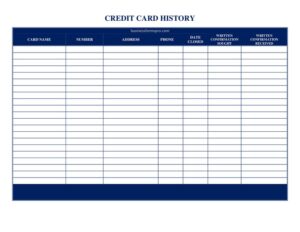
Credit Card History
Track every card transaction with our free Credit Card History form template, available as a free download in PDF and DOCX for easy record keeping.
PDF
DOCX
0
likes
Download Files
- DOCX
A Credit Card History form is a simple record-keeping document used to log and track every charge, payment, and balance change tied to a credit card account over time. The most common reason people reach for one is to keep an organized, at-a-glance summary of card activity for budgeting, expense reconciliation, or dispute resolution. You can download it free in PDF and DOCX, with no signup required.
What Is a Credit Card History Form?
A Credit Card History form is a worksheet that captures the running activity of a credit card account in one place. Individuals, bookkeepers, and small-business owners use it to document each transaction date, the merchant or description, the amount charged or paid, and the resulting balance. Unlike a bank-issued statement, which arrives once a month and follows the issuer’s format, this form lets you record activity in real time and in a layout that suits your own tracking needs. It serves as a personal ledger that complements official statements, making it easier to catch errors, monitor spending categories, and reconcile what you owe against what you have actually paid.
When Do You Need a Credit Card History Form?
This form is useful any time you want a clearer picture of card activity than a single statement provides. Common situations include:
- Monthly budgeting — logging purchases as they happen so you know exactly how much of your limit is spent before the statement closes.
- Reconciling business expenses — matching receipts to charges for tax records, expense reports, or reimbursement requests.
- Disputing a charge — building a dated record of transactions to support a claim with the card issuer.
- Tracking debt payoff — watching the balance shrink as payments are recorded, which helps maintain motivation and accuracy.
- Managing multiple cards — keeping a separate history sheet for each account so activity is never blended or confused.
- Sharing finances — giving a partner, accountant, or financial advisor a consolidated view of card usage over several months.
What a Credit Card History Form Should Have
A complete and useful Credit Card History form should include space to identify the account and to record each transaction line clearly. Key elements include the cardholder name and account identifier (often just the last four digits for security), the statement or tracking period, and a transaction table with columns for the date, a description of the merchant or payment, the charge amount, any payment or credit applied, and a running balance. Many users also add a column for spending category and a notes field for reference numbers or dispute remarks. Totals at the bottom for charges, payments, and ending balance make the sheet easy to reconcile against an official statement.
How to Fill Out a Credit Card History Form
- Identify the account. At the top, enter the cardholder’s name and a safe account identifier such as the last four digits of the card. Avoid writing the full card number anywhere on the sheet.
- Set the tracking period. Note the start and end dates you intend to cover, such as a billing cycle or a calendar month.
- Record the opening balance. Write the balance carried over from the previous period so your running total starts accurately.
- Log each transaction. For every charge, fill in the date, a clear description of the merchant or item, and the amount in the charge column.
- Enter payments and credits. When you make a payment or receive a refund, record it in the payment/credit column on its own line.
- Update the running balance. After each line, adjust the balance by adding charges and subtracting payments and credits.
- Add categories and notes. Tag entries by category and note any reference numbers, especially for charges you may need to question later.
- Total and reconcile. At the end of the period, sum the columns and compare the ending balance to your official statement.
Reconciling Against Your Statement
The real power of a Credit Card History form comes when you compare it to the issuer’s monthly statement. Go line by line and check off each transaction that appears on both. Charges on your sheet that are missing from the statement may simply be pending; charges on the statement that are not on your sheet deserve a closer look, because they could be subscriptions you forgot, delayed postings, or unauthorized activity. When your running balance matches the statement’s closing balance, you have confirmed the period is clean. If the numbers differ, the discrepancy usually traces to a missed entry, a duplicate charge, or a transposed figure — all of which are easier to spot on a clear, dated worksheet.
Tips for Keeping an Accurate Card History
Consistency makes this form valuable. Update it the same way each time — for example, every evening or every few days — so transactions are still fresh in your memory. Keep your receipts in a folder or photo album and match them to entries as you go. Use one sheet per card and per period to avoid clutter, and archive completed sheets with the matching statements so you can reference a full history later. If you use a digital DOCX version, formulas in a spreadsheet equivalent can auto-calculate the running balance, but the printable form works just as well for those who prefer pen and paper.
Common Mistakes to Avoid
- Writing the full card number — only use the last four digits to protect against theft if the sheet is lost.
- Skipping small purchases — minor charges add up and are the ones most often missed during reconciliation.
- Forgetting to update the running balance — leaving the balance column blank defeats the purpose of tracking.
- Mixing multiple cards — combining accounts on one sheet makes totals impossible to verify.
- Recording charges by memory weeks later — delays lead to forgotten transactions and inaccurate amounts.
- Not saving the completed sheet — discarding old histories removes your evidence trail for future disputes.
Frequently Asked Questions
What is a Credit Card History form used for? It is a personal ledger for tracking every charge, payment, and balance change on a credit card account. People use it for budgeting, reconciling business expenses, monitoring debt payoff, and documenting transactions in case a charge needs to be disputed. It complements your official statement rather than replacing it.
How do I fill out a Credit Card History form? Start by identifying the account and the tracking period, then record the opening balance. Add each transaction with its date, description, and amount, log any payments or credits, and update the running balance after every line. Total the columns at the end of the period and compare them to your statement.
Is this form a substitute for my bank statement? No. The official statement from your card issuer is the authoritative record for billing and credit reporting. This form is a personal tracking tool that helps you stay organized and catch discrepancies, but you should always rely on the issuer’s statement for final balances.
Is it safe to write my card details on this form? To stay safe, record only the last four digits of the card number rather than the full number. Store the completed sheet somewhere secure, since it contains spending information, and shred or securely delete it once you no longer need the records.
Can I use this form for more than one credit card? It is best to use a separate sheet for each card and each tracking period. Keeping accounts separate prevents your totals from blending and makes it far easier to reconcile each card against its own statement.
How much does the Credit Card History form cost? Nothing — it is completely free to download here in both PDF and DOCX formats, with no signup required. You can print it as is or open the DOCX to customize columns, categories, and headings to fit how you track your spending.
This Credit Card History template is provided as a general example for informational purposes only and does not constitute financial, tax, or legal advice. Requirements and best practices for managing credit accounts vary by issuer and jurisdiction, so consult a qualified financial professional for guidance specific to your situation.
Official resource: for the rules that apply to your situation, see the Consumer Financial Protection Bureau.
Related Forms
- Furniture Cash Envelope
- Monthly Bank Reconciliation
- Christmas Cash Envelope
- Daily Cash Sheet
- Gifts Cash Envelope
- Client Income Tracker
Browse more in Money.