
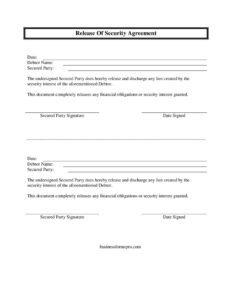
Release Of Security Agreement
Download a free Release Of Security Agreement template to discharge a lien and release a security interest, available as a free PDF and DOCX download.
PDF
DOCX
0
likes
Download Files
- DOCX
A Release Of Security Agreement is a short document a secured party signs to discharge a lien and release the security interest it holds over a debtor’s collateral. People most often use it once a secured loan has been paid in full and they need written proof that the creditor’s claim has ended. You can download this Release Of Security Agreement free in both PDF and DOCX formats — no signup required.
What Is a Release Of Security Agreement?
A Release Of Security Agreement is a written statement issued by a secured party — typically a lender, finance company, or any creditor that previously took collateral to guarantee repayment. It confirms that the security interest created under an earlier security agreement is now released and discharged. In plain terms, the document tells the debtor and any third party that the creditor no longer has a claim against the property that was pledged. It documents the end of the financial obligation tied to that collateral, restoring the debtor’s clear ownership. The release is usually the final paperwork in a secured lending relationship, signed once the underlying debt has been satisfied or the parties otherwise agree to terminate the security interest.
When Do You Need a Release Of Security Agreement?
A secured party issues this document at the point the security interest should formally end. Common situations include:
- A loan is paid in full — the debtor has made the final payment and wants written confirmation the lien is gone.
- Selling pledged property — a buyer or title company needs proof the existing security interest has been released before the sale closes.
- Refinancing — an old creditor releases its interest so a new lender can take a clean first position.
- Settling a debt early — the parties agree to discharge the obligation and release the collateral ahead of schedule.
- Clearing a UCC filing — supporting a termination statement that removes a recorded financing statement from public records.
- Correcting records — confirming that a security interest taken in error or no longer needed has been released.
What a Release Of Security Agreement Should Have
To be clear and effective, the release should identify the people involved, reference the obligation being discharged, and carry an authorized signature. The core elements are the date, the debtor’s full legal name, the secured party’s name, an express statement releasing and discharging the lien and security interest, and the signature of the secured party with the date signed. Strong releases also point back to the original security agreement so there is no doubt which interest is being terminated. Because the secured party is the one giving up rights, the document is signed by the secured party — not the debtor. Clarity here prevents disputes about whether the obligation and the collateral claim are truly extinguished.
How to Fill Out a Release Of Security Agreement
- Date: Enter the date the release is being executed. This establishes when the security interest is treated as discharged.
- Debtor Name: Write the full legal name of the debtor exactly as it appeared on the original security agreement — for an individual use their legal name, and for a business use the registered entity name.
- Secured Party: Enter the full name of the secured party releasing the interest, such as the lender, finance company, or individual creditor.
- Release statement: Review the body language confirming that the undersigned secured party releases and discharges any lien created by the security interest, and that the document completely releases the financial obligations or security interest granted. Make sure this accurately reflects the agreement.
- Secured Party Signature: Have an authorized representative of the secured party sign. If the secured party is a company, include the signer’s name and title.
- Date Signed: Record the date the signature is applied, which should match or follow the document date.
Filing and Follow-Up After the Release
Signing the release is often only part of the process. If the original security interest was recorded publicly — for example, through a UCC-1 financing statement filed with a state office, or a lien noted on a vehicle title — you will usually need to take an additional step to remove that public record. That typically means filing a UCC termination statement or submitting a lien release to the relevant titling agency. Keep the signed release with your records, and give the debtor a copy so they have proof the obligation ended. Where to file and which form to use vary by jurisdiction and by the type of collateral, so confirm the correct procedure with the office that holds the original filing.
Release vs. Termination Statement
People sometimes confuse a Release Of Security Agreement with a UCC termination statement. The release is the agreement between the parties confirming the secured party gives up its interest. A termination statement, by contrast, is the public filing that removes the recorded financing statement from government records. The release supports the termination but does not automatically clear the public record on its own. In many cases you want both: a signed release as private proof, and a filed termination so third parties searching the records see that the interest no longer exists.
Common Mistakes to Avoid
- Using the wrong signer — the secured party must sign, since they are the one releasing rights, not the debtor.
- Mismatched names — failing to match the debtor and secured party names to the original security agreement can create confusion about what is being released.
- Forgetting the public record — signing the release but never filing a termination statement, leaving an active lien on file.
- No date or signature date — omitting either date makes it unclear when the discharge took effect.
- Releasing before payment clears — issuing the release before the final payment has actually cleared the bank.
- Keeping no copy — neither party retaining a signed copy for their records.
Frequently Asked Questions
What is a Release Of Security Agreement used for? It is used to formally discharge a lien and release the security interest a secured party holds in a debtor’s collateral. Most often it is signed once a secured debt is paid in full, giving the debtor written proof the creditor no longer has a claim against the pledged property.
Who signs the Release Of Security Agreement? The secured party signs it, because the secured party is the one giving up its security interest. If the secured party is a business, an authorized representative should sign and note their title. The debtor’s signature is generally not required for the release itself.
Does it need to be notarized or witnessed? This basic template does not require notarization or witnesses, and many releases are valid with just the secured party’s signature. However, notarization can add credibility, and some filing offices or titling agencies have their own requirements, so check the rules for your jurisdiction and collateral type.
Does signing the release remove a UCC filing automatically? No. The release confirms the parties’ agreement, but a recorded UCC financing statement usually stays on file until a termination statement is filed with the appropriate state office. Treat the release and the public filing as separate steps.
Is this Release Of Security Agreement legally binding? When completed accurately and signed by an authorized secured party, it represents a binding statement that the security interest is discharged. Its full effect depends on applicable law and whether related public filings are properly updated.
How much does this template cost? It is completely free to download from Business Forms Pro in both PDF and DOCX formats, with no signup required. You can edit the DOCX version to add details like the original agreement reference or signer title.
This Release Of Security Agreement template is a general example provided for informational purposes only and is not legal, financial, or tax advice. Requirements for releasing security interests and clearing public filings vary by jurisdiction and collateral type — consult a qualified attorney or professional before relying on this document.
Official resource: for the rules that apply to your situation, see the Consumer Financial Protection Bureau.
Related Forms
- Weekly Sales Commission Tracker
- Payment Calculator per $100
- Loan Deferral Request
- Weekly Payroll Form
- Balance Sheet
- Pocket Tip Calculator
Browse more in Money.