
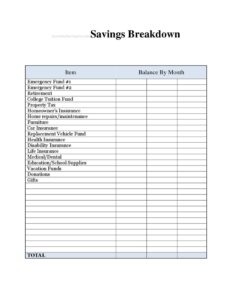
Savings Breakdown
Use this free Savings Breakdown template to organize and track your savings goals, balances, and progress — free download in PDF and DOCX.
PDF
DOCX
2 downloads
0
likes
Download Files
- DOCX
A Savings Breakdown is a simple worksheet that splits your total savings into separate goals, accounts, or categories so you can see exactly where every dollar is going. People most often use it to stop treating savings as one vague lump sum and instead track progress toward specific targets like an emergency fund, a vacation, or a down payment. It’s free to download in both PDF and DOCX, with no signup required.
What Is a Savings Breakdown?
A Savings Breakdown is a personal-finance document that itemizes your savings by purpose rather than leaving it as a single account balance. Anyone managing money can use it — individuals, couples, families, or students — to assign portions of their savings to defined goals and monitor how each one grows over time. It typically lists each savings category, the target amount, how much has already been saved, the remaining balance, and a target date. The point is clarity: instead of asking “how much do I have saved?” you can answer “how much do I have saved for what?” That distinction makes budgeting decisions easier and keeps long-term goals from being quietly drained by short-term spending.
When Do You Need a Savings Breakdown?
This worksheet earns its place any time your savings serve more than one purpose. Common situations include:
- Building an emergency fund while also saving for something else, and wanting to keep the two from blending together.
- Saving for a major purchase such as a car, home down payment, or wedding, where you need to know if you’re on pace to hit a deadline.
- Managing sinking funds for predictable annual costs like insurance premiums, holidays, or property taxes.
- Splitting one savings account across multiple goals when you don’t want to open separate bank accounts for each.
- Coordinating finances with a partner, so both people can see shared goals and agreed contributions in one place.
- Doing a monthly money check-in, where you update balances and confirm each goal is moving in the right direction.
Types of Savings Goals to Track
Most breakdowns mix three kinds of goals. Safety goals protect you from setbacks — an emergency fund or a buffer for unexpected repairs. Short-term goals are things you plan to buy within a year or two, such as a trip, new appliance, or holiday gifts. Long-term goals stretch further out: a home, a vehicle, education costs, or a larger investment. Listing them side by side helps you balance priorities and decide which goal gets the next dollar when funds are tight.
What a Savings Breakdown Should Have
A complete breakdown gives you a clear picture at a glance. Useful elements include a named category or goal for each row, a target amount, the current amount saved, the remaining balance, a planned monthly contribution, and a target completion date. A totals row at the bottom ties everything back to your overall savings figure, and a notes column lets you record reminders such as which account holds the money or why a target changed.
How to Fill Out a Savings Breakdown
- Date the worksheet. Write the month or week you’re recording so you can compare past versions and see growth over time.
- List each goal. In the first column, name every savings category — for example “Emergency Fund,” “Summer Vacation,” or “Car Repairs.”
- Enter the target amount. For each goal, write the total you ultimately want to save.
- Record the current balance. Note how much you’ve already set aside for that specific goal.
- Calculate the remaining amount. Subtract the current balance from the target to see how far you still have to go.
- Add a monthly contribution. Decide how much you’ll put toward each goal each month, and write it in.
- Set a target date. Estimate when you’ll reach each goal based on your contribution amount.
- Total everything. Add up the current balances to confirm the sum matches your actual savings, and use the notes column for account names or reminders.
Tips for Getting the Most From Your Breakdown
Update the worksheet on the same day each month — payday is a natural choice — so the habit sticks. If a goal stalls, ask whether its monthly contribution is realistic or whether it should be paused while you focus elsewhere. When you finish a goal, don’t delete the row immediately; mark it complete so you can celebrate the progress and redirect that contribution to the next priority. Keeping both a printed PDF copy and an editable DOCX version lets you scribble quick updates by hand or recalculate totals on a computer, whichever fits your routine.
How It Differs From a Budget
A budget tracks money flowing in and out each month — income against expenses. A Savings Breakdown is narrower and forward-looking: it tracks only the savings portion and how it’s allocated across goals. The two work best together. Your budget decides how much you can save in total, and your breakdown decides how that amount is split. Using both prevents the common problem of saving diligently but losing track of what the money is actually for.
Common Mistakes to Avoid
- Lumping everything together. The whole purpose is separation; resist the urge to leave a single “savings” line.
- Setting vague targets. “Save more” isn’t measurable — assign a specific dollar amount and date to each goal.
- Forgetting to update balances. An outdated breakdown gives false confidence; review it regularly.
- Ignoring the totals check. If your category balances don’t add up to your real account totals, money is unaccounted for.
- Over-committing contributions. Promising more per month than your budget allows leads to skipped deposits and frustration.
- Skipping the notes. Without a reason recorded, you’ll forget why a target changed or which account holds which goal.
Frequently Asked Questions
What is a Savings Breakdown used for? It’s used to divide your total savings into individual goals so you can track progress toward each one separately. Instead of seeing one balance, you see how much you’ve saved for an emergency fund, a vacation, a down payment, and anything else. This makes it far easier to prioritize and stay motivated.
How do I fill out a Savings Breakdown? List each savings goal, then record its target amount, current balance, remaining amount, monthly contribution, and target date. Add a totals row at the bottom to confirm the figures match your actual savings. Update it regularly — monthly is ideal — to keep the numbers accurate.
Is a Savings Breakdown the same as a budget? No. A budget tracks all income and expenses, while a Savings Breakdown focuses only on the savings portion and how it’s allocated across goals. They complement each other: the budget sets how much you save, and the breakdown decides where it goes.
Do I need separate bank accounts for each goal? Not necessarily. Many people keep one savings account and use this worksheet to mentally and visually divide it among goals. Separate accounts or sub-accounts can help with discipline, but the breakdown works fine with a single account.
How often should I update it? A monthly review works well for most people, ideally on payday when you make your contributions. You can update more often if your savings change frequently, or revisit it any time a goal or target shifts.
Is this Savings Breakdown template free? Yes. You can download it free in both PDF and DOCX formats with no signup required. Use the PDF for printing and quick handwritten updates, or the DOCX to edit goals and recalculate totals on your computer.
This Savings Breakdown template is a general example provided for informational purposes only and is not financial, investment, or tax advice. Personal financial situations and applicable rules vary, so consider consulting a qualified financial professional before making important money decisions.
Official resource: for the rules that apply to your situation, see the Consumer Financial Protection Bureau.
Related Forms
- Income Statement
- Large-Print Bill Tracker
- Budget Revision Request
- Fraud Alert Request
- Cosigner Agreement
- Payment Calculator per $100
Browse more in Money.