
Report Lost Or Stolen Credit Card
Use this free Report Lost or Stolen Credit Card letter template to notify your issuer fast and request a replacement — free PDF and DOCX download.
DOCX
0
likes
Download Files
- DOCX
A Report Lost or Stolen Credit Card letter is a short written notice you send to your card issuer asking them to cancel a missing card and issue a replacement. People most often use it to create a dated paper trail confirming exactly when they reported the card, which can protect them from charges made by a thief. You can download this template free in PDF and DOCX formats — no signup required.
What Is a Report Lost or Stolen Credit Card Letter?
A Report Lost or Stolen Credit Card letter is a formal written request from a cardholder to their bank or credit card company. It identifies the cardholder, states that a specific card has been lost or stolen, and asks the issuer to cancel that card and send a replacement. While most issuers let you report a missing card by phone or app, a written letter documents the date and details of your report in your own records. This is useful if a dispute later arises over fraudulent charges, since liability for unauthorized transactions often depends on how quickly you notified the issuer. The letter is simple, direct, and built to be acted on immediately.
When Do You Need a Report Lost or Stolen Credit Card Letter?
This letter is helpful any time a credit card leaves your control and you want a written record of your report. Common situations include:
- Your wallet or purse was stolen and one or more cards are gone, so you need everything canceled fast.
- You misplaced a card at a restaurant, store, or hotel and can’t locate it after searching.
- You notice suspicious charges and suspect your physical card was taken or copied.
- A card never arrived in the mail after you were told it shipped, suggesting it may have been intercepted.
- You’re traveling and discover a card is missing while away from home.
- You already called the issuer and want a follow-up letter on file to confirm the date and request in writing.
What a Report Lost or Stolen Credit Card Letter Should Have
To be effective, the letter must clearly connect you to the affected account and leave no doubt about what you’re asking for. The essential elements are your full name and contact details so the issuer can reach you and verify your identity, the date you are sending the letter, and the name and address of the credit card company. The body should plainly state that the card has been lost or stolen, request immediate cancellation, and ask for a replacement card. Critically, it should identify the card by the exact name printed on it and the card number. A signature at the bottom completes the request and confirms it came from the cardholder.
How to Fill Out a Report Lost or Stolen Credit Card Letter
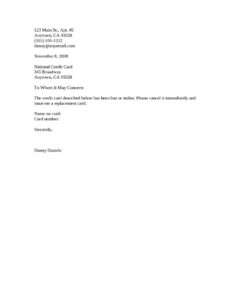
- Add your address block. At the top, enter your street address, apartment number, city, state, and ZIP (for example, 123 Main St., Apt. #5, Anytown, CA 95928).
- List your contact info. Include your phone number and email so the issuer can confirm the cancellation or reach you about a replacement.
- Date the letter. Write the date you are actually sending it — this is the key reference point for liability on any later charges.
- Address the issuer. Enter the credit card company’s name (such as National Credit Card) and its mailing address.
- Open with a salutation. “To Whom It May Concern:” works when you don’t have a specific contact name.
- State the problem. Note that the card described below has been lost or stolen and ask the issuer to cancel it immediately and issue a replacement.
- Identify the card. Fill in the Name on card exactly as printed and the Card number.
- Sign off. Close with “Sincerely,” and your printed name and signature (for example, Danny Daniels).
Phone First, Then Send the Letter
For a lost or stolen card, time matters. Call your issuer’s customer service or report the loss through its mobile app the moment you realize the card is gone, because that immediate notice stops new charges fastest. Use this letter as a written follow-up that documents your report. When you call, note the date, the time, and the name of the representative you spoke with, then reference that call in your records alongside this letter. Sending the letter by a method that provides proof of mailing or delivery gives you an extra layer of documentation. Keep a copy of everything — the letter, your notes from the phone call, and any confirmation number the issuer provides.
Protecting Yourself After You Report
Once you’ve reported the card, monitor your account closely for the next several billing cycles. Review your statement line by line and flag anything you don’t recognize, since a thief may test small charges before larger ones. Watch for your replacement card to arrive and activate it promptly. If you spot unauthorized transactions, dispute them in writing with the issuer right away. Federal protections in many places limit a cardholder’s liability for unauthorized credit card charges, but the exact protection can depend on how and when you reported the loss — another reason a dated letter is worth keeping. Consider whether other accounts tied to the lost wallet, such as debit cards or IDs, also need attention.
Common Mistakes to Avoid
- Waiting too long to report. Delays can increase your exposure to fraudulent charges, so act immediately and send the letter as a follow-up.
- Leaving the card number blank. The issuer needs the account details to locate and cancel the right card.
- Forgetting to date the letter. The date is your evidence of when you reported the loss.
- Using an outdated address or phone number. The issuer must be able to verify your identity and reach you about the replacement.
- Not keeping a copy. Always retain a copy of the signed letter and any confirmation numbers.
- Relying on the letter alone. Mail can be slow; call or use the app first, then send this letter to document the report.
Frequently Asked Questions
What is a Report Lost or Stolen Credit Card letter? It is a written notice to your card issuer stating that a specific card is lost or stolen and asking the company to cancel it and send a replacement. It creates a dated record of when you reported the loss, which can matter if disputes over charges come up later.
Should I call my issuer or just send this letter? Call or use the issuer’s app first, because immediate notice stops new charges fastest. Use this letter as a written follow-up that documents the date, the card details, and your request in your own records.
What information do I need to fill it out? You need your name, address, phone, and email, the date, the issuer’s name and address, and the exact name printed on the card along with the card number. A signature finishes the request.
Does the letter need to be notarized or witnessed? No. A Report Lost or Stolen Credit Card letter does not require notarization or witnesses. Your signature and accurate account details are what the issuer needs to act.
Am I responsible for charges made after my card is stolen? Liability for unauthorized credit card charges is often limited, and reporting promptly generally improves your protection. The exact rules vary by jurisdiction and issuer, so report quickly and keep records of when you did.
Is this template really free? Yes. You can download this Report Lost or Stolen Credit Card letter for free in PDF and DOCX with no signup required, then customize it with your own details.
This template is a general example provided for informational purposes only and is not legal, financial, or tax advice. Rules on liability for lost or stolen cards and reporting procedures vary by jurisdiction and by issuer. For guidance on your specific situation, consult your card issuer and a qualified professional.
Official resource: for the rules that apply to your situation, see the Consumer Financial Protection Bureau.
Related Forms
- Utilities Annual Use Tracker
- School Cash Envelope
- Profit And Loss Statement
- Zero-Based Budget
- Weekly Bookkeeping Record
- Appraisal Worksheet
Browse more in Money.