
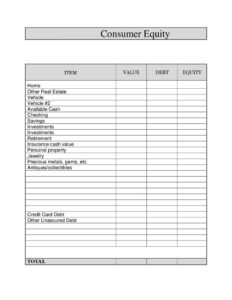
Consumer Equity Form
Download a free Consumer Equity Form template in PDF and DOCX to document a consumer's ownership stake, assets, and equity — free download, no signup.
PDF
DOCX
0
likes
Download Files
- DOCX
A Consumer Equity Form is a document used to record an individual consumer’s ownership interest, assets, and net financial stake in a property, account, or transaction. People most often use it to capture how much equity a consumer holds after debts and obligations are subtracted, and it’s free to download here in both PDF and DOCX formats with no signup required.
What Is a Consumer Equity Form?
A Consumer Equity Form is a financial worksheet that summarizes a consumer’s equity position — the value they actually own once any loans, liens, or balances owed are deducted from the total value of an asset. It is typically completed by the consumer, a loan officer, a financial counselor, or an account representative. The form documents identifying details, the asset or property in question, its current value, any outstanding obligations against it, and the resulting equity figure. It serves as a clear, shareable snapshot used in lending decisions, refinancing reviews, financial planning sessions, and account reconciliations. Because it lays out the numbers in one place, it helps both the consumer and the institution agree on a starting point before any further action is taken.
When Do You Need a Consumer Equity Form?
This form comes into play whenever someone needs to demonstrate or verify how much value a consumer truly owns. Common situations include:
- Applying for a loan or line of credit where equity in a home, vehicle, or account is used as collateral or as proof of financial standing.
- Refinancing an existing loan, where the lender needs the current equity figure to determine eligibility and terms.
- Financial counseling or budgeting sessions, where an advisor reviews a consumer’s overall net position across assets and liabilities.
- Account closures or transfers, where the remaining equity or balance owed to the consumer must be calculated and documented.
- Estate, divorce, or settlement reviews that require a written statement of what a consumer owns versus owes on a particular asset.
- Internal recordkeeping, where an institution wants a consistent, signed snapshot of a customer’s equity on file.
What a Consumer Equity Form Should Have
A complete and useful Consumer Equity Form should clearly identify the consumer and the asset, then show how the equity figure is reached. At minimum it should include the consumer’s full name and contact information, an account or reference number, a description of the asset or property, its current market or appraised value, the total of any outstanding loans or liens against it, and the resulting equity amount (value minus obligations). It should also include the date of preparation, the name of whoever completed the form, and a signature line. Showing the math transparently — rather than just a single number — makes the form credible and easy to verify. A notes section is helpful for explaining how values were determined or flagging anything unusual.
How to Fill Out a Consumer Equity Form
Because this is a straightforward financial worksheet, fill it out in order so the equity calculation flows naturally:
- Enter consumer details. Write the consumer’s full legal name, address, phone number, and any account or customer reference number tied to the asset.
- Add the date. Record the date the form is being completed, since equity values change over time.
- Describe the asset. Identify the property, account, or item — for example a home address, vehicle make and VIN, or account type and number.
- Record the current value. Enter the asset’s market value, appraised value, or current balance, and note how that figure was obtained.
- List outstanding obligations. Total any loans, liens, balances owed, or claims secured against the asset.
- Calculate equity. Subtract total obligations from the current value to arrive at the consumer’s equity.
- Add notes. Explain any assumptions, pending payments, or valuation sources.
- Sign and date. Have the consumer and/or preparer sign to confirm the figures are accurate to the best of their knowledge.
Understanding the Equity Calculation
Equity is simply what you own outright. The core formula on this form is straightforward: current value minus what you still owe equals equity. If a consumer’s home is worth $300,000 and they owe $180,000 on the mortgage, their equity is $120,000. The same logic applies to a vehicle, an investment account, or any financed asset. Positive equity means the asset is worth more than the debt against it; negative equity (sometimes called being “underwater”) means the consumer owes more than the asset is currently worth. Documenting both the value and the obligations side by side makes it easy to see this relationship at a glance, which is exactly why lenders and advisors rely on a clear equity statement.
Tips for an Accurate and Useful Form
Use recent, verifiable figures rather than estimates whenever possible — an appraisal, statement, or payoff quote carries far more weight than a guess. Always note the date your values are current as of, because property values and loan balances shift. If multiple assets are involved, consider completing a separate form for each so each calculation stays clean, then summarize the totals. Keep a copy for the consumer’s own records, since this snapshot can be helpful later for comparison or for future applications. Finally, keep supporting documents (statements, appraisals, payoff letters) attached or referenced so anyone reviewing the form can trace where each number came from.
Common Mistakes to Avoid
- Using outdated values. An old appraisal or stale loan balance can throw off the entire equity figure.
- Forgetting some obligations. Leaving out a second lien, line of credit, or tax claim overstates the equity.
- Mixing up gross value and equity. The asset’s total value is not the same as the consumer’s stake in it.
- Leaving the asset description vague. Without a clear identifier, the form can’t be tied to the right property or account.
- Skipping the signature and date. An unsigned, undated form has little credibility for lending or recordkeeping.
- Not showing the math. A single equity number with no supporting figures is hard to verify and easy to dispute.
Frequently Asked Questions
What is a Consumer Equity Form used for? It documents how much value a consumer actually owns in an asset after subtracting any debts or obligations against it. People use it for loan and refinance applications, financial counseling, account reconciliation, and general recordkeeping. It gives both the consumer and the institution a shared, written starting point.
How do I fill out a Consumer Equity Form? Enter the consumer’s details, describe the asset, record its current value, list all outstanding obligations, then subtract those obligations from the value to get the equity. Add the date, any explanatory notes, and a signature. Working from recent statements or appraisals keeps the figures accurate.
Does a Consumer Equity Form need to be notarized? In most everyday situations it does not, since it is primarily an informational worksheet. Some lenders or legal proceedings may request a notarized or witnessed version for added verification. Check the requirements of whoever is requesting the form before submitting it.
Is a Consumer Equity Form legally binding? On its own, it is generally a statement of figures rather than a binding contract. It can carry weight as a representation of the consumer’s financial position, especially when signed. Its legal effect depends on how it is used and on the agreement or process it supports.
How much does this Consumer Equity Form cost? The template on this page is completely free to download in PDF and DOCX with no signup required. You can use it as-is or edit the DOCX version to match your institution’s branding or specific needs. There are no hidden fees.
What’s the difference between equity and asset value? Asset value is the full worth of the property or account, while equity is only the portion the consumer truly owns after debts are deducted. For example, a financed car has value, but the consumer’s equity is that value minus the remaining loan balance. The form is designed to show both clearly.
This Consumer Equity Form template is provided as a general example for informational purposes only and does not constitute legal, financial, or tax advice. Requirements and definitions vary by jurisdiction and by institution, so consult a qualified financial professional or advisor before relying on this form for any specific decision.
Official resource: for the rules that apply to your situation, see the Consumer Financial Protection Bureau.
Related Forms
- Saving Cash Envelope
- Pets Cash Envelope
- Fixed Expenses Worksheet
- Blank Cash Envelope
- Request Credit Card Chargeback
- Hair Cash Envelope
Browse more in Money.