
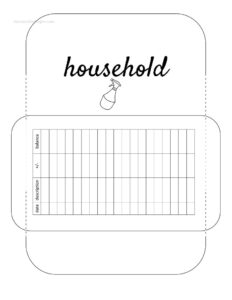
Household Cash Envelope
Download a free Household Cash Envelope template to organize your cash budgeting by spending category and track every dollar with a free download.
PDF
DOCX
0
likes
Download Files
- DOCX
A Household Cash Envelope is a simple budgeting tool that holds physical cash set aside for one spending category—like groceries, gas, or entertainment—with a label and tracking grid printed on the front. People reach for it most often when they want to stop overspending by limiting themselves to the cash inside the envelope. You can download this template free in PDF and DOCX, with no signup required.
What Is a Household Cash Envelope?
A Household Cash Envelope is a labeled paper envelope used in the cash envelope budgeting method, a system where you withdraw cash and divide it into envelopes assigned to specific spending categories. Once an envelope is empty, you stop spending in that category until the next budgeting period. The template typically includes a category name, a budgeted amount, a date or pay period, and a small ledger to log deposits and withdrawals. Households, couples, students, and anyone trying to build better money habits use it to make spending tangible. By turning abstract budget numbers into physical cash you can see and touch, the envelope makes overspending obvious and self-control easier.
When Do You Need a Household Cash Envelope?
The envelope system shines whenever you want hard limits on flexible, easy-to-overspend categories. Common situations include:
- Curbing grocery overspending: Cap your weekly or monthly food budget and shop only with the cash inside the grocery envelope.
- Paying down debt: Free up money by tightly controlling discretionary categories like dining out, coffee, and entertainment.
- Managing a variable income: Allocate cash each time you get paid so you never spend money you haven’t earned yet.
- Teaching kids or teens about money: Give children allowance envelopes for saving, spending, and giving to build lifelong habits.
- Saving for a specific goal: Funnel set amounts into a vacation, holiday, or emergency envelope until you reach your target.
- Recovering from a budget setback: Reset spending discipline after a tight month by switching from cards to cash for a few categories.
Types of Cash Envelopes
Most households use a small set of envelopes rather than one for every line item. Common categories include groceries, dining out and takeout, gas and transportation, personal care, entertainment and hobbies, household supplies, gifts, and miscellaneous. You can also keep sinking-fund envelopes for irregular expenses like car maintenance, holidays, or annual subscriptions, adding a little each pay period until the bill arrives. Fixed expenses—rent, utilities, and loan payments—are usually paid electronically and don’t need envelopes. The key is choosing only the categories where you tend to overspend, so the system stays simple enough to stick with.
What a Household Cash Envelope Should Have
A useful cash envelope is clear, durable, and easy to update at a glance. The essentials are:
- Category label so you instantly know what the cash is for.
- Budgeted amount for the period, written prominently on the front.
- Pay period or date range so old and new cycles don’t get mixed up.
- Running ledger with columns for date, description, amount spent, and remaining balance.
- Starting balance line to record how much cash you placed inside.
- Space for notes to flag rollover amounts or planned purchases.
How to Fill Out a Household Cash Envelope
Follow these steps to set up and maintain each envelope:
- Write the category name on the label line—for example, “Groceries” or “Dining Out.”
- Enter the pay period or date range the envelope covers, such as a single month or two-week pay cycle.
- Record the budgeted amount, the total cash you plan to allocate to this category.
- Withdraw and insert the cash, then write the actual starting balance you placed inside on the starting balance line.
- Log every purchase in the ledger as it happens: write the date, a short description, and the amount spent.
- Update the remaining balance after each transaction by subtracting the amount spent from the previous balance.
- Check the envelope before spending to confirm enough cash remains; if it’s empty, pause spending in that category.
- Reconcile at period end by comparing remaining cash to the ledger, then decide whether to roll leftover money forward or move it to savings.
Tips for Making the Envelope System Stick
The biggest predictor of success is consistency, so make the routine effortless. Withdraw your cash on payday in the denominations you’ll actually use—plenty of smaller bills make it easier to spend exactly what you intend. Keep envelopes together in a wallet, accordion folder, or small binder so you never leave the right one at home. Log purchases immediately, before the receipt disappears into a pocket. When an envelope runs dry, resist the temptation to “borrow” from another one; that habit quietly unravels the whole system. Finally, review all your envelopes at the end of each cycle to see which categories were over- or under-funded, then adjust the budgeted amounts so next month’s plan is more realistic.
Cash Envelopes vs. Digital Budgeting
Cash envelopes and budgeting apps aim for the same goal—spending within limits—but work differently. Physical cash creates friction and a visceral awareness that swiping a card lacks, which is why many people overspend less with envelopes. Apps, on the other hand, track automatically and handle online purchases that cash can’t. Many households blend the two: they pay fixed bills and online orders digitally while using cash envelopes only for the discretionary categories where willpower tends to fail. This printable template supports that hybrid approach by giving you a clear paper record you can reconcile against your bank statement.
Common Mistakes to Avoid
- Creating too many envelopes: A dozen categories become unmanageable—start with three to five problem areas.
- Forgetting to log purchases: An unrecorded transaction throws off your remaining balance and undermines trust in the system.
- Borrowing between envelopes: Raiding one category to cover another defeats the purpose of fixed limits.
- Carrying large sums of cash: Only carry the envelopes you’ll need that day to reduce loss and theft risk.
- Setting unrealistic amounts: Budgets that are too tight lead to frustration and abandonment—base amounts on real past spending.
- Ignoring the end-of-period review: Skipping reconciliation means you never learn from overspending and repeat the same mistakes.
Frequently Asked Questions
What is the cash envelope budgeting method? It’s a system where you divide your spending money into labeled envelopes, one per category, and spend only the cash inside each. When an envelope is empty, you stop spending in that category until the next budgeting cycle. The physical limit makes overspending obvious and easy to control.
How do I fill out a Household Cash Envelope? Write the category name, the pay period it covers, and the budgeted amount on the front. Insert the cash, note the starting balance, and log each purchase in the ledger with the date, description, amount spent, and updated remaining balance. Reconcile the envelope at the end of the period.
How many envelopes should I use? Most people do best with three to five envelopes covering the categories where they tend to overspend, such as groceries, dining out, and entertainment. Fixed bills paid online usually don’t need envelopes. Start small and add categories only if you genuinely need them.
Should I roll over leftover cash? That depends on the category. For variable spending like groceries, you might sweep leftovers into savings or a debt payment, while for sinking funds like car repairs or holidays you should let the balance accumulate. Decide your rule in advance so the choice is consistent.
Is the cash envelope method better than a budgeting app? Neither is universally better—it depends on your habits. Cash creates strong spending awareness and works well for people who overspend with cards, while apps automate tracking and handle online purchases. Many people combine both, using cash only for their hardest-to-control categories.
Is this Household Cash Envelope template free? Yes. You can download it free in PDF and DOCX formats with no signup required. Print as many copies as you need, customize the categories and amounts, and reuse the template every pay period.
This Household Cash Envelope template is a general example provided for informational purposes only and does not constitute financial, tax, or legal advice. Personal budgeting needs vary, and the right approach for you may differ. Consult a qualified financial professional for guidance tailored to your situation.
Official resource: for the rules that apply to your situation, see the Consumer Financial Protection Bureau.
Related Forms
- Sinking Funds Tracker
- Cash Flow Statement
- Car Insurance Exchange Form
- Bad Check Notice
- Petty Cash Out
- Monthly Receipts List
Browse more in Money.