
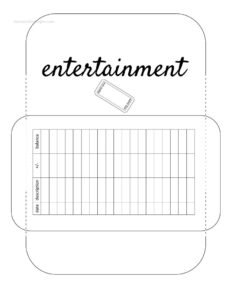
Entertainment Cash Envelope
Download a free Entertainment Cash Envelope template to budget fun money the envelope way — track spending and stay on budget with a free download.
PDF
DOCX
4 downloads
0
likes
Download Files
- DOCX
An Entertainment Cash Envelope is a simple budgeting tool that holds the cash you’ve set aside for fun — movies, dining out, concerts, streaming, hobbies, and nights out — and helps you track every dollar you spend until it’s gone. It’s the cornerstone of the cash-stuffing method, and you can download it free in PDF and DOCX with no signup required.
What Is an Entertainment Cash Envelope?
An Entertainment Cash Envelope is a labeled envelope (or printable template you fold into one) used in the envelope budgeting system to manage discretionary spending. At the start of a budget period, you place a fixed amount of cash inside, then spend only from that envelope for entertainment-related purchases. A tracking grid on the front or back records each transaction, the amount, the date, and the remaining balance. When the envelope is empty, your fun spending stops until the next period. People use it because physical cash creates a hard, visible limit that card swipes never do — making overspending far easier to avoid.
When Do You Need an Entertainment Cash Envelope?
This envelope is most useful whenever you want a firm boundary around discretionary, non-essential spending. Common situations include:
- Paying off debt: You’re following a strict budget and need to cap how much fun money you can spend each month.
- Going cash-only: You’ve decided to stop using cards for variable categories and want a tangible spending limit.
- Curbing impulse buys: Concerts, takeout, and streaming add-ons quietly drain your account, and you want to see the money disappear in real time.
- Couples or families budgeting together: Each person gets an entertainment envelope so everyone knows the shared limit.
- Saving for a goal: Trimming entertainment frees cash for a vacation, emergency fund, or large purchase.
- Teaching kids or teens about money: A physical envelope makes the trade-off between spending now and saving obvious.
What an Entertainment Cash Envelope Should Have
A complete entertainment envelope does more than hold money — it doubles as a mini ledger. The strongest versions include a clear category label so it doesn’t get mixed up with groceries or gas, a budget-period field (weekly, biweekly, or monthly), and a starting-balance line showing how much cash you loaded. The front or back should have a transaction log with columns for the date, a short description of the purchase, the amount spent, and a running balance so you always know what’s left. Some templates add a savings or rollover line for leftover cash. Together these elements turn a plain envelope into an accountability tool that records exactly where your discretionary dollars went.
How to Fill Out an Entertainment Cash Envelope
Follow these steps to set up and use your envelope:
- Label the category. Write “Entertainment” on the front so it’s instantly recognizable among your other envelopes.
- Set the budget period. Note whether this envelope covers a week, two weeks, or a month so you know when it resets.
- Enter the starting amount. Write the total cash you’re loading on the budgeted/starting-balance line, then place that exact amount inside.
- Log each purchase. Every time you spend, record the date, a brief description (for example “movie tickets” or “dinner out”), and the dollar amount in the transaction grid.
- Update the running balance. Subtract each amount from the previous balance so the remaining figure is always current at a glance.
- Stop at zero. When the cash runs out, entertainment spending pauses until the next period — no borrowing from other envelopes.
- Reconcile at period end. Count any leftover cash, decide whether to roll it over or move it to savings, and reset the envelope for the next cycle.
How to Use It With the Rest of Your Budget
The entertainment envelope works best as one piece of a complete cash-stuffing system. After you’ve covered fixed bills and essentials like rent, utilities, and groceries, you allocate a realistic slice of what’s left to entertainment. Keep that amount honest: setting it too low almost guarantees you’ll raid another envelope, while setting it too high defeats the purpose. Review your spending log at the end of each period to spot patterns — maybe streaming subscriptions are eating more than you realized, or weekend outings cluster at month-end. Use those insights to adjust the next period’s allocation. Pairing the envelope with a written monthly budget keeps the category connected to your bigger financial goals rather than floating on its own.
Tips for Sticking to Your Entertainment Budget
A few habits make the envelope far more effective. Refill it only on your set schedule, never early, so the limit stays meaningful. Treat the running balance as the real number — if the log says you have eight dollars left, that’s your ceiling for the rest of the period. If you tend to overspend on one activity, split entertainment into smaller envelopes such as “dining out” and “hobbies.” Finally, celebrate leftover cash: rolling unused entertainment money into savings turns restraint into visible progress.
Common Mistakes to Avoid
- Forgetting to log purchases: Skipping entries makes the running balance meaningless and invites overspending.
- Borrowing from other envelopes: Pulling cash from groceries or gas to fund extra entertainment undermines the whole system.
- Setting an unrealistic amount: A budget that’s too tight collapses within days; base the figure on your actual habits.
- Refilling early: Topping up before the period ends erases the spending limit you set.
- Mixing categories: Using the entertainment envelope for non-fun expenses muddies your tracking.
- Not reviewing at period end: Failing to count leftover cash and reset means you lose the chance to learn from your spending.
Frequently Asked Questions
What is an entertainment cash envelope used for? It’s used to set a firm, physical limit on discretionary fun spending such as dining out, movies, concerts, and hobbies. You load it with a set amount of cash for a budget period and spend only from it. When the cash is gone, entertainment spending pauses until the next refill.
How much should I put in my entertainment envelope? The right amount depends on your income, fixed expenses, and goals — there’s no universal figure. A good approach is to budget essentials first, then assign a realistic slice of what remains to entertainment. Track your spending for a month or two and adjust the amount up or down based on what you actually use.
How do I track spending on the envelope? Use the transaction log printed on the template to record the date, a short description, and the dollar amount for every purchase. Subtract each amount from the previous balance so the running total always shows what’s left. This keeps you aware of your limit without checking a separate app or account.
What happens to leftover cash at the end of the period? That’s your choice. Many people roll unused entertainment cash into the next period for a bigger treat, while others move it straight into savings or debt payoff. Counting and reassigning leftover cash is a satisfying way to reward staying under budget.
Is the cash envelope method better than using a card? Physical cash creates a visible, tangible limit that card swipes don’t, which helps many people curb impulse spending. However, it works best for variable categories like entertainment rather than fixed bills. Choose whichever approach keeps you most consistent — some people use cash for fun money and cards for everything else.
Is this entertainment cash envelope template free to download? Yes. You can download this template free in both PDF and DOCX formats with no signup required. Print it, fold it into an envelope, and start tracking your entertainment spending right away, or edit the DOCX version to fit your own categories and budget period.
This Entertainment Cash Envelope template is a general example provided for informational purposes only and is not financial, tax, or budgeting advice. Personal financial needs vary by individual and circumstance — consider consulting a qualified financial professional before making decisions about your budget.
Official resource: for the rules that apply to your situation, see the Consumer Financial Protection Bureau.
Related Forms
- Overdue Account History
- Credit Memo
- Loan Deferral Request
- Date Night Cash Envelope
- Accounts Receivable Form
- Appraisal Worksheet
Browse more in Money.