
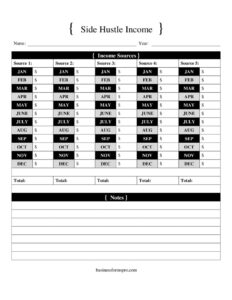
Side Hustle Income Tracker
Track every dollar your side gig earns with this free Side Hustle Income Tracker template, available as a free download in PDF and DOCX.
PDF
DOCX
1 downloads
0
likes
Download Files
- DOCX
A Side Hustle Income Tracker is a simple worksheet for recording the money you earn from freelance gigs, resale flips, rideshare driving, online sales, or any extra work outside your main job. The most common reason people use it is to keep clean records for tax time and to see whether a side venture is actually making money. It’s free to download in PDF and DOCX, with no signup required.
What Is a Side Hustle Income Tracker?
A Side Hustle Income Tracker is a personal record-keeping document that logs the income and related expenses from one or more side businesses. It’s used by freelancers, gig workers, creators, and hobbyists who sell products or services on the side. Rather than guessing how much a venture earns, the tracker captures each payment by date, source, amount, and payment method, alongside any costs you incur to do the work. Over weeks and months it builds a picture of gross income, deductible expenses, and net profit. While it isn’t an official tax form, it organizes the raw numbers you’ll need to file accurately and to make smart decisions about your hustle.
When Do You Need a Side Hustle Income Tracker?
This tracker earns its keep any time money flows in or out of a non-employee venture. Common situations include:
- Freelance and gig work — logging payments from clients, platforms, or apps that don’t withhold taxes for you.
- Reselling and flipping — tracking sales from marketplaces, garage sales, or consignment alongside what you paid for inventory.
- Creator and content income — recording ad revenue, sponsorships, affiliate payouts, and tip-jar earnings.
- Tax preparation — assembling a year’s worth of self-employment income so you can report it and claim legitimate expenses.
- Quarterly estimated taxes — checking whether your earnings are large enough to require periodic payments.
- Deciding whether to scale or quit — comparing months to see if the hustle is growing, flat, or losing money.
Types of Income You Might Log
Side income comes in many shapes, and a flexible tracker handles them all: one-off project fees, recurring retainers, per-item sales, hourly gigs, tips, refunds (entered as negatives), and platform payouts that arrive after fees. Noting the income type next to each entry makes year-end categorization far easier.
What a Side Hustle Income Tracker Should Have
A useful tracker captures enough detail to answer “what did I earn, from whom, when, and what did it cost me?” At minimum it should include the date of each transaction, the income source or client, a short description, the gross amount received, the payment method, any expense tied to that work, and a running or monthly total. A column for the hustle or category lets you separate multiple ventures. Space for notes — invoice numbers, tax-withheld flags, or reimbursement status — adds clarity. Finally, a summary area that tallies total income, total expenses, and net profit turns a list of entries into a snapshot you can act on.
How to Fill Out a Side Hustle Income Tracker
Work entry by entry as money comes in, and update expenses as you spend. Follow these steps:
- Label the hustle. At the top, write the name of the side venture and the year or month the sheet covers so multiple trackers don’t get mixed up.
- Enter the date. Record the date you actually received payment (or the date money was spent for an expense row).
- Name the source. Note the client, customer, platform, or marketplace that paid you.
- Describe the transaction. Add a short line — “logo design,” “3 vintage shirts sold,” or “ad revenue” — so the entry is meaningful later.
- Record the gross amount. Write the full amount received before any deductions.
- Log the payment method. Cash, bank transfer, PayPal, or app payout helps you reconcile against statements.
- Add related expenses. In the expense column, enter costs tied to the work, such as supplies, fees, mileage, or shipping.
- Update the totals. Add the entry to your monthly income and expense subtotals, then calculate net profit in the summary.
Tips for Keeping Accurate Records
Consistency beats perfection. Log entries weekly so nothing slips through the cracks, and keep digital receipts in a folder named to match each line. Track platform fees as expenses rather than reducing your gross income — this preserves a true picture of revenue. If you mix personal and business money, consider a separate account or card so the tracker stays clean. Save a copy of each completed monthly or yearly sheet; together they form a paper trail that supports your tax return and any deductions you claim.
Why Net Profit Matters More Than Gross Income
It’s easy to feel rich when sales roll in, but the number that matters is what’s left after costs. The tracker’s expense column and net-profit summary reveal whether your effort actually pays. A hustle grossing high but netting little may signal pricing that’s too low or fees eating your margin. Watching net profit month over month also tells you when a hobby has grown into a real business worth formalizing.
Common Mistakes to Avoid
- Logging only the big payments — small tips and one-off sales add up and are still taxable income.
- Forgetting to record expenses — unlogged costs mean missed deductions and an inflated profit picture.
- Mixing gross and net — entering after-fee payouts in some rows and pre-fee amounts in others makes totals unreliable.
- Waiting until tax season — reconstructing a year from memory invites errors and overlooked income.
- Skipping the source or description — vague entries are useless when you need to verify a number months later.
- Combining multiple hustles on one untagged sheet — without a category column you can’t tell which venture is profitable.
Frequently Asked Questions
What is a Side Hustle Income Tracker used for? It’s used to record the income and expenses from extra work or small ventures outside your main job. The goal is to keep organized records for tax filing and to measure whether the hustle is profitable. It turns scattered payments into a clear, reviewable summary.
How do I fill out the tracker? Add a new row each time you get paid or spend money on the hustle, recording the date, source, description, gross amount, payment method, and any related expense. Update the monthly subtotals and net-profit summary as you go. Reviewing it weekly keeps the numbers accurate and complete.
Do I have to report side hustle income on my taxes? In most places, income from side work is taxable even without an official tax form from the payer, and rules vary by jurisdiction. This tracker helps you gather the figures, but it is not a substitute for professional advice. Check your local tax rules or consult a qualified tax professional.
Is this tracker a legal or official tax document? No — it’s a personal organizing tool, not a government form or filing. It simply consolidates the numbers you’ll later transfer to your actual tax return. Keep your receipts and statements as supporting evidence behind each entry.
Can I track more than one side hustle on it? Yes. Use the category or hustle-name column to tag each entry so you can separate ventures and see which one earns the most. Many people keep one sheet per hustle per year for the cleanest records.
How much does this template cost? It’s completely free to download here in both PDF and DOCX formats, with no signup required. Use the PDF for printing or the DOCX to edit columns and add formulas. You can reuse it every month or start a fresh copy each year.
This template is a general example provided for informational purposes only and is not legal, financial, or tax advice. Tax and recordkeeping requirements vary by jurisdiction and individual circumstance. Consult a qualified tax or financial professional before relying on this tracker for filing or business decisions.
Official resource: for the rules that apply to your situation, see the Consumer Financial Protection Bureau.
Related Forms
- Loan Deferral Request
- Profit And Loss Statement
- Petty Cash
- Fund Raiser Source Log
- Hobby Cash Envelope
- Gas Cash Envelope
Browse more in Money.