
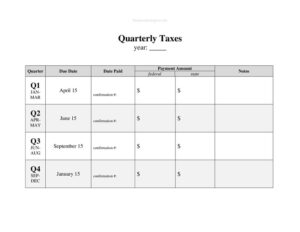
Quarterly Tax Payment Worksheet
Calculate and track your estimated taxes with a free Quarterly Tax Payment Worksheet template — organize income, deductions, and due dates. Free download.
PDF
DOCX
10 downloads
0
likes
Download Files
- DOCX
A Quarterly Tax Payment Worksheet is a simple planning tool that helps self-employed people, freelancers, and small business owners estimate and track the income tax they owe throughout the year and pay it in four installments. The most common reason people use it is to avoid underpayment penalties and the shock of a giant tax bill by setting aside the right amount each quarter. You can download it free in PDF and DOCX — no signup required.
What Is a Quarterly Tax Payment Worksheet?
A Quarterly Tax Payment Worksheet is a one-page (or multi-section) document used to calculate estimated taxes due for each of the four payment periods in a tax year. Unlike employees who have taxes withheld from every paycheck, independent earners are generally responsible for paying their own income and self-employment taxes directly. This worksheet helps you project your annual income, subtract expected deductions, apply your estimated tax rate, and divide the total into manageable quarterly payments. It also gives you a place to record what you actually paid and when, so you have a clear running tally for your records and at tax-filing time.
When Do You Need a Quarterly Tax Payment Worksheet?
This worksheet is useful any time taxes aren’t automatically withheld from your earnings. Common situations include:
- You’re a freelancer, consultant, or gig worker receiving 1099 income with no withholding.
- You run a sole proprietorship, partnership, or single-member LLC and take draws rather than a payroll salary.
- You earn significant income from investments, dividends, rental property, or capital gains.
- You have a side business in addition to a W-2 job and your withholding doesn’t cover the extra income.
- You received a large one-time payment — a bonus, severance, or contract settlement — that needs estimated tax planning.
- You expect to owe a meaningful amount when you file and want to spread payments across the year to avoid a penalty.
What a Quarterly Tax Payment Worksheet Should Have
A complete worksheet captures everything you need to arrive at an accurate quarterly figure. Look for these core elements:
- Tax year and quarter identifiers so each calculation is tied to the right period.
- Projected income fields for business revenue, freelance pay, and other taxable sources.
- Deductions and business expenses to reduce taxable income.
- Estimated tax rate or bracket for income and self-employment tax.
- Calculated tax owed and the amount divided into four payments.
- Payment tracking columns for due date, amount paid, date paid, and confirmation number.
- Running balance showing how much of your projected annual liability remains.
How to Fill Out a Quarterly Tax Payment Worksheet
- Enter the tax year and quarter. Label the period you’re calculating (Q1, Q2, Q3, or Q4) so payments stay organized.
- Project your income. Add up expected revenue from self-employment, contracts, investments, and any other untaxed sources for the period or the full year.
- List your deductions. Record business expenses, the deductible portion of self-employment tax, retirement contributions, and other adjustments that lower taxable income.
- Calculate taxable income. Subtract deductions from projected income to find the amount actually subject to tax.
- Apply your tax rate. Multiply taxable income by your estimated income tax rate, then add estimated self-employment tax if applicable.
- Divide into four payments. Split the projected annual liability into quarterly installments, adjusting for income already withheld elsewhere.
- Record each payment. As you pay, log the due date, amount, date paid, and any confirmation number in the tracking section.
- Update the running balance. Recalculate as income changes during the year so later payments stay accurate.
Understanding Quarterly Due Dates
Estimated taxes are typically paid on a quarterly schedule that does not align with even calendar quarters. In the United States, the four installment deadlines generally fall in mid-April, mid-June, mid-September, and mid-January of the following year, though exact dates shift when a deadline lands on a weekend or holiday. Your worksheet should note the specific due date for each period so payments aren’t late. Missing a deadline — even when you eventually pay the full amount — can trigger an underpayment penalty, so it helps to set calendar reminders alongside the worksheet and confirm the current year’s dates with your tax authority.
Tips for Staying on Track All Year
The biggest advantage of this worksheet is that it turns a stressful annual event into a manageable routine. A few habits make it far more effective:
- Set aside a percentage of every payment you receive into a separate savings account so the quarterly amount is already waiting.
- Revisit your projections each quarter — if income jumps or drops, adjust the remaining payments rather than waiting until filing.
- Keep receipts and expense records in one place so the deductions you enter are backed by documentation.
- Use the safe-harbor approach where it applies: paying based on last year’s tax can protect you from penalties even if this year’s income rises.
- Save proof of every payment, including confirmation numbers, in case you need to reconcile at filing time.
Common Mistakes to Avoid
- Forgetting self-employment tax. Many people estimate only income tax and underpay because they overlook the additional self-employment portion.
- Using calendar quarters. The payment periods are uneven, so don’t assume each covers exactly three months.
- Not adjusting for growth. Income that rises mid-year leaves you short if you keep paying the original estimate.
- Ignoring deductions. Overestimating taxable income means overpaying and tying up cash you could use elsewhere.
- Missing deadlines. Late payments can incur penalties even if your total for the year is correct.
- Failing to keep records. Without logged payment dates and confirmation numbers, reconciling at tax time becomes guesswork.
Frequently Asked Questions
What is a Quarterly Tax Payment Worksheet used for? It is a planning tool that helps you estimate the income and self-employment tax you owe and divide it into four scheduled payments. People who don’t have taxes withheld — such as freelancers and business owners — use it to budget for taxes and avoid penalties. It also serves as a record of what you’ve paid throughout the year.
Who needs to make quarterly estimated tax payments? Generally, anyone who expects to owe a meaningful amount at filing time and doesn’t have enough tax withheld should make estimated payments. This commonly includes self-employed individuals, independent contractors, investors, and people with significant side income. Thresholds and rules vary, so check your tax authority’s current guidelines.
How do I calculate how much to pay each quarter? Start by projecting your annual taxable income, subtract deductions, and apply your estimated tax rate plus any self-employment tax. Divide the total by four, adjusting for any taxes already withheld elsewhere. The worksheet walks you through each step and lets you update figures as your income changes.
Is this worksheet an official tax form? No. It is a personal planning and tracking tool, not a government filing. You use it to organize your numbers, but you still submit payments through your tax authority’s official channels and file the required forms at year-end.
What happens if I miss a quarterly payment? You may owe an underpayment penalty and interest, even if you pay the full balance when you file. The sooner you catch up, the smaller the penalty tends to be. Tracking due dates on your worksheet helps prevent missed deadlines.
Is this Quarterly Tax Payment Worksheet free to download? Yes. You can download it free in both PDF and DOCX formats with no signup required. Use the PDF to print and fill in by hand or the DOCX to customize the fields in a word processor.
This Quarterly Tax Payment Worksheet template is a general example provided for informational purposes only and is not legal, financial, or tax advice. Tax rules, rates, and deadlines vary by jurisdiction and change over time. Consult a qualified tax professional or your local tax authority for guidance specific to your situation.
Official resource: for the rules that apply to your situation, see the Consumer Financial Protection Bureau.
Related Forms
- Petty Cash Voucher
- List of Accounts
- Dependent Care Claim Form
- Bad Check Notice
- Account Reconciliation Form
- Pocket Payment Calculator
Browse more in Money.