
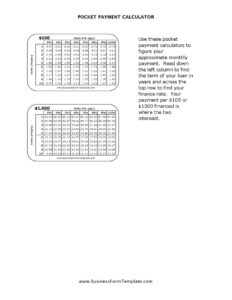
Pocket Payment Calculator
Estimate loan and installment payments fast with the free Pocket Payment Calculator template, available as a free download in PDF and DOCX.
PDF
3 downloads
0
likes
Download Files
A Pocket Payment Calculator is a compact, fill-in worksheet that helps you estimate the regular payment on a loan, installment plan, or financed purchase without needing software or a financial advisor. People most often reach for it when they want a quick, on-paper answer to the question “What will this cost me each month?” before signing anything. It’s free to download here in both PDF and DOCX, with no signup required.
What Is a Pocket Payment Calculator?
A Pocket Payment Calculator is a simple, portable money worksheet used to work out the periodic payment amount for a financed item or loan. It’s used by shoppers comparing car or appliance financing, small-business owners pricing out equipment, and anyone weighing a personal loan offer. The form documents the key inputs of a borrowing decision erm loan amount, interest rate, term length, and payment frequency erm and gives you space to record the resulting estimated payment and total cost. Unlike a binding loan agreement, it isn’t a contract; it’s a planning aid that lets you sketch the numbers by hand or in a printed table. The goal is clarity: seeing the real cost of borrowing before you commit to a lender.
When Do You Need a Pocket Payment Calculator?
This worksheet earns its keep any time money is being borrowed or paid in installments. Common situations include:
- Shopping for a vehicle and comparing two or three dealer financing offers side by side.
- Considering a personal loan from a bank, credit union, or online lender and wanting to confirm the quoted payment.
- Buying appliances, furniture, or electronics on a store installment plan or “buy now, pay later” arrangement.
- Budgeting for a mortgage or refinance at a draft stage, before requesting formal lender quotes.
- Lending money to family or a small business and needing to set a fair repayment schedule.
- Teaching or learning personal finance, where a printed calculator makes the math visible and memorable.
What a Pocket Payment Calculator Should Have
A complete calculator worksheet captures every variable that affects your payment, plus the results. At minimum it should include the principal (the amount financed), the annual interest rate, the loan term, and the payment frequency. It should also leave room to record the calculated payment, the total of all payments, and the total interest paid over the life of the loan. A good worksheet adds a line for fees or a down payment, a date and a label for the scenario, and a notes area so you can remember which lender or offer each calculation represents. Having all of this on one page makes comparisons honest and easy.
How to Fill Out a Pocket Payment Calculator
Work through the inputs in order, then record the results:
- Label the scenario. Write a name or description at the top erm for example “Dealer A car loan” or “Credit union personal loan” erm and add the date you ran the numbers.
- Enter the loan amount (principal). Record the amount you actually plan to borrow after any down payment or trade-in is subtracted.
- Note any down payment or fees. List a cash down payment or financed fees separately so the principal stays accurate.
- Enter the annual interest rate. Use the APR or quoted rate as a percentage, and convert it to a periodic rate to match your payment frequency.
- Enter the term. Write the loan length in months or years, then convert to the total number of payments.
- Choose the payment frequency. Monthly is typical, but mark weekly or biweekly if that applies.
- Calculate the payment. Apply the standard amortization formula and record the estimated regular payment.
- Record totals. Write the total of all payments and subtract the principal to find total interest paid.
- Add notes. Capture the lender name, the offer’s expiration, or any assumptions for later comparison.
Understanding the Math Behind the Payment
The worksheet relies on the standard fixed-payment amortization formula, where each payment covers a slice of interest plus a slice of principal. Early payments are interest-heavy; later ones chip away at the balance faster. Two inputs drive the result more than any other: the interest rate and the term length. A longer term lowers your payment but raises total interest, while a shorter term does the opposite. The Pocket Payment Calculator makes these trade-offs visible. By running the same loan amount with different terms or rates, you can see exactly how much a half-point rate increase or an extra year of payments costs you over the full life of the loan.
Tips for Comparing Offers Fairly
When you use the worksheet to compare lenders, keep the comparison apples-to-apples. Use the same loan amount and term for each, and always rely on the APR rather than the advertised “rate” so that fees are reflected. Watch for offers that lower the monthly payment simply by stretching the term erm a small payment over many years can hide a large total interest bill. Run a best-case and worst-case version of each scenario, and keep the completed sheets together so you can revisit them before you sign.
Common Mistakes to Avoid
- Mixing up the rate period. Entering an annual rate where a monthly rate is needed inflates the payment dramatically.
- Forgetting the down payment. Calculating on the sticker price instead of the financed amount overstates your payment.
- Ignoring fees. Origination, documentation, or insurance fees change the true cost and should be included.
- Comparing different terms. A lower payment on a longer term is not automatically a better deal.
- Treating estimates as final. Lender quotes, taxes, and timing can shift the actual number.
- Losing the assumptions. Without notes, you won’t remember which figures produced which payment.
Frequently Asked Questions
What is a Pocket Payment Calculator used for? It’s a quick worksheet for estimating the regular payment on a loan or installment purchase. People use it to compare financing offers and to budget before committing to a lender. It records your inputs and the resulting payment in one easy-to-read place.
How accurate are the results? The worksheet uses the standard amortization math, so results are accurate for the inputs you provide. Real-world figures can differ slightly because of fees, taxes, rounding, and the exact day-count method a lender uses. Always confirm the final numbers with the lender before signing.
Do I need any special software to use it? No. The Pocket Payment Calculator is designed to be filled in by hand or typed into the DOCX version, and you only need a basic calculator for the math. That portability is the point erm you can run numbers anywhere without internet access.
Is this form a loan agreement? No. It is a planning and estimation tool only, not a contract, and it does not obligate you or anyone else to lend or borrow. The actual loan terms come from the lender’s signed paperwork, which you should read carefully.
Should I use the interest rate or the APR? For comparing offers, use the APR whenever possible because it folds in many fees and gives a truer picture of cost. If you only have the nominal rate, you can still calculate the payment, but note that fees may make the real cost higher.
How much does this template cost? It’s completely free to download here in PDF and DOCX with no signup required. You can print as many copies as you need and reuse it for every loan or purchase you’re weighing. There are no hidden charges or accounts to create.
This template is a general example provided for informational purposes only and is not financial, tax, or legal advice. Payment estimates depend on the inputs you enter and may differ from a lender’s actual terms, which vary by product and jurisdiction. Consult a qualified financial professional before making borrowing decisions.
Official resource: for the rules that apply to your situation, see the Consumer Financial Protection Bureau.
Related Forms
- Full Page Check Register
- Side Hustle Income Tracker
- Dependent Care Claim Form
- Debit Register Wallet
- Credit Card History
- Blank Cash Envelope
Browse more in Money.