
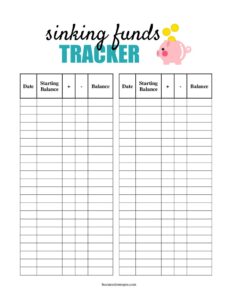
Sinking Funds Tracker
Use this free Sinking Funds Tracker template to plan and monitor savings goals month by month, available as a free download in PDF and DOCX.
PDF
DOCX
2 downloads
0
likes
Download Files
- DOCX
A Sinking Funds Tracker is a simple budgeting worksheet that helps you set aside small amounts of money over time for known future expenses, so a big bill never catches you off guard. People most often use it to break large or irregular costs — like holidays, car repairs, or annual insurance premiums — into manageable monthly contributions. You can download this template free as a PDF or DOCX, with no signup required.
What Is a Sinking Funds Tracker?
A Sinking Funds Tracker is a personal-finance tool for planning and recording money you save toward specific, named goals rather than one general pot. The term “sinking fund” comes from the practice of gradually setting aside cash to “sink” a future debt or expense. Anyone managing a household budget can use it — individuals, couples, families, or roommates splitting shared costs. The tracker documents each fund’s purpose, target amount, deadline, and how much you contribute each month. Its core job is to make irregular or large expenses predictable: instead of scrambling when the bill arrives, you’ve already saved the money in deliberate, scheduled increments.
When Do You Need a Sinking Funds Tracker?
A sinking funds approach works best for expenses you can see coming but that don’t fit neatly into a monthly budget. Common situations include:
- Holiday and gift spending — saving a set amount each month so December doesn’t blow your budget or rack up credit card debt.
- Car maintenance and repairs — building a cushion for tires, brakes, registration, or an unexpected breakdown.
- Annual or semi-annual bills — insurance premiums, property taxes, subscriptions, or membership renewals paid in one lump sum.
- Home projects — funding a new appliance, furniture, or a planned renovation without dipping into emergency savings.
- Travel and vacations — accumulating money for flights, lodging, and spending money ahead of a trip.
- Medical and dental costs — setting aside funds for predictable copays, orthodontics, or elective procedures.
Types of Sinking Funds to Track
It helps to separate your funds by category so each goal has its own line. Many people maintain several at once: short-term funds (a quarterly bill due in three months), medium-term funds (a vacation eight months away), and recurring annual funds (insurance that resets every twelve months). You might also keep “replacement” funds for items you know will wear out — laptops, phones, or a water heater. Grouping funds this way on a single tracker lets you see at a glance which goals are fully funded, which are behind schedule, and where to direct your next paycheck’s savings.
What a Sinking Funds Tracker Should Have
A complete tracker captures enough detail to keep each goal on schedule without becoming a chore to update. The key elements are:
- A clear name or purpose for each fund.
- The target amount you need to reach.
- A target date or deadline for when the money is needed.
- A monthly contribution amount, ideally calculated from the target divided by months remaining.
- Columns for each month’s deposit so you can mark contributions as you make them.
- A running total or balance showing progress toward the goal.
- A notes area for reminders, due dates, or where the money is held.
How to Fill Out a Sinking Funds Tracker
- Name each fund. In the first column, write a specific label such as “Car Insurance” or “Summer Vacation” so every entry is unmistakable.
- Set the target amount. Record the total dollar figure you need for that expense.
- Enter the target date. Note when the money must be ready — a renewal date, trip date, or expected bill date.
- Calculate the monthly contribution. Divide the target by the number of months until the deadline and write that figure in the monthly amount column.
- Log each month’s deposit. As you fund the goal, fill in the amount under the matching month so you can track consistency.
- Update the running balance. Add each new deposit to the prior total to see how close you are to the target.
- Use the notes column. Record where the money sits (a specific savings account or envelope) and any due-date reminders.
- Review monthly. Compare your balance against the target and adjust contributions if you fall behind or the cost changes.
Tips for Making Sinking Funds Work
Automate transfers on payday so contributions happen before you can spend the money. Keep sinking fund cash separate from your everyday checking — a dedicated savings account or even a labeled envelope reduces the temptation to dip in. If you get paid biweekly, split each fund’s monthly contribution in half and deposit it twice a month to smooth out cash flow. When a fund is fully funded and the expense is paid, reset the line and start saving for next year’s version of the same cost. Review all your funds together once a month so you can rebalance if one goal becomes more urgent than another.
Common Mistakes to Avoid
- Underestimating the target. Round costs up rather than down so you aren’t short when the bill arrives.
- Forgetting to update the tracker. A sheet you never fill in won’t reflect reality — log deposits as you make them.
- Mixing sinking funds with your emergency fund. They serve different purposes; keep them clearly separated.
- Setting too many funds at once. Spreading small contributions across a dozen goals can mean none gets fully funded in time.
- Ignoring the deadline. Without a target date you can’t calculate a realistic monthly amount.
- Spending the money on something else. Once cash is allocated to a fund, treat it as already committed.
Frequently Asked Questions
What is a sinking fund? A sinking fund is money you save gradually toward a specific, known future expense rather than for emergencies. By contributing a small amount each month, you spread the cost of a large or irregular bill over time so it’s fully funded by the time it’s due.
How is a sinking fund different from an emergency fund? An emergency fund covers unexpected events like job loss or a sudden medical bill, while a sinking fund is for expenses you can anticipate, such as a holiday, vacation, or annual premium. Keeping them separate prevents you from draining your safety net for planned costs.
How do I calculate my monthly contribution? Divide the target amount by the number of months until you need the money. For example, a $1,200 goal due in twelve months means saving $100 per month, which you record in the tracker’s monthly column.
How many sinking funds should I have? There’s no fixed number — it depends on your budget and upcoming expenses. Many people start with two or three priority goals and add more as they free up cash, since spreading contributions too thin can leave every fund underfunded.
Where should I keep the money? Most people use a dedicated savings account, separate sub-accounts, or labeled cash envelopes to keep sinking funds apart from everyday spending. Note the location in the tracker’s notes column so you always know where each fund is held.
Is this Sinking Funds Tracker free to download? Yes. You can download this template free as a PDF or editable DOCX with no signup required, then print it or fill it in digitally to suit your routine.
This Sinking Funds Tracker template is a general example provided for informational purposes only and is not financial, tax, or investment advice. Personal financial situations vary, so consider consulting a qualified financial professional before making important money decisions.
Official resource: for the rules that apply to your situation, see the Consumer Financial Protection Bureau.
Related Forms
- Customer Credit Analysis
- Accounts Receivable Form
- Petty Cash
- Kids Cash Envelope
- Financial Worksheet
- Debt Worksheet
Browse more in Money.