
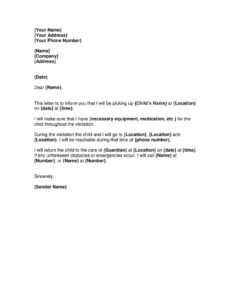
Child Visitation Letter
Download a free Child Visitation Letter template to confirm pickup, return times, and contacts for a parenting-time visit — free PDF and DOCX download.
PDF
DOCX
1 downloads
0
likes
Download Files
- DOCX
A Child Visitation Letter is a written notice that confirms the details of an upcoming parenting-time visit — who is picking up the child, when, where the child will be, and when they will be returned. People most often use it to give the other parent or guardian clear, advance notice so a scheduled visitation goes smoothly and is documented in writing. You can download this template free in PDF and DOCX, with no signup required.
What Is a Child Visitation Letter?
A Child Visitation Letter is a courtesy and notification document, usually written by one parent or a non-custodial relative to the child’s custodial parent or guardian. It lays out the practical logistics of a visit: the pickup time and location, the activities or destinations planned, the contact number where the sender can be reached, and the agreed return time and place. It also identifies emergency contacts in case something goes wrong. The letter does not create custody rights on its own — those come from a custody agreement or court order. Instead, it documents that proper notice was given and that both sides understand the plan, which helps reduce confusion and disputes around scheduled parenting time.
When Do You Need a Child Visitation Letter?
This letter is useful any time a visit needs to be confirmed in writing rather than arranged by a quick phone call. Common situations include:
- Notifying the custodial parent of a weekend or holiday visit covered by a parenting plan.
- Arranging a first visit after a separation or divorce when communication needs to stay clear and formal.
- Coordinating pickup and drop-off when a third party (a grandparent, aunt, or family friend) is supervising or transporting the child.
- Documenting a planned overnight or out-of-town trip with the child, including the places you intend to visit.
- Creating a paper trail when there has been past confusion or disagreement about times and locations.
- Confirming arrangements where a child has specific medication, dietary needs, or equipment that must travel with them.
What a Child Visitation Letter Should Have
A complete visitation letter answers the practical questions any guardian would ask before handing over a child. It should clearly state the sender’s name and contact details, the recipient’s name and address, and the date the letter is written. The body must name the child, the exact pickup location, date, and time, and the planned destinations during the visit. It should confirm that needed items — medication, car seats, supplies — will be provided, give a phone number where the sender can be reached, and specify the return date, time, location, and the guardian receiving the child. Finally, it should list at least one or two emergency contacts with phone numbers, and close with a signature.
How to Fill Out a Child Visitation Letter
- Enter Your Name, Your Address, and Your Phone Number at the top so the recipient knows who is writing.
- Add the recipient’s Name, Company (if applicable, such as an agency or supervised visitation center), and Address, followed by the Date of the letter.
- Open with the greeting using the recipient’s Name.
- In the first line, fill in the Child’s Name, the pickup Location, the date, and the time you will collect the child.
- List the necessary equipment, medication, etc. you will bring for the child throughout the visit.
- Name the three Location fields for where you and the child plan to go during the visitation.
- Provide the phone number where you can be reached during that time.
- State the return details: the Guardian receiving the child, the return Location, date, and time.
- Fill in the emergency contacts — each Name and Number — to call if obstacles or emergencies arise.
- Close with Sincerely and your Sender Name, then sign.
How This Letter Fits With a Custody Order
A Child Visitation Letter works alongside — not in place of — any formal custody or parenting agreement. If a court order already defines visitation days and exchange points, your letter should match those terms exactly; it simply confirms the specifics of one upcoming visit. Keeping the letter consistent with the order protects you, because deviating from court-ordered times or locations without agreement can create problems. When no formal order exists, the letter still serves as a record of what both parties expected, which can be helpful if a dispute later arises. Either way, treat the letter as a communication and documentation tool rather than a legal authorization.
Tips for a Smooth Exchange
Send the letter far enough in advance that the other party has time to read it and raise concerns. Be precise with times and addresses rather than vague ranges, and keep the tone neutral and businesslike even if the relationship is strained. Save a copy of every letter you send, and consider sending it by a method that confirms delivery, such as email or certified mail, so you can show notice was given. If plans change, send an updated letter rather than relying on a verbal change, and confirm the other party received it.
Common Mistakes to Avoid
- Leaving the return date, time, or location blank — these are the details guardians most want confirmed.
- Forgetting to list medication or equipment the child needs during the visit.
- Providing a phone number you won’t actually answer during the visitation window.
- Listing only one emergency contact, or omitting emergency contacts entirely.
- Setting times or locations that conflict with an existing custody order.
- Sending the letter at the last minute, leaving no time for questions or adjustments.
Frequently Asked Questions
What is a Child Visitation Letter used for? It is used to give the custodial parent or guardian written notice of the details of an upcoming visit, including pickup time, planned destinations, return time, and emergency contacts. It helps both parties stay on the same page and creates a record that proper notice was given.
Is a Child Visitation Letter legally binding? The letter itself does not grant custody or visitation rights — those come from a custody agreement or court order. It functions as a notice and a record, so it should always align with any existing legal arrangement rather than override it.
How do I fill out the visitation letter? Add your contact details and the recipient’s information, then complete the body with the child’s name, pickup location, date and time, the places you’ll visit, your reachable phone number, the return details, and at least one or two emergency contacts. Sign it at the bottom and keep a copy for your records.
Do I need to have a Child Visitation Letter notarized? Notarization is generally not required for a courtesy notice like this. If you want extra proof, send it by a trackable method or email so you have a dated delivery record, but check your local rules or any court order for specific requirements.
How far in advance should I send it? Send it early enough that the other party can read it and respond before the visit, ideally several days ahead. Giving notice in advance leaves time to resolve scheduling conflicts and shows good faith.
How much does this template cost? Nothing — this Child Visitation Letter template is completely free to download in both PDF and DOCX formats, with no signup required. You can edit it as many times as you need for each visit.
This template is a general example provided for informational purposes only and is not legal advice. Custody and visitation requirements vary by jurisdiction and depend on your specific court order or parenting agreement. Consult a qualified family law attorney for guidance on your situation.
Related Forms
- General Notice Of Death
- Stop Payment Check Recipient
- Letter To Notify Creditors Of Death
- Notice To Heirs And Legatees
- Demand Alimony Payment Letter
- Name Change Notification Letter
Browse more in Notifications.