
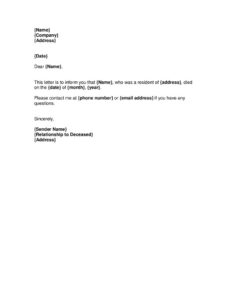
General Notice Of Death
Use this free General Notice of Death template to formally inform banks, agencies, and contacts that a loved one has passed away — free PDF and DOCX download.
PDF
DOCX
2 downloads
1
likes
Download Files
- DOCX
A General Notice of Death is a short, formal letter used to inform a person, company, or institution that someone has passed away. People most often use it to notify banks, insurers, employers, government offices, subscription services, and other contacts so that accounts and obligations can be reviewed or closed. It is free to download here in both PDF and DOCX formats, with no signup required.
What Is a General Notice of Death?
A General Notice of Death is a written communication, typically sent by a family member, executor, or representative, that formally announces the death of an individual. It is not a legal certificate and does not replace an official death certificate issued by a vital records office. Instead, it serves as a courteous, documented first contact that prompts the recipient to take appropriate action — such as freezing an account, stopping a service, or requesting further documentation. The letter identifies the deceased, states where they resided, gives the date of death, and provides a way to reach the sender with follow-up questions. Its purpose is to communicate the essential facts clearly and respectfully.
When Do You Need a General Notice of Death?
This letter is useful in many practical situations during the difficult period after a loss. Common scenarios include:
- Notifying banks and credit unions so they can flag or freeze the deceased’s accounts and provide guidance on next steps.
- Informing insurance companies — life, health, auto, or home — to begin a claim or cancel a policy.
- Contacting an employer or former employer regarding final pay, pensions, or benefits.
- Alerting utility, telephone, and subscription providers to stop recurring charges or transfer service.
- Reaching government agencies such as tax authorities, pension offices, or licensing bodies.
- Notifying creditors, landlords, or membership organizations who need to update their records.
In each case, the letter opens the conversation in a clear, dated form that the recipient can keep on file while they request supporting documents like a death certificate.
What a General Notice of Death Should Have
To be useful and credible, the notice should contain a few essential elements. It needs the recipient’s name, company, and address so it reaches the right department. It must clearly name the deceased and state their place of residence, since recipients often match records by address. The date of death — day, month, and year — should be stated precisely. Finally, it should include the sender’s name, their relationship to the deceased, contact details, and an address. A polite, professional tone and an invitation to follow up round out the letter, making it easy for the recipient to respond and request anything further they require.
How to Fill Out a General Notice of Death
Using the actual fields in this template, complete the letter in the following order:
- At the top, enter the recipient’s {Name}, their {Company}, and their {Address} so the notice is correctly addressed.
- Add the {Date} you are sending the letter, which establishes a clear timeline of notification.
- In the greeting, repeat the recipient’s {Name} after “Dear” to personalize the letter.
- In the body, insert the deceased’s {Name} and their {address} of residence so the recipient can match their records.
- State the date of death by completing the {date}, {month}, and {year} fields exactly as they appear on official records.
- Provide your {phone number} and {email address} so the recipient can reach you with questions.
- Close with your {Sender Name}, your {Relationship to Deceased}, and your {Address} beneath the signature line.
Review every entry for accuracy before sending, then keep a copy for your own records.
How to Send and Follow Up
Decide whether to send the notice by mail, email, or both, depending on the recipient’s preferred contact method. For sensitive accounts like banks or insurers, mailing a printed letter — and keeping proof of postage — creates a clean paper trail. Many institutions will respond by asking for a certified copy of the death certificate, the will, or letters of administration, so it helps to have those documents ready. Send notices in order of urgency: accounts with automatic payments, active insurance policies, and government benefits often deserve early attention. Keep a simple log of who you contacted, the date, and any reference number provided so nothing slips through the cracks during a busy time.
How It Differs from a Death Certificate
It is important to understand that this letter and an official death certificate serve different purposes. The General Notice of Death is a courtesy communication you write yourself to start a conversation. A death certificate is an official legal document issued by a government vital records office and is the proof most institutions ultimately require to release funds, pay claims, or close accounts. The notice often arrives first and simply alerts the recipient; the certificate follows when they formally process the matter. Using both together — the letter to notify and the certificate to verify — keeps the process organized and prevents delays.
Common Mistakes to Avoid
- Misspelling names or addresses — recipients match records exactly, so an error can delay action.
- Leaving out the date of death or stating it inconsistently across different letters.
- Forgetting your contact details, which makes it hard for the recipient to follow up.
- Sending the notice without keeping a copy for your own records.
- Assuming the letter alone closes an account — most institutions still require a death certificate.
- Using an overly casual tone for formal recipients such as banks or government offices.
Frequently Asked Questions
What is a General Notice of Death used for? It is a formal letter that informs a person, company, or institution that someone has died. People use it to notify banks, insurers, employers, utilities, and agencies so accounts and services can be reviewed, frozen, or closed. It opens the conversation and prompts the recipient to request any further documents they need.
How do I fill out the General Notice of Death template? Enter the recipient’s name, company, and address at the top, add the sending date, and then state the deceased’s name, place of residence, and exact date of death. Finish with your phone number, email, name, relationship to the deceased, and address. Double-check spelling and dates before sending.
Does this letter replace a death certificate? No. The notice is a courtesy communication you write yourself, while a death certificate is an official document issued by a vital records office. Most institutions will still ask for a certified copy of the certificate before they take final action on an account or claim.
Does a General Notice of Death need to be notarized or witnessed? Generally no — it is an informational letter rather than a legal instrument, so it usually does not require notarization or witnesses. Requirements can vary by recipient and jurisdiction, so check whether a specific institution has its own forms or verification steps.
Who should sign and send the notice? Typically a close family member, the executor, the estate administrator, or an authorized representative sends it. Stating your relationship to the deceased helps the recipient understand your standing. For estate matters, the executor or administrator is usually the most appropriate sender.
Is this template really free to download? Yes. You can download the General Notice of Death template here for free in both PDF and DOCX formats, with no signup or payment required. You can edit the DOCX version to match each recipient and reuse it for every notification you need to send.
This template is a general example provided for informational purposes only and is not legal, financial, or tax advice. Requirements and procedures vary by jurisdiction and by institution. For guidance on estate administration or notifying specific parties, consult a qualified attorney or relevant professional.
Related Forms
- Name Change Notification Letter
- Stolen Identity Report To FBI
- Child Visitation Letter
- Letter To Notify Creditors Of Death
- Notice To Heirs And Legatees
- Stop Payment Check Recipient
Browse more in Notifications.